
.jpg) 1 hour ago
2
1 hour ago
2
Article content
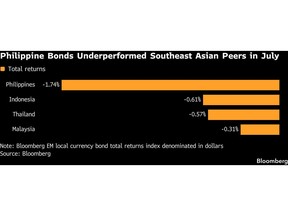
(Bloomberg) — Philippine sovereign debt faces prolonged pressure, analysts say, as sticky inflation keeps the central bank hawkish, extending a slump that made the bonds Southeast Asia’s worst performer last month.

THIS CONTENT IS RESERVED FOR SUBSCRIBERS ONLY
Subscribe now to read the latest news in your city and across Canada.
- Exclusive articles from Barbara Shecter, Joe O'Connor, Gabriel Friedman, and others.
- Daily content from Financial Times, the world's leading global business publication.
- Unlimited online access to read articles from Financial Post, National Post and 15 news sites across Canada with one account.
- National Post ePaper, an electronic replica of the print edition to view on any device, share and comment on.
- Daily puzzles, including the New York Times Crossword.
SUBSCRIBE TO UNLOCK MORE ARTICLES
Subscribe now to read the latest news in your city and across Canada.
- Exclusive articles from Barbara Shecter, Joe O'Connor, Gabriel Friedman and others.
- Daily content from Financial Times, the world's leading global business publication.
- Unlimited online access to read articles from Financial Post, National Post and 15 news sites across Canada with one account.
- National Post ePaper, an electronic replica of the print edition to view on any device, share and comment on.
- Daily puzzles, including the New York Times Crossword.
REGISTER / SIGN IN TO UNLOCK MORE ARTICLES
Create an account or sign in to continue with your reading experience.
- Access articles from across Canada with one account.
- Share your thoughts and join the conversation in the comments.
- Enjoy additional articles per month.
- Get email updates from your favourite authors.
THIS ARTICLE IS FREE TO READ REGISTER TO UNLOCK.
Create an account or sign in to continue with your reading experience.
- Access articles from across Canada with one account
- Share your thoughts and join the conversation in the comments
- Enjoy additional articles per month
- Get email updates from your favourite authors
Sign In or Create an Account
or
Article content
Union Bank of the Philippines expects Philippine 10-year bond yields to rise to 7.60%-7.80% in the near term, while Aberdeen Investments sees them staying elevated and within the range of 7.20%-7.60%. Those on benchmark 10-year notes are currently hovering around 7.25%.
Article content
Article content
Article content
The weak outlook marks a deepening of July’s selloff, when returns on Philippine bonds fell 1.74%, driven by inflation pressures and rate-hike bets. With global energy prices volatile and inflation well above target, analysts expect Philippine debt to remain vulnerable to further downside.
Article content
By signing up you consent to receive the above newsletter from Postmedia Network Inc.
Article content
“We believe Philippine bond yields could move higher in the near term,” said Ruben Carlo Asuncion, chief economist at Union Bank of the Philippines. “The main reason is that markets continue to price in a 25-basis-point Bangko Sentral ng Pilipinas rate hike at the August 27 Monetary Board meeting amid renewed inflation pressures.”
Article content
That forecast comes on the heels of a sharp selloff, in which the Philippine 10-year yield climbed 52 basis points in July, far outpacing most Asian peers. Data on Wednesday showed Philippine inflation eased for a third month in July to 6.2% but remained well above the BSP’s full-year target of 3%.
Article content
The central bank said it’s prepared to take further monetary action as needed to ensure that inflation returns close to target. It has already raised the benchmark interest rate by 50 basis points this year.
Article content
Article content
Inflation staying elevated is still the dominant concern for fixed-income markets, Asuncion said. “Elevated US Treasury yields, oil price volatility and geopolitical uncertainties have also created a less favorable backdrop for emerging market bonds, including the Philippines.”
Article content
Despite those macro risks, some analysts see a floor for the selloff as investors move to lock in higher yields.
Article content
Strong dip-buying demand should emerge if yields rise above 7.50%, said Winson Phoon, head of fixed‑income research at Maybank Securities in Singapore. “A 10-year yield above 7.50% would make the curve sufficiently steep to provide a decent buffer against further policy tightening, and this level historically attracted dip-buying interest.”
Article content
Debt issuance dynamics could counter that dip-buying demand, according to some analysts. Shivank Sehgal, investment analyst at Aberdeen Investments, sees back-loaded debt issuance and light bond maturities during this period to add to headwinds for the market.
Article content
“Elevated oil prices, uncertainty surrounding the US-Iran conflict and material second-round inflation effects should keep inflation risks prominent and require further BSP tightening,” he said.
Article content
 English (US)