
 By David Crow | October 21, 2026 |
There are not even 40 confirmed, sufficiently complete moa eggs known about on this planet. Those that survive are a glimpse, a keyhole really, into a past and time when these great, enormous birds dominated the islands of New Zealand (or Aotearoa, as it is known in Māori). Of those less than 40 surviving eggs, only eight are believed to have 90 percent or more of their shells still intact. That number is about to go up to nine.
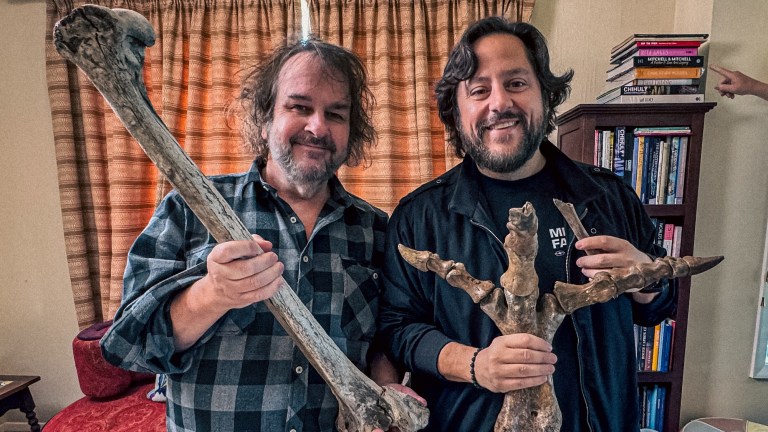
Indeed, the Giant Moa egg that Peter Jackson and Colossal Biosciences just acquired for Jackson’s native home of New Zealand is a monumental find which has (apparently) been hidden away in a private American collection for more than 60 years. Colossal and the filmmaker were able to hone in and acquire it the moment it was put on an auction listing. Now the Lord of the Rings filmmaker touts it to be among the five best best-preserved examples of moa oology on the world, which in addition to being rescued from private collectors is now being donated to Professor Te Maire Tau, a Māori historian, academic leader, and tribal leader in New Zealand.
“Every New Zealander grows up knowing the moa and feeling its loss,” Jackson said in a statement to the press. “Whenever I’ve been walking deep in the New Zealand bush, I can’t help but keep looking into the thick forest, hoping for a glimpse of the mythic ‘last Moa,’ an amazing bird that sadly no longer exists, no matter how hard you look … and hope. When we learned that this exceptionally rare moa egg was being sold outside of New Zealand, we spoke to Colossal, who not only offered to rescue it at their own considerable expense, but to also fly it privately to New Zealand, so it returns home safely. After expert restoration, it will very likely become only the ninth known nearly intact moa egg.”
The Giant Moa remains an extinct and legendary creature, a flightless bird that ruled what is modern day New Zealand for tens of thousands of years before going extinct in roughly 1400 CE (so about 600 years ago). Measuring at an average 3.6 meters, or 12 feet, the Giant Moa really did tower over human beings, although not enough to save the bird. It is believed that humans drove all species of moa, giant and otherwise, to extinction over the course of centuries due to both hunting and habitat reduction that followed the clearing of forests.
Nonetheless the myth of the Giant Moa has persisted in Māori tradition and the modern imagination. It also has become a mission statement for Jackson and Colossal Biosciences to bring it back, or at least a variation of the bird.
When we visited Colossal Biosciences headquarters for the first time last year in Dallas, Texas scientists revealed to us that they were using emu and ostrich eggs to prepare the creation of an artificial, “shell-less” egg (which has since been created, albeit for a chicken so far). Still, it is the even more diminutive, pint-sized tinamou whose egg has proven the most promising for gene-editing in the hopes of one day functionally replicating a Giant Moa’s genetic code.
“When we launched the moa program we made a clear commitment that indigenous leadership would guide the science and every decision surrounding the project,” Colossal CEO and co-founder Ben Lamm said in a statement this week. “Securing and transporting this egg back to its rightful home is just part of that commitment. Regardless of when and how it left the country, we strongly feel all recognizable moa bones and remains as well as any other New Zealand artifacts should be returned to the country and its people. To quote Indiana Jones, ‘It belongs in a museum,’ a museum in Aotearoa, under the care of the people whose ancestors lived alongside these extraordinary birds.”