
.jpg) 1 hour ago
2
1 hour ago
2
A protein best known for its role in Parkinson's disease may help explain why women make up around two-thirds of Alzheimer's cases, according to new research.
Researchers from the Mayo Clinic in the US studied a group of 415 individuals, including cognitively healthy people and those with mild cognitive impairment or dementia, to identify biomarkers of disease.
In people who had abnormal alpha-synuclein in their cerebrospinal fluid and signs of Alzheimer's-related brain changes on PET scans, those brain changes were happening up to 20 times faster in women than in men.
Specifically, the brain changes measured here were the harmful buildup of a protein called tau, characteristic of brains damaged by Alzheimer's and other neurological diseases. Women with abnormal alpha-synuclein showed the fastest rise in tau over time, hinting at a potential biological difference.
The findings suggest that misfolded alpha-synuclein may act like an accelerant in some cases of Alzheimer's, and it could eventually help researchers design more targeted clinical trials and treatments.
"When we see disease-related changes unfolding at dramatically different rates, we cannot keep approaching Alzheimer's as though it behaves exactly the same way in everyone," says neuroradiologist Kejal Kantarci. "Co-pathologies may impact the disease process."
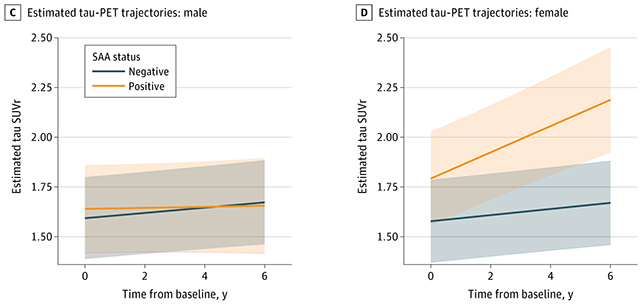 Tau was projected to become more of a problem faster in women with abnormal alpha-synuclein. (Mak et al., JAMA Netw. Open, 2026)
Both alpha-synuclein and tau proteins are produced naturally and have roles in keeping the brain healthy. Problems arise when they start to malfunction and go off-script, though it's not clear whether they're causes or consequences of disease.
Around half of Alzheimer's patients are found to have abnormal, misfolded alpha-synuclein proteins in the brain, though this particular problem is far more significant in Parkinson's disease and Parkinson's-related dementias, where it's believed to be one of the main drivers.

The researchers controlled for several factors, including age and genetic risk, to help isolate the connection between these two proteins – although other factors not yet accounted for may also be playing a role.
That the association between misfolded alpha-synuclein and a quicker rise in bad tau was only found in women suggests that there's something happening at a biological level that isn't matched in men, and finding out what that is could improve our understanding of Alzheimer's.
"This opens an entirely new direction for understanding why women bear a disproportionate burden of dementia," says neuroscientist Elijah Mak.
The team has some ideas about what may be behind the effect, though those hypotheses still need to be tested. A greater and more sudden drop in estrogen levels in women in later life may be a factor, as estrogen can act as a protective shield against the buildup of toxic proteins.
Another idea is that malfunctioning alpha-synuclein proteins act as a "second hit amplifier," increasing inflammation in the brain and worsening tau clumping.
Related: Microplastics May Be Fueling Parkinson's Disease, Scientists Warn
The study isn't proof of cause-and-effect regarding alpha-synuclein and tau issues, and the median follow-up period was relatively short – just over a year. Longer studies may reveal a more complete picture of how these protein changes shape Alzheimer's over time.
Still, each new clue helps researchers build a clearer picture of how Alzheimer's can get started and why some groups of individuals – including women – are at a higher risk of developing the disease.
The team also suggests that their findings might prove valuable in diagnosing Alzheimer's, Parkinson's, and related dementias, helping to differentiate between overlapping conditions that can sometimes mask one another.
"Recognizing these sex-specific differences could help us design more targeted clinical trials and ultimately more personalized treatment strategies," says Kantarci.
The research has been published in JAMA Network Open.
 English (US)