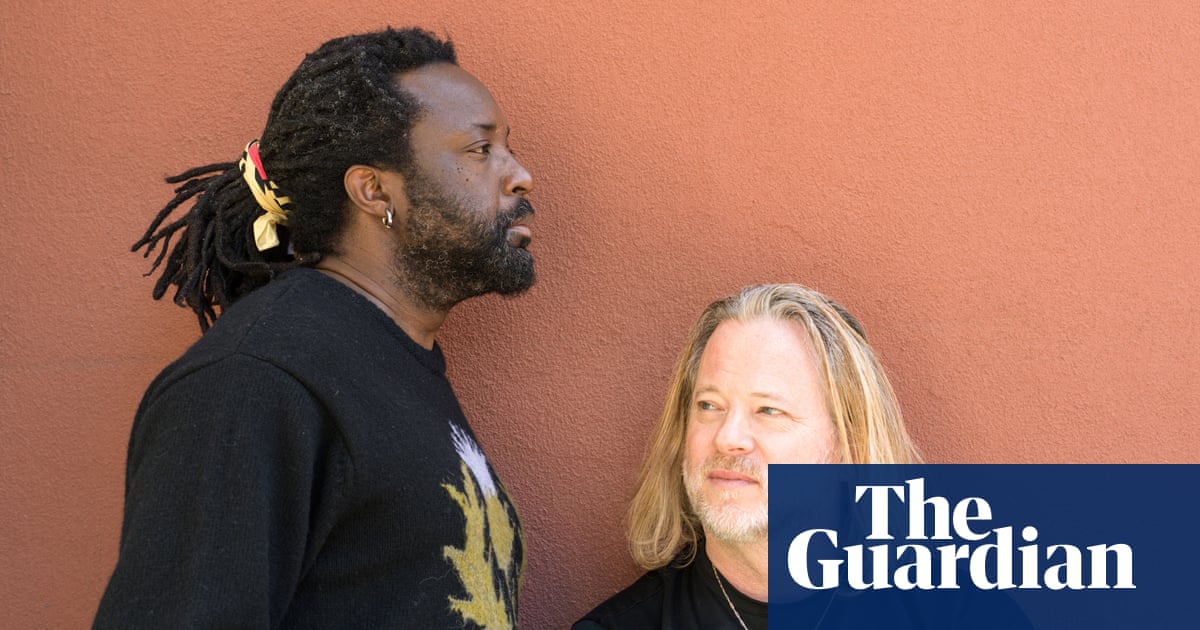
The literary power couple is a historically seductive concept. Two writers sharing a life, their private and creative worlds entwined, each becoming witness to and critic of the other’s work. Think Simone de Beauvoir and Jean-Paul Sartre, Joan Didion and John Gregory Dunne. Or, less auspiciously, Sylvia Plath and Ted Hughes.
Now, into this illustrious company steps a new pair: the novelist Marlon James and the biographer Nicholas Boggs, whose books have each been shortlisted for one of Britain’s most prestigious literary awards – James for the Booker prize and Boggs for the Baillie Gifford prize for nonfiction. Between them, they have produced two formidable books, each the culmination of years of work, and each concerned with the lives of Black queer men whose stories have often been overlooked.
“I’m not sure what to do with it,” James says, when I ask how they feel about the inevitable impending “literary power couple” label. “I have all these romantic notions that we were like Joan Didion and John Gregory Dunne or something – I don’t know. What do you think?” He turns to Boggs, who laughs. “It’s all very new,” he says. “We’re still getting used to it.”
It is a warm October morning in Williamsburg, the fashionable writerly enclave in Brooklyn, and I am sitting across from the pair at their apartment. They are relaxing on a chaise longue, looking comfortable enough to have been there all morning. Their exchanges have the easy rhythm of a long relationship, full of small corrections and private jokes.
James, the 55-year-old Jamaican-born novelist whose 2015 book A Brief History of Seven Killings won the Booker prize, is back on the shortlist this year with The Disappearers, a sprawling, dark reckoning with the brutality of Aids-era gay life and homophobia in Jamaica. Boggs, his 53-year-old partner of nearly nine years, has been shortlisted for the Baillie Gifford prize for his first book, Baldwin: A Love Story, a biography of James Baldwin that draws on two decades of research into the writer’s intimate life and creative relationships.
“The Baillie Gifford’s a prize I know well,” James says. “So when Nick was on the shortlist, I knew what a big deal it was.” Boggs remembers James’s reaction when the nonfiction shortlist was announced on 1 October. “His eyes got very wide. I don’t think I’ve seen his eyes get quite that wide before.”
James had the first taste of the excitement, when the Booker shortlist was announced in September. “You got shortlisted first, so the pressure was on!” Boggs jokes. “No matter how many times you do this, it’s always a great surprise,” James adds.
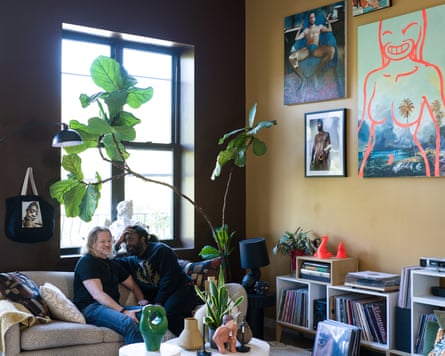
The pair have been together since 2018 and have lived in this apartment for a little under a year. Its walls form something of a shrine to their work and interests, crowded with art by African American and queer artists, from intimate, often erotic photography to paintings. At one point they rummage beneath the bed to retrieve an original 1938 portrait of James Baldwin by Beauford Delaney, the Harlem renaissance artist who became one of Baldwin’s mentors, and features heavily in Boggs’s book. A monumental horse sculpture dominates the room – or, as Boggs points out with a laugh, “it’s really just the horse’s ass, isn’t it!” Bought by James after his 2015 Booker win and christened “Booker” by Boggs, it stands alongside a similarly imposing gorilla.
Their romance began not in a rarefied literary salon, but through the very ordinary business of a dating app. “I was on the apps and was like, well, I’m only dating in my neighbourhood,” Boggs says. “He was three blocks away, so it was perfect.”
By then, they were both in their 40s. Boggs, who had never been out with a writer before – “it was mostly bartenders”, he jokes – knew of James’s work, but hadn’t read any of his books. James, for his part, didn’t know Boggs was a writer prior to their first meeting.
“It was a very chaste first date,” James says, with a twinkle in his eye. “We were gentlemen.” The relationship developed “healthily slowly” over a summer spent apart while Boggs was teaching in London, until they reunited when James invited Boggs to a Booker anniversary event in the capital. He was keen to set the bar high.
“Our third date was at Buckingham Palace,” James says, with a faux shrug. “I try to keep it classy, you know, gotta impress him. We actually made out in the queen’s bathroom.”
Their relationship may have brought them into the same orbit, but the worlds they each came from – and the experiences that inform their writing – are markedly different.
Growing up in Washington DC, where his father was a civil rights attorney, Boggs read Baldwin from a young age. While studying the writer at college, he came across a reference in a 1966 biography to an out-of-print children’s book by Baldwin, illustrated by a French artist, Yoran Cazac. Boggs had suspicions that there was a love affair behind the collaboration, tried to track down Cazac, but was told he was most likely dead. A few weeks later, the phone rang.
“It was Yoran saying, ‘I’m alive, I’m in Paris, come on over, I have many stories to tell you about Jimmy,’” Boggs recalls. “That was 23 years ago, and it began a realisation that there were these untold stories in Baldwin’s life that needed to be unearthed.”
For James, rampant homophobia shaped his upbringing and his storytelling. Growing up gay and closeted in 1980s Kingston, in the classroom he was “the school homo”; at church, he tried to become straight. He only began to build a more comfortable queer identity after moving to Minneapolis to teach in 2007, away from the scrutiny of family and friends in Jamaica. Unlike Boggs, his queer literary education came late. He picked up Baldwin’s Giovanni’s Room for the first time when he was 50. “The first thing I thought was I could never have read this at 20,” he says. “I was so in the closet.”
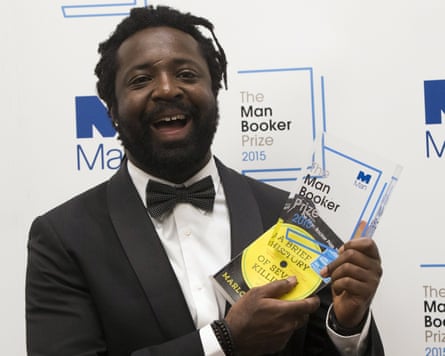
Across his fiction, James has repeatedly excavated Jamaica’s histories of violence and political upheaval, from his debut 2005 novel John Crow’s Devil (famously rejected 78 times by publishers), to the gang warfare and state corruption of A Brief History of Seven Killings, which made him the first Jamaican to win the Booker prize. The Disappearers, his sixth novel, grew out of a rumoured homophobic attack in a middle-class area of Kingston in the late 1980s.
“I first heard about it when I was 21,” he says. “I knew it happened, I just couldn’t prove it. It haunted me: the idea that that could happen – and in a posh neighbourhood – was one of the things that certainly pushed me firmly into the closet.”
He was unable to establish exactly what had happened until he began researching the novel, interviewing almost 20 people in Jamaica who helped him piece together the incident over several years. “I wanted to fill in the blanks,” he says. “I wanted to give those guys back some sort of agency and power.”
In different ways, both men are trying to recover Black queer histories that have been marginalised or lost. “We both respond to gaps,” Boggs says.
For James, one such gap became the starting point for The Disappearers. He wanted to build his novel around the production of a play, but couldn’t find one that would fit. The solution came, serendipitously, from Boggs: while researching his biography, he discovered Baldwin directed a 1969 production of John Herbert’s Fortune and Men’s Eyes in Turkey. He suggested James consider it for his novel.
“At first you were like, ‘no’,” Boggs recalls. “And I was like, ‘just read these 60 pages’. And I was right.”
It is no exaggeration to say that the play serves as the novel’s structural and emotional scaffolding, and is central to Boggs’s chapters on Baldwin’s life in Turkey, too. “I like to say I plundered his book with his permission,” James says, smiling. “It’s one way in which our books wouldn’t be possible or wouldn’t have ended up the way they did were we not together.”
after newsletter promotion
On a table in the couple’s living room there sits a 25 September edition of the New York Times. It contains a review now infamous in the literary world, in which the notoriously harsh critic Dwight Garner devoted an almost novella-length appraisal to The Disappearers, hailing it as “a masterpiece, the novel of the decade and possibly of the century”, placing it alongside the work of Salman Rushdie, Toni Morrison and William Faulkner.
“I still don’t quite believe it,” James says. The morning the piece came out, an author friend had emailed to alert him to what he described as a “stonking review” from Garner. “I didn’t know what stonking meant, I thought it was something bad!” he laughs. “So I’m like, ‘God, no. I’m not going to read this.’” But he clicked the link anyway, and saw the word “masterpiece”.
“I went to the newsstand to go find it, because I still didn’t believe it,” he says. “I was like, ‘if I leave this bed, I’m going to wake up.’”
He is wary of the idea that acclaim should ever become an expectation, or success a fait accompli. “There’s a part of me that still thinks I’m this underground, scrapping writer who got lucky,” he says. “For me, it’s still a genuine surprise. It still catches me off guard. I don’t know if I want to get to that point where I start to expect good reviews. I don’t know if I want that level of entitlement.” He laughs. “I know some writers who are like that – I’m not going to name any names,” he adds, with a mischievous look.
Joan Didion once described her collaboration with John Gregory Dunne as a process of creative osmosis: “One of us writes the first draft, and the other functions as really kind of a super-editor and writes the second draft. In the end, you can’t really tell who has done what.”
There is no such blurring of authorship in the James-Boggs household. The pair keep their manuscripts to themselves until the work is finished, even as they discuss the ideas and research behind it.
“People are always surprised to hear that,” Boggs says. “Marlon didn’t read my book until after it was finished, I finished his on the publication date.”
Their working habits are almost opposite, too. James describes himself as a binge writer, while Boggs writes every day and keeps regular hours. James needs music – “lots of free jazz” – while Boggs requires “perfect peace and quiet”. They work on opposite sides of the house, and Boggs also has a separate office a few blocks away. But living with James has helped Boggs reconsider his idea of what writing should feel like.
“Marlon has an incredible work ethic, and it was really a reminder that this is a job,” he says. “That was really helpful. It’s not screaming from the other room in frustration, or complaining about it at dinner every night.”
They insist there is no competition between them. “I think I really worried about that when we first met,” Boggs says. “But we write so differently, even stylistically. And because of the time that we’re living in, getting these stories told is so much more important than any individual anyway.”
Just this month, new research from PEN America found that the US saw almost 12,000 book bans in public schools during the 2025-2026 school year, the highest number in a single year. For James and Boggs, whose work is concerned with recovering the lives and histories that have been overlooked or suppressed, the stakes are difficult to ignore.
James refuses to censor himself in anticipation of a backlash, but he is not oblivious to the risks. “I do sometimes get this fear that the oppressors are coming, because they always burn the books first,” he says. “The forces stacked against me are immense. But then, when have the forces against us not been immense?”
I ask if they have thought about leaving the US altogether. “Yes, 100%,” James says, without skipping a beat. He is uncompromising in his diagnosis of the country’s downward slide. “For me, it’s weird seeing America become the type of country America has spent the past 60 years creating everywhere else. I think we’re becoming a banana republic, which, coming from the Caribbean, I know a lot about.”
He is not, however, a pessimist. “I have to have a pretty big sense of optimism to think that my big-ass books are going to sell,” he says. “Throughout all of this, I’ve never lost faith in the reader. Writing has always been an art form that had to struggle against oppression, that speaks truth to power. If you decide to be a writer, part of it is to say that you’re going to take this on.”
For all their independence on the page, Boggs and James are now embarking on a creative collaboration. Baldwin: A Love Story has been optioned for a film, produced by Barack and Michelle Obama’s production company, Higher Ground. Boggs knew immediately whom he wanted to write the screenplay: James, who has experience writing for the screen, including the television series Get Millie Black.
So far, the process has been seamless. “I think even we are surprised how smooth it’s going,” Boggs says, laughing. “But we’re just so interested in each other’s work and interested in how one another thinks.”
I ask how it feels to be adding to the queer literary canon, in their shared and solo endeavours. They look at each other for a moment before Boggs responds. “Just to be alive is wonderful,” he says. “Something that Marlon and I both share is that when you grow up in the shadow of Aids, you don’t necessarily think that you have a future.”
“We lost so many great artists, gay artists,” Boggs adds. “So there’s a certain kind of responsibility to telling those stories. There are so many that still need to be told.”