
.jpg) 1 hour ago
2
1 hour ago
2
Article content
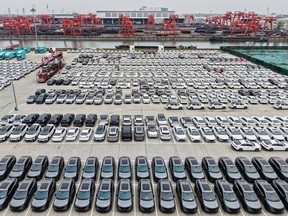
China’s electric vehicle (EV) manufacturers have been at the heart of Canadians’ discussions surrounding recent federal government announcements about EVs in Canada, but are they worth all the attention?

THIS CONTENT IS RESERVED FOR SUBSCRIBERS ONLY
Subscribe now to read the latest news in your city and across Canada.
- Exclusive articles from Barbara Shecter, Joe O'Connor, Gabriel Friedman, and others.
- Daily content from Financial Times, the world's leading global business publication.
- Unlimited online access to read articles from Financial Post, National Post and 15 news sites across Canada with one account.
- National Post ePaper, an electronic replica of the print edition to view on any device, share and comment on.
- Daily puzzles, including the New York Times Crossword.
SUBSCRIBE TO UNLOCK MORE ARTICLES
Subscribe now to read the latest news in your city and across Canada.
- Exclusive articles from Barbara Shecter, Joe O'Connor, Gabriel Friedman and others.
- Daily content from Financial Times, the world's leading global business publication.
- Unlimited online access to read articles from Financial Post, National Post and 15 news sites across Canada with one account.
- National Post ePaper, an electronic replica of the print edition to view on any device, share and comment on.
- Daily puzzles, including the New York Times Crossword.
REGISTER / SIGN IN TO UNLOCK MORE ARTICLES
Create an account or sign in to continue with your reading experience.
- Access articles from across Canada with one account.
- Share your thoughts and join the conversation in the comments.
- Enjoy additional articles per month.
- Get email updates from your favourite authors.
THIS ARTICLE IS FREE TO READ REGISTER TO UNLOCK.
Create an account or sign in to continue with your reading experience.
- Access articles from across Canada with one account
- Share your thoughts and join the conversation in the comments
- Enjoy additional articles per month
- Get email updates from your favourite authors
Sign In or Create an Account
or
Article content
It all began with a preliminary agreement-in-principle between Canada and China during Prime Minister Mark Carney’s visit to Beijing in mid-January.
Article content
Article content
Article content
Under this “deal” (to use Donald Trump’s terminology), Canada plans to allow up to 49,000 EVs to be imported from China at a tariff rate of 6.1 per cent, increasing to 70,000 over a five-year period. In exchange, China agreed to reduce its tariff levels on key Canadian products such as canola seeds, peas, lobsters and crabs.
Article content
The new tariff rate on Chinese EVs is the same that Canada applied before adopting a tariff rate of 100 per cent on Chinese-made EVs on Oct. 1, 2024, in response to pressure from the United States.
Article content
The federal government anticipates that more than half of the imported EVs from China will cost less than $35,000 in five years, which would help Canadian consumers who can’t afford a new car anymore, given that the average price of a new car in Canada is $63,665.
Article content
In response, industry and labour leaders and Ontario Premier Doug Ford have complained that the deal will lead to job losses by undercutting domestically produced cars and parts. The industry is already facing struggles because of renewed U.S. protectionism under Trump 2.0.
Article content
Then, last week, Carney announced his government will scrap the EV sales mandate, which requires 60 per cent of all new cars in Canada to be zero-emission vehicles (ZEVs) by 2030 and 100 per cent by 2035.
Article content
Article content
Instead, it will adopt more stringent emissions standards for vehicles and reintroduce incentives to purchase ZEVs, but only for those built in Canada or in countries with which Canada has a free-trade agreement, thereby excluding imports from China.
Article content
Article content
With this new strategy, which also includes tax incentives, the federal government expects significant investments by automotive manufacturers, including Chinese ones, to produce ZEVs in Canada.
Article content
So, who’s right? The federal government, which sees Chinese EV manufacturers as strategic partners, or those who see competition from China as detrimental to Canada’s auto industry?
Article content
In the short term, the deal with China doesn’t mean much since 49,000 vehicles only represents about three per cent of vehicles sold in Canada. Moreover, it’s far from obvious that the quota will be rapidly filled.
Article content
In the year before it imposed a 100 per cent tariff on Chinese EVs (October 2023 to September 2024), Canada imported 31,658 EVs from China, and this was before the federal government paused its incentive program.
Article content
It is also important to consider the kind of cars Canadians like. They are abandoning passenger cars in favour of SUVs, light trucks and minivans, which are the vehicles assembled in Canada for the most part. The sale of passenger cars has declined by more than half between 2018 and 2024.
 English (US)