
.jpg) 1 hour ago
3
1 hour ago
3
Article content
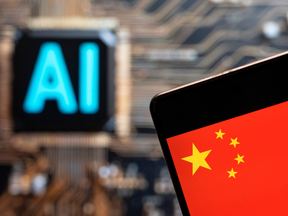
OpenAI and Google are selling their advanced AI models to Chinese tech giants blacklisted by the Pentagon, exposing a gap in Washington’s efforts to slow Beijing’s AI development.

THIS CONTENT IS RESERVED FOR SUBSCRIBERS ONLY
Subscribe now to read the latest news in your city and across Canada.
- Exclusive articles from Barbara Shecter, Joe O'Connor, Gabriel Friedman, and others.
- Daily content from Financial Times, the world's leading global business publication.
- Unlimited online access to read articles from Financial Post, National Post and 15 news sites across Canada with one account.
- National Post ePaper, an electronic replica of the print edition to view on any device, share and comment on.
- Daily puzzles, including the New York Times Crossword.
SUBSCRIBE TO UNLOCK MORE ARTICLES
Subscribe now to read the latest news in your city and across Canada.
- Exclusive articles from Barbara Shecter, Joe O'Connor, Gabriel Friedman and others.
- Daily content from Financial Times, the world's leading global business publication.
- Unlimited online access to read articles from Financial Post, National Post and 15 news sites across Canada with one account.
- National Post ePaper, an electronic replica of the print edition to view on any device, share and comment on.
- Daily puzzles, including the New York Times Crossword.
REGISTER / SIGN IN TO UNLOCK MORE ARTICLES
Create an account or sign in to continue with your reading experience.
- Access articles from across Canada with one account.
- Share your thoughts and join the conversation in the comments.
- Enjoy additional articles per month.
- Get email updates from your favourite authors.
THIS ARTICLE IS FREE TO READ REGISTER TO UNLOCK.
Create an account or sign in to continue with your reading experience.
- Access articles from across Canada with one account
- Share your thoughts and join the conversation in the comments
- Enjoy additional articles per month
- Get email updates from your favourite authors
Sign In or Create an Account
or
Article content
The United States companies confirmed to the FT that they have been supplying AI services to Singapore-based subsidiaries of Alibaba, Baidu and Tencent, which the U.S. government has accused of working with China’s military.
Article content
Article content
Article content
After being contacted by the FT this week, OpenAI said it had last month suspended Alibaba-affiliated users’ access to its API, the software interface that lets developers remotely access AI models, over concerns about illicit use. Although the sales are legal, they have reignited calls for tighter U.S. regulation of AI models similar to its restrictions on exports of the chips used to train powerful models.
Article content
By signing up you consent to receive the above newsletter from Postmedia Network Inc.
Article content
The U.S. government has moved to control access to individual advanced AI models such as Anthropic’s Mythos and Fable and OpenAI’s GPT-5.6.
Article content
But it has not banned the use of cutting-edge AI software more broadly by Chinese-headquartered entities, even those on the so-called 1260H list, a congressionally mandated blacklist that includes Chinese companies with alleged ties to the People’s Liberation Army.
Article content
“The [Trump] administration says we need to beat China on AI all the time, but the problem is they haven’t done anything on export control which is the actual tool we have to slow China down,” said Chris McGuire, a technology and security expert at the Council on Foreign Relations.
Article content
Article content
OpenAI’s recent block of Alibaba users followed suspected “distillation”, in which developers use the outputs of AI models to improve rival systems. The activity was flagged to the U.S. government, a spokesperson said.
Article content
Article content
OpenAI said it does not allow its models to be accessed in China but confirmed that it allows “some companies” with Chinese ownership or headquarters to use its tools for operations in “countries where we can enforce safeguards and monitor for distillation”.
Article content
It added: “we would rather see more of the world using AI shaped by democratic values than AI controlled by autocratic governments”. They added that “we don’t think nationality alone should decide access”.
Article content
Google said its AI services are available in Hong Kong and Singapore, subject to its usage policies, including the banning of distillation.
Article content
But it added that geographic sales restrictions were not enough to mitigate distillation risk, as they could be easily circumvented by sophisticated attackers.
Article content
Alibaba did not immediately respond to requests for comment. Last month, the company asked a U.S. court to order the Pentagon to remove it from the 1260H blacklist, describing the designation as “arbitrary and capricious”.Baidu declined to comment. Tencent did not respond to request for comment on how it was using the U.S. AI models.
 English (US)