
.jpg) 1 hour ago
4
1 hour ago
4
Article content
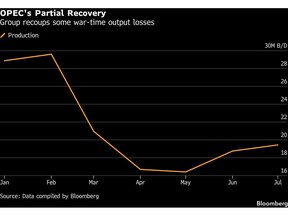
(Bloomberg) — OPEC’s crude oil production recouped some more of its wartime losses last month with gains in Kuwait, Saudi Arabia and Iraq, though opaque shipping data complicated the process of tracking the group’s output, a Bloomberg survey showed.

THIS CONTENT IS RESERVED FOR SUBSCRIBERS ONLY
Subscribe now to read the latest news in your city and across Canada.
- Exclusive articles from Barbara Shecter, Joe O'Connor, Gabriel Friedman, and others.
- Daily content from Financial Times, the world's leading global business publication.
- Unlimited online access to read articles from Financial Post, National Post and 15 news sites across Canada with one account.
- National Post ePaper, an electronic replica of the print edition to view on any device, share and comment on.
- Daily puzzles, including the New York Times Crossword.
SUBSCRIBE TO UNLOCK MORE ARTICLES
Subscribe now to read the latest news in your city and across Canada.
- Exclusive articles from Barbara Shecter, Joe O'Connor, Gabriel Friedman and others.
- Daily content from Financial Times, the world's leading global business publication.
- Unlimited online access to read articles from Financial Post, National Post and 15 news sites across Canada with one account.
- National Post ePaper, an electronic replica of the print edition to view on any device, share and comment on.
- Daily puzzles, including the New York Times Crossword.
REGISTER / SIGN IN TO UNLOCK MORE ARTICLES
Create an account or sign in to continue with your reading experience.
- Access articles from across Canada with one account.
- Share your thoughts and join the conversation in the comments.
- Enjoy additional articles per month.
- Get email updates from your favourite authors.
THIS ARTICLE IS FREE TO READ REGISTER TO UNLOCK.
Create an account or sign in to continue with your reading experience.
- Access articles from across Canada with one account
- Share your thoughts and join the conversation in the comments
- Enjoy additional articles per month
- Get email updates from your favourite authors
Sign In or Create an Account
or
Article content
Supplies from the Organization of the Petroleum Exporting Countries increased by 1.16 million barrels a day in July to an average of 19.44 million barrels a day, with the three Persian Gulf nations accounting for almost all of the gains. With shipping traffic through the Persian Gulf still disrupted by the Iran war — and flows through the Red Sea at risk — the group’s output remains considerably below pre-war levels.
Article content
Article content
Article content
The partial recovery in OPEC supplies following the short-lived ceasefire reached in mid-June between the US and Iran has helped cool oil prices and mitigated the risks to the global economy. Crude futures sank below $80 a barrel in London on Tuesday as Treasury Secretary Scott Bessent said the two sides may be close to an agreement.
Article content
By signing up you consent to receive the above newsletter from Postmedia Network Inc.
Article content
While visible tanker traffic through the Strait of Hormuz chokepoint has been reduced to a trickle, exporters have had some success in discreetly shuttling barrels out. The process involves using tankers with transponders switched off to avoid detection, then transferring cargoes to other vessels in safer areas for transport to international markets.
Article content
The output gains in July could also be partly explained by higher domestic consumption. Oil producers in the Middle East typically bolster output during the summer months, when surging electricity demand for air conditioning often requires them to directly burn crude oil.
Article content
Iraq led OPEC’s increases in July, boosting production by 460,000 barrels a day to 2.3 million a day, according to the survey. The country’s exports jumped 37% in July on increased loadings from the southern port of Basrah, according to tanker-tracking data compiled by Bloomberg.
Article content
Article content
Kuwait, which had seen its output crushed to a fraction of normal levels by the conflict, increased 360,000 barrels a day to a monthly average of 1.57 million a day. Kuwaiti officials said this week the country had restored output to the highest average level since the start of the conflict.
Article content
The picture for OPEC leader Saudi Arabia was more mixed.
Article content
According to the survey, the kingdom’s production rose by 390,000 barrels a day to 7.4 million barrels a day, an increase that still leaves output several million barrels short of pre-conflict volumes. Its exports also came under pressure as Iran’s allies in Yemen, the Houthi rebel group, threatened tankers on the Red Sea route used by the Saudis as an alternative to the Persian Gulf.
Article content
Last weekend, major members of an alliance composed of OPEC and its allies agreed another modest increase in quotas, completing the reversal of cutbacks announced in 2023. Still, with so much Middle East output still shuttered, the increase remains largely theoretical until the war ends.
Article content
Bloomberg’s production survey is based on ship-tracking data, information from officials and estimates from consultants Rapidan Energy Group, FGE NexantECA, Kpler Ltd. and Rystad Energy AS.
Article content
—With assistance from Prejula Prem, Lucia Kassai and John Deane.
Article content
 English (US)