
.jpg) 3 hours ago
3
3 hours ago
3
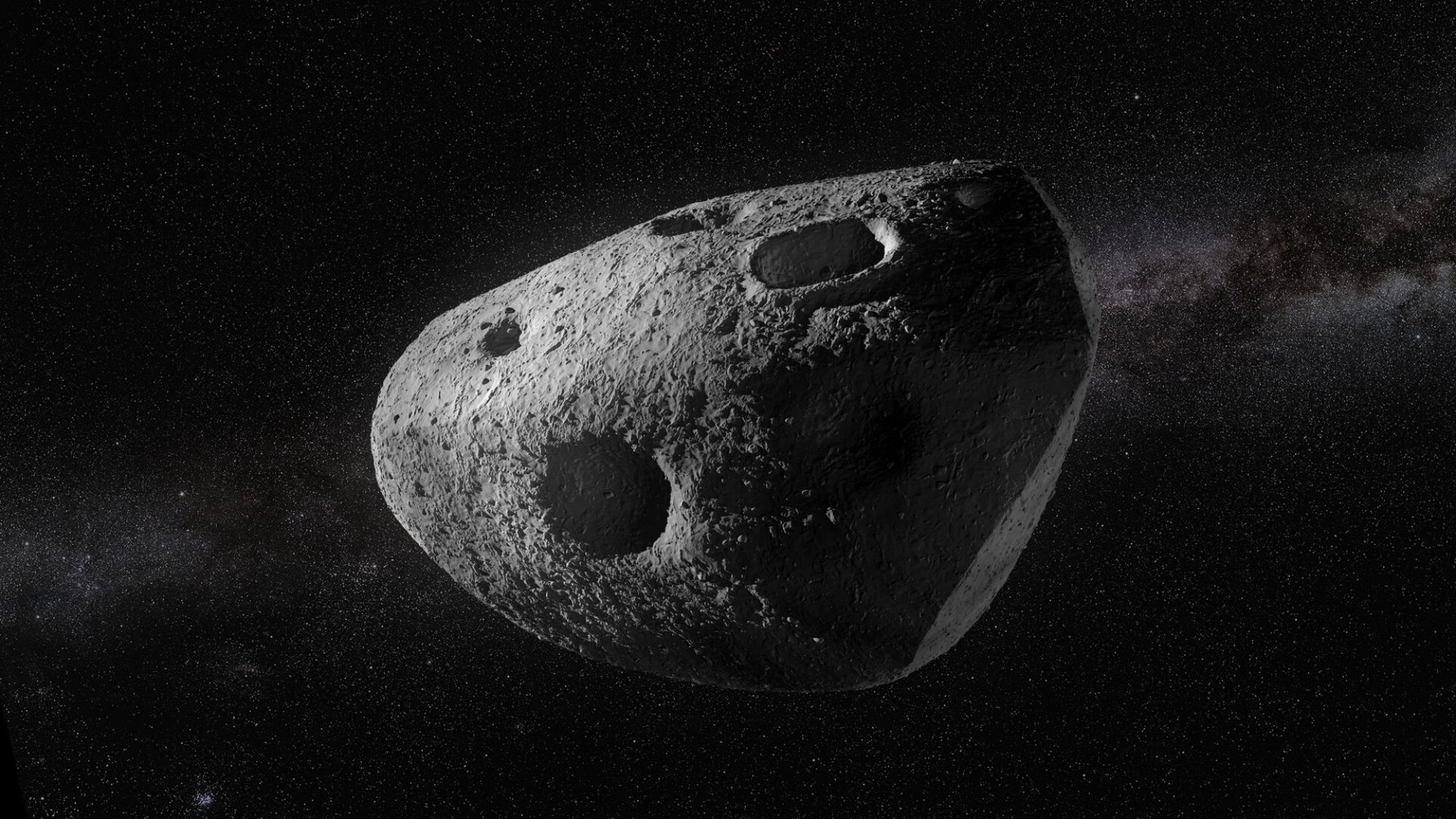
Three years before the skyscraper-size asteroid Apophis makes its very close (but safe) flyby of Earth, scientists have already begun charting exactly when and where billions of people can watch it sweep across the sky.
Speaking at an "Apophis T-3 Years" workshop held earlier this month at the University of Padua in Italy, retired cartographer Michael Zeiler and astronomer Rick Fienberg shared detailed visibility maps charting the asteroid's passage across Earth's skies.
According to their calculations, roughly 90% of the world's population — about 7.6 billion people — lives in regions where Apophis could, in principle, be seen with the naked eye on April 13, 2029. The actual viewing success will depend more on earthly considerations, however, including cloud cover and the extent of light pollution.
Known formally as 99942 Apophis, the space rock will not resemble a blazing meteor tearing through the sky. Instead, scientists say it will appear as a point-like speck of light gliding steadily across, which, at its closest approach, will appear to move by about the apparent width of the full moon every minute.
"It will definitely be noticeable," Fienberg told Space.com. "It's going to be moving more slowly than a satellite — it will cross the sky in hours, rather than minutes, and it will just be a point."
According to the new maps, the asteroid should remain visible to the naked eye for about seven hours, beginning over Australia at 11:00 a.m. EDT (15:00 UTC) and concluding over the North Atlantic at 6:00 p.m. EDT (22:00 UTC).
At 4:35 p.m. EDT (20:35 UTC), Apophis is expected to reach its greatest apparent brightness as it passes over Cameroon, offering prime viewing to an estimated 3.9 billion people across Africa, Asia, eastern South America and parts of Europe.
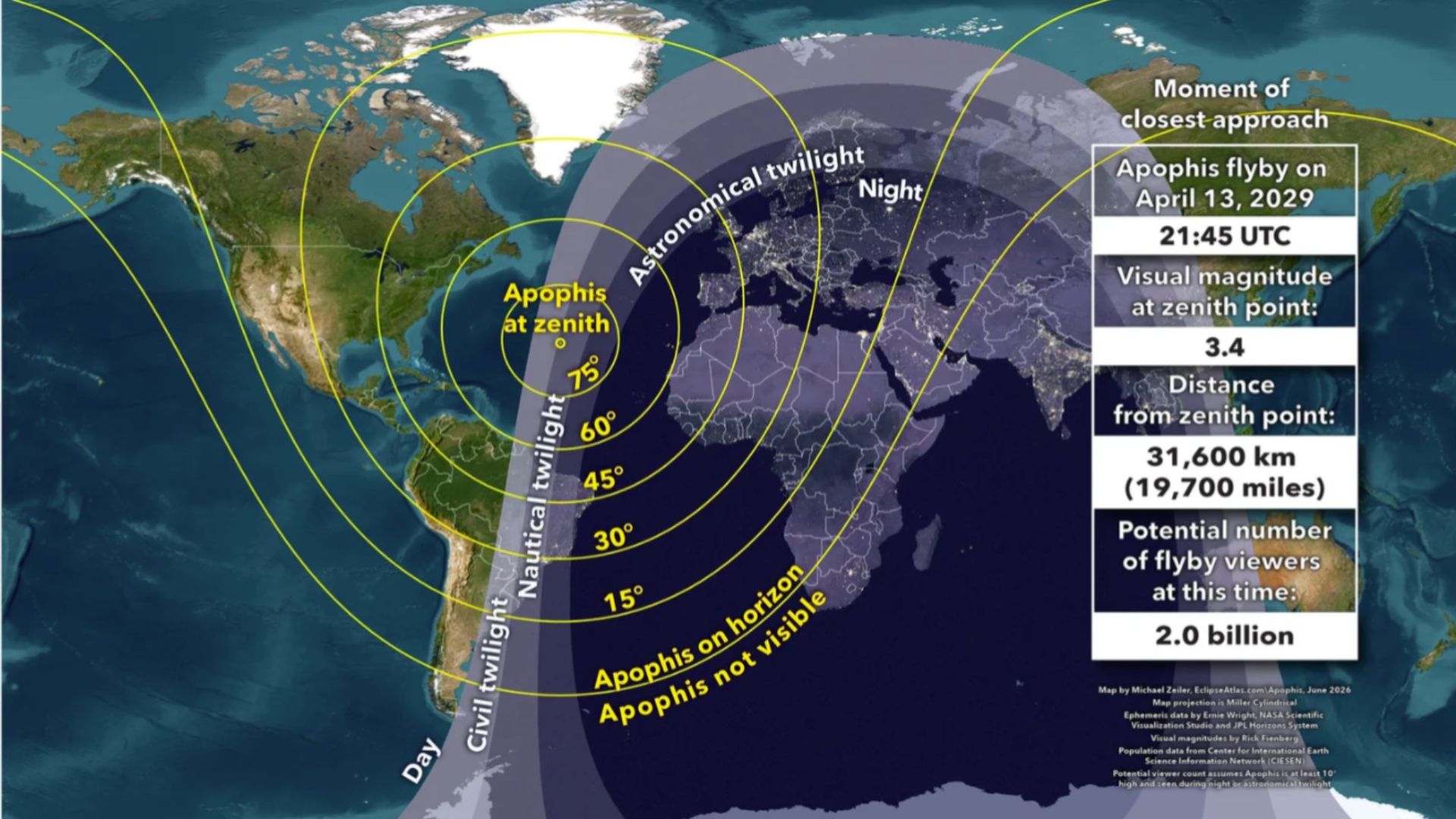
About an hour later, at 5:45 p.m. EDT (21:45 UTC), the asteroid will make its closest approach to Earth, passing about 19,700 miles (31,600 kilometers) above the North Atlantic — well inside the orbit of Earth's geostationary satellites. The event would be visible across much of South America, the United States, Africa and parts of Europe, reaching roughly 2 billion people.
"This is the first time we've been able to predict in human history an asteroid visibly passing by the Earth," Richard Binzel, a professor of planetary sciences at the Massachusetts Institute of Technology (MIT), said during the workshop. "That's part of a shared experience."
As excitement ramps up for the once-in-a-millennium spectacle, Binzel opened the workshop with three messages: "Apophis will safely pass the Earth. Apophis will safely pass the Earth. Apophis will safely pass the Earth."
That absolute certainty is the hard-won fruit of more than two decades of increasingly precise observations. When Apophis was discovered in 2004, early calculations suggested a 1-in-37 chance of an impact in 2029, making it the most potentially hazardous asteroid known at the time. Additional observations steadily refined the asteroid's orbit, eliminating any possibility of a collision in 2029 and also ruling out any impact threat for at least the next century, according to NASA.
With the impact threat removed, scientists now view the flyby as a rare opportunity to observe how Earth's gravity affects an asteroid during an exceptionally close encounter.
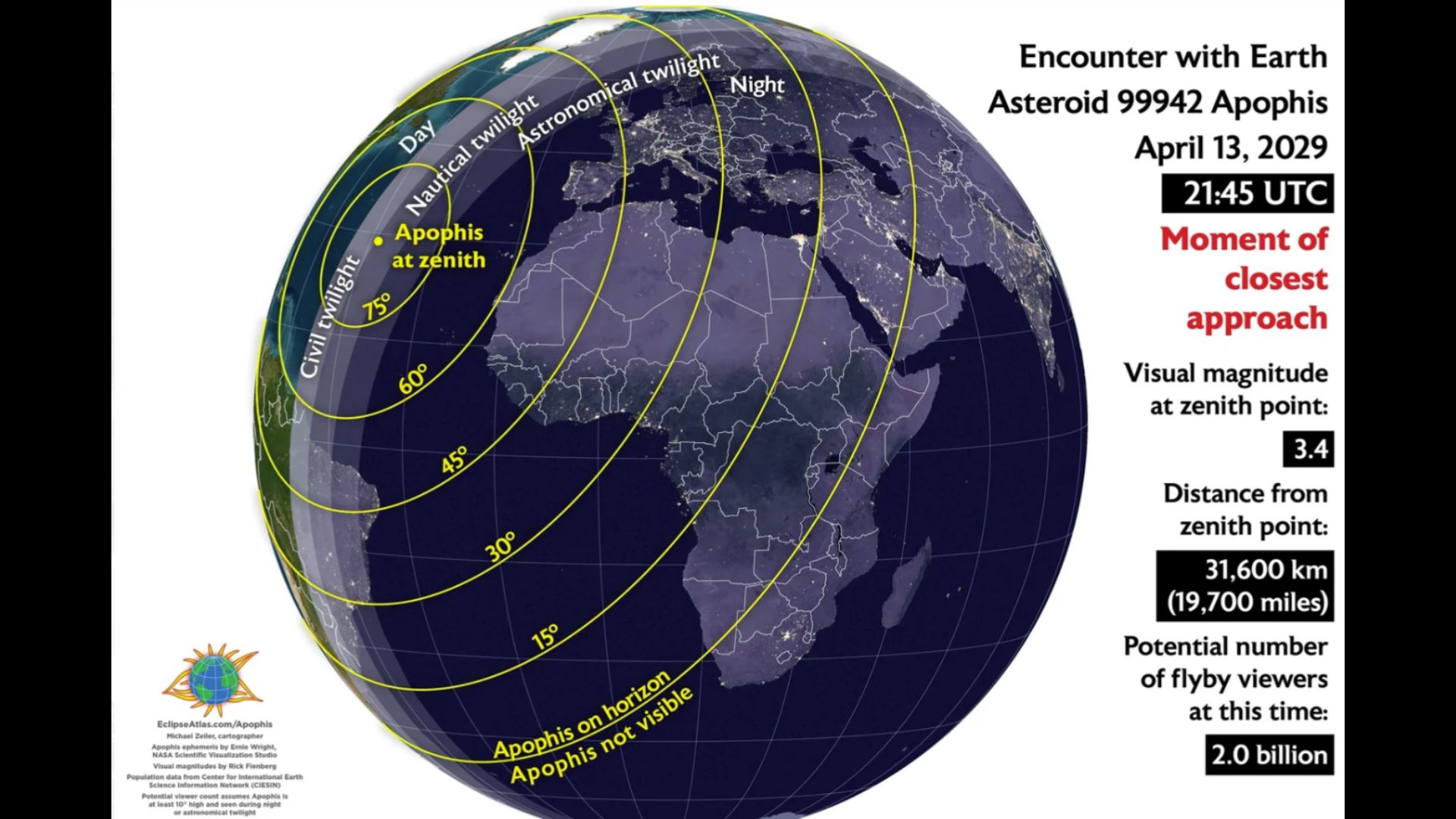
Our planet's gravity is expected to tug the asteroid into a new orbit around the sun without posing any future danger. During the flyby, however, those same gravitational forces may stretch and squeeze the asteroid enough to trigger landslides or expose pristine material hidden beneath its weathered surface. Or they may do almost nothing.
"We simply don't know what's going to happen," Binzel said during the workshop. "Apophis may go by and not care too much, or maybe we'll see something significant."
"That's why we have to look," he added. "We're gonna learn a lot either way."
At the workshop, scientists said they hope to monitor the flyby from observatories in Spain's Canary Islands, among other places, as its location in the Atlantic Ocean offers an ideal view of the asteroid's closest approach as well as favorable prospects for clear skies.
 English (US)