
.jpg) 2 hours ago
3
2 hours ago
3
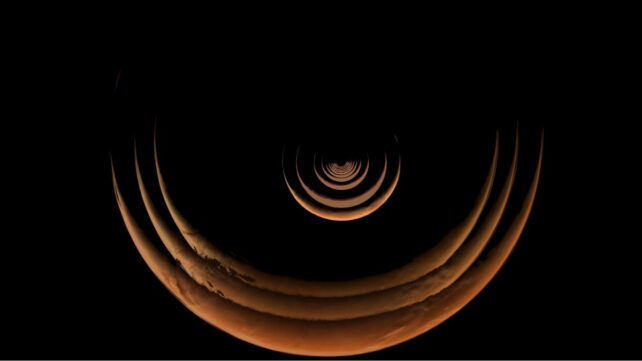 A psychedelic composite image of Mars, showing what the Psyche mission saw as it approached the red planet from 2 May to 15 May 2026. (NASA/JPL-Caltech/ASU)
The Universe is so unimaginably immense, we'll never be able to see all of it – yet some of its most intriguingly mysterious objects are located right in our own solar backyard.
A NASA spacecraft is currently speeding toward such an object, promising to reveal a unique body unlike any we've ever explored.
"For the first time ever, we are exploring a world made not of rock or ice, but of metal," astronomers announce.
On its journey to this mysterious object, NASA's probe is capturing some incredible views of the Solar System, which the space agency has just revealed to the world.
The spacecraft's ultimate destination is an asteroid named Psyche, after the Greek goddess of the soul, discovered by Italian astronomer Annibale de Gasparis in 1852.
Astronomers have since hypothesized that potato-shaped Psyche may be the debris-blasted iron core of a planetesimal, the building block of planets.
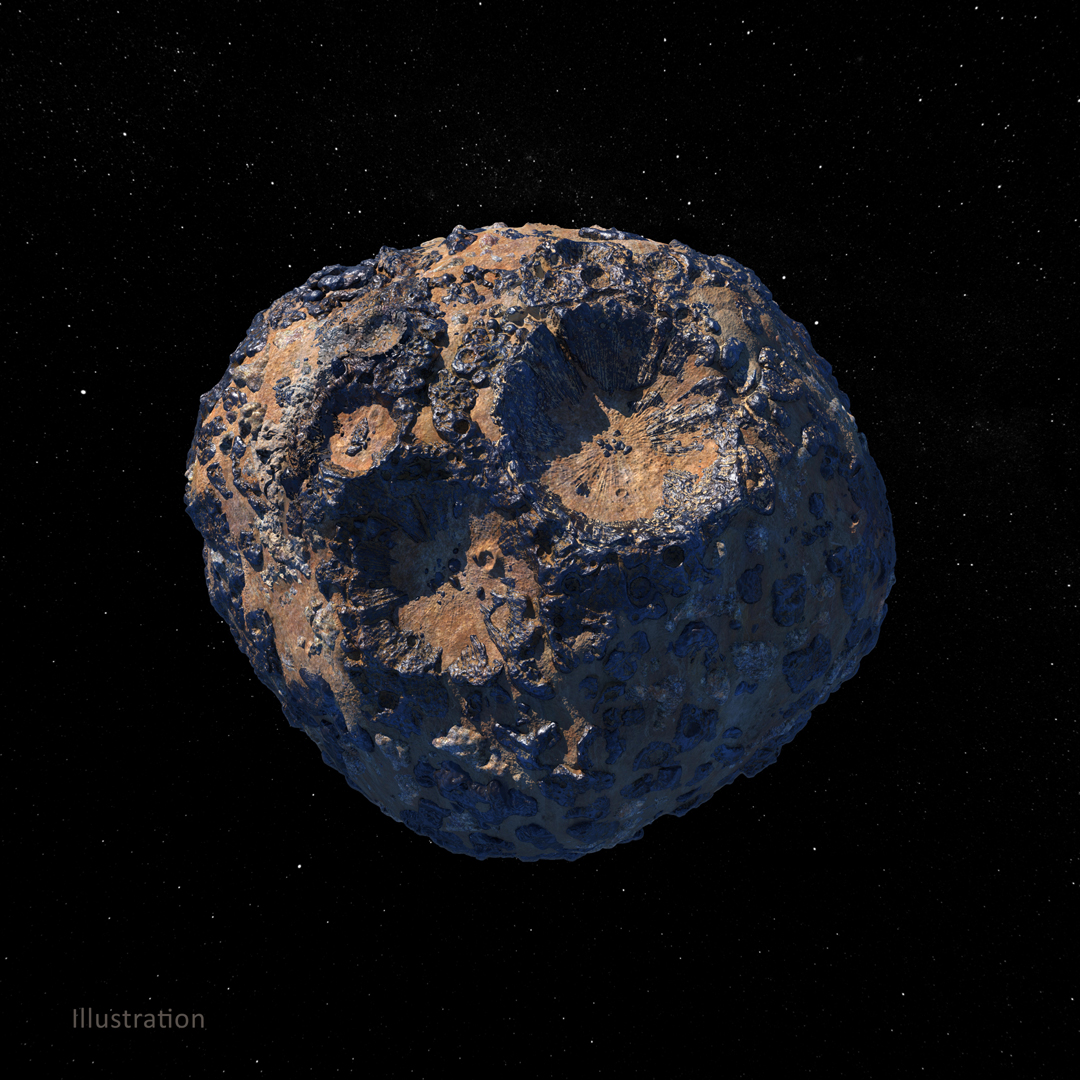 An illustration of the 16th asteroid to be discovered, named Psyche, or 16 Psyche, though its true visual appearance is still unknown. (NASA/JPL-Caltech/ASU)
As is consistent with Greek imagery, this asteroid may be partially nude, perhaps exhibiting an exposed metal core like the bare ribs of a tattered zombie from the Solar System's early days, when embryonic planets routinely smashed each other to bits.
Accordingly, Psyche is situated in a planetary graveyard of sorts, three times farther from the Sun than we are, in the asteroid belt that forms the rocky-to-gassy-body boundary between Mars and Jupiter.
Psyche is approximately 280 kilometers (170 miles) across its longest dimension and roughly the size of Massachusetts, but its overall composition is contentiously uncertain.

The world will find out what it's made of around August 2029, when a mission led by NASA and multiple institutions, including Arizona State University and Caltech, is scheduled to arrive at the asteroid.
This speeding spacecraft, launched in 2023 aboard a SpaceX Falcon Heavy rocket, is also named Psyche and is about the size of a singles tennis court. The solar-powered spacecraft also sports a suite of sensors.
It has a multispectral imager to capture the asteroid in different wavelengths of light, a gamma-ray and neutron spectrometer to determine its surface chemical composition, and a magnetometer to measure its remnant magnetic field.
Additionally, an X-band radio telecommunications system will ascertain the asteroid's gravitational field and its inner composition.
The spacecraft has also been testing the sophisticated deep space optical communication (DSOC) system, which beams data – including the first interplanetary cat video – to Earth using near-infrared lasers rather than radio waves.
 Tater the cat, streamed from nearly 19 million miles away, at up to 1.8 Mbps. (NASA/JPL-Caltech)
Most recently, on May 15, the Psyche spacecraft completed its flyby of Mars, passing only around 4,600 kilometers (2,800 miles) from the red planet's surface at more than 19,848 kilometers (12,000 miles) per hour.
In addition to capturing a trippy time-lapse and some stunning images of Mars as a thin, nighttime crescent, the spacecraft achieved two essential goals.
First, this 'dress rehearsal' of its ultimate mission goal further calibrated its sensors, offering a better look at Mars' bow shock, which diverts particles around the planet like a ship plowing through waves.
It also imaged Mars' water-ice-rich, south polar cap, which spans some 700 kilometers, and its double-ringed Huygens crater.

"The mission's imager, magnetometer, and gamma-ray and neutron spectrometer teams worked overtime to make full use of this planetary encounter, and all instruments delivered great results," says Lindy Elkins-Tanton, the Principal Investigator of the Psyche mission and Director of the Berkeley Space Sciences Laboratory.
Second, the Psyche spacecraft gained a significant speed boost by using Mars as a planet-sized slingshot.

"We've confirmed that Mars gave the spacecraft a 1,000 mile‑per‑hour boost and shifted its orbital plane by about 1 degree relative to the Sun," explains Don Han, the Navigation Lead of the Psyche mission at NASA's Jet Propulsion Laboratory (JPL).
Somewhat akin to siphoning gas from somebody else's (preposterously gigantic) car, Psyche increased its speed without using any of its xenon propellant by 'stealing' some of Mars' orbital energy, thereby slowing the planet itself by a correspondingly tiny amount.
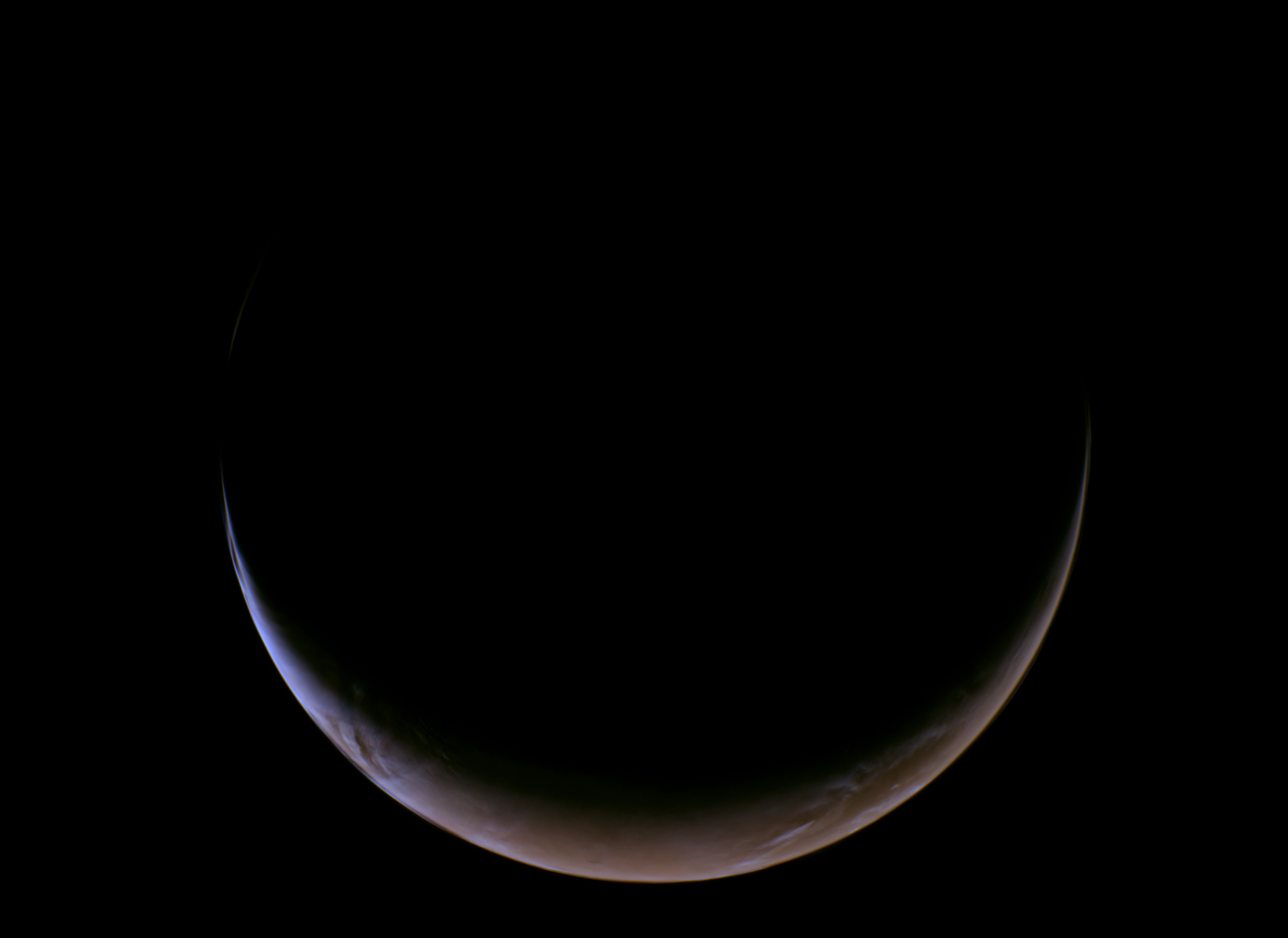 Crescent Mars, captured on 15 May 2026, processed into a natural-color image utilizing red, green, and blue data from the Psyche spacecraft's multispectral imager. (NASA/JPL-Caltech/ASU)
"This gravity assist was years in the making, and the navigation team nailed it – Psyche flew by Mars on exactly the trajectory we needed to set us on a path to rendezvous with the asteroid in the summer of 2029," says Bob Mase, the project manager of Psyche at JPL.
"The spacecraft is in great shape, and we're on schedule to resume sustained thrusting with the solar-electric propulsion system this fall."
Related: Evidence of Ancient Life Found Buried Under an Asteroid Crater
Whether Psyche is closer to a planetary core battered by untold past collisions or a rubble pile, like the asteroid Bennu, will be revealed before the decade's end.
As Elkins-Tanton concludes: "Onward to the asteroid Psyche!"
This article was fact-checked by Rachel Garner and edited by Clare Watson. While we pride ourselves on our process, we are only human. If you spot a mistake, please let us know.
 English (US)