
.jpg) 20 hours ago
7
20 hours ago
7
Article content
The writer is the Rene M Kern professor of practice at Wharton School, chief economic adviser at Allianz and chair of Gramercy Funds Management.

THIS CONTENT IS RESERVED FOR SUBSCRIBERS ONLY
Subscribe now to read the latest news in your city and across Canada.
- Exclusive articles from Barbara Shecter, Joe O'Connor, Gabriel Friedman, and others.
- Daily content from Financial Times, the world's leading global business publication.
- Unlimited online access to read articles from Financial Post, National Post and 15 news sites across Canada with one account.
- National Post ePaper, an electronic replica of the print edition to view on any device, share and comment on.
- Daily puzzles, including the New York Times Crossword.
SUBSCRIBE TO UNLOCK MORE ARTICLES
Subscribe now to read the latest news in your city and across Canada.
- Exclusive articles from Barbara Shecter, Joe O'Connor, Gabriel Friedman and others.
- Daily content from Financial Times, the world's leading global business publication.
- Unlimited online access to read articles from Financial Post, National Post and 15 news sites across Canada with one account.
- National Post ePaper, an electronic replica of the print edition to view on any device, share and comment on.
- Daily puzzles, including the New York Times Crossword.
REGISTER / SIGN IN TO UNLOCK MORE ARTICLES
Create an account or sign in to continue with your reading experience.
- Access articles from across Canada with one account.
- Share your thoughts and join the conversation in the comments.
- Enjoy additional articles per month.
- Get email updates from your favourite authors.
THIS ARTICLE IS FREE TO READ REGISTER TO UNLOCK.
Create an account or sign in to continue with your reading experience.
- Access articles from across Canada with one account
- Share your thoughts and join the conversation in the comments
- Enjoy additional articles per month
- Get email updates from your favourite authors
Sign In or Create an Account
or
Article content
Imagine that, as a result of an activist investor campaign, you are suddenly installed as the chief executive of a company that has missed its targets for five straight years and experienced a number of embarrassing operational lapses. Or imagine that, much like United Kingdom Prime Minister Andy Burnham, you now lead a country that has been held back by a lack of vision and sluggish decision-making.
Article content
Article content
Article content
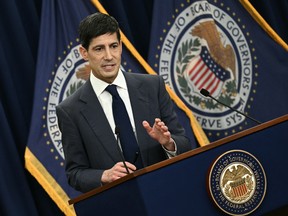
That is the equivalent of what has happened to Kevin Warsh, the new chair of the Federal Reserve. Judging from his initial actions, he is committed to turning around the institution. If he succeeds, he could also spur an evolution in the practice of modern central banking globally. If he fails, there is more at risk than just the institutional integrity of the Fed.
Article content
By signing up you consent to receive the above newsletter from Postmedia Network Inc.
Article content
The facts leading to the need for regime change at the Fed are clear, albeit uncomfortable for the world’s most powerful central bank. Under its previous leadership, the Fed missed its inflation target for some 60 consecutive months, communicated in a manner that was both confused and confusing, slipped in the supervision of certain regional banks, had internal compliance lapses, and committed numerous forecasting errors.
Article content
Yet, in the face of all this, there was remarkably little enthusiasm for internal reform. This complacency was laid bare by the 2025 “framework review”, a process undertaken every five years. That iteration, much like the 2020 review, raised concerns about being too narrow and overly backward-looking.
Article content
Article content
Enter Warsh, set on changing this trajectory. He immediately established five task forces with an array of eminent figures with diverse viewpoints to come up with fresh thinking on the Fed’s major areas of operational slippages.
Article content
Article content
Warsh suspended the chair’s forward guidance on policy and refused to submit individual projections to the “dot plot” of economic projections by members of the Federal Open Market Committee, rightly arguing that they offer a false sense of precision. And he is reportedly considering altering the format and frequency of the eight annual policy-setting meetings to foster more rigorous debate and better decision-making.
Article content
Despite the glaring need for reform, Warsh has received a frosty reception. Some have argued that his performance has undermined the Fed’s credibility in a manner that has unnecessarily boosted the country’s borrowing costs. Others complain that Warsh has not been transparent, a critique that baffles me given the extent to which he has publicly outlined his analytical framework, his views on how policy should react to economic conditions and his belief in the primary role of interest rates in tackling inflation. As a reading of his speeches, congressional testimony and confirmation hearings shows, Warsh has an unwavering commitment to the Fed’s mandate.
 English (US)