
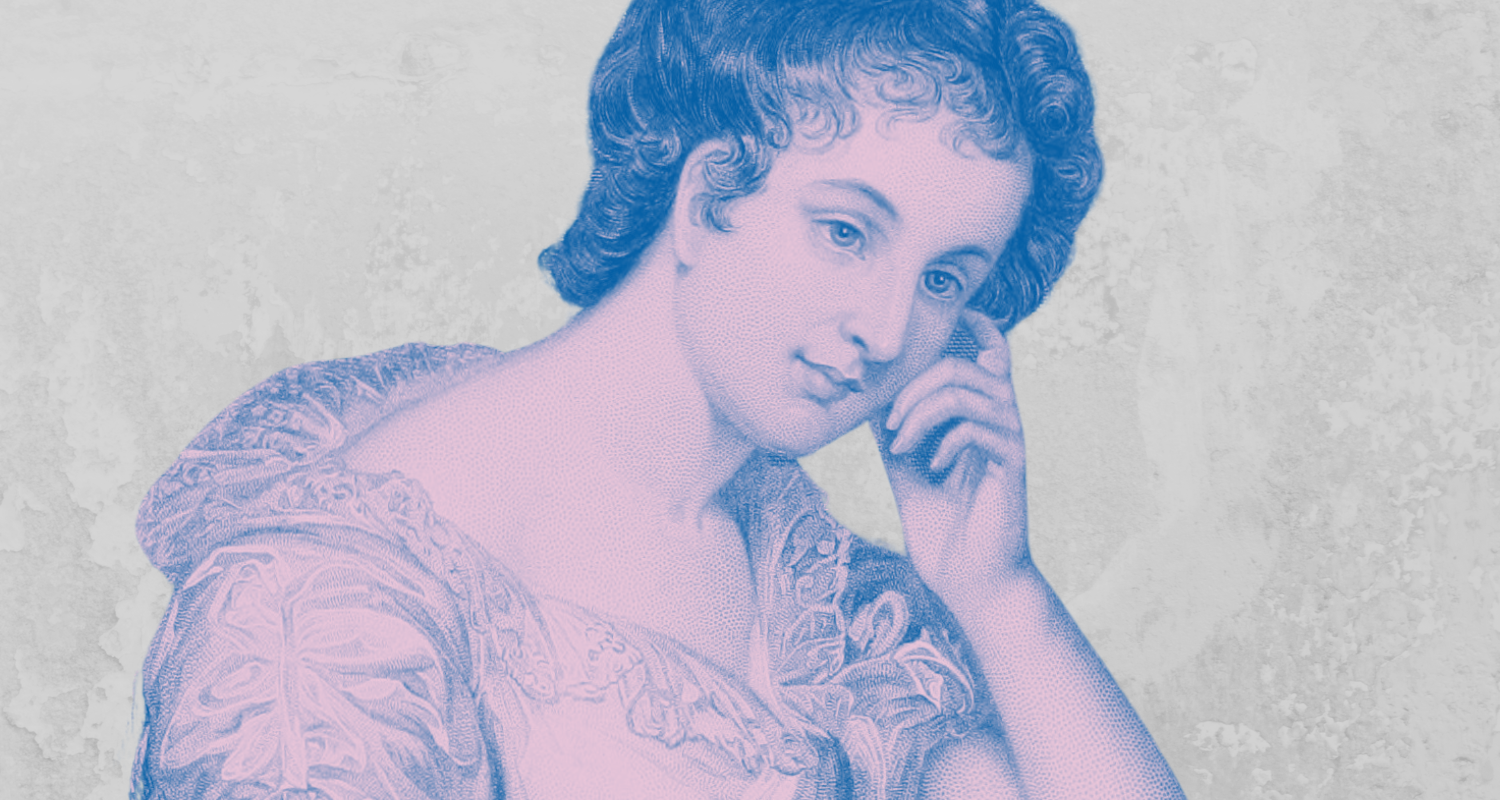
London society buzzed with one name that spring: Miss Edgeworth.
Article continues after advertisement
The year was 1813. The Regency era was in full swing, and the upper class had assembled for the season in a pastel whirl of lace and silk, complete with calling cards and exclusive dinner parties. The Napoleonic Wars raged across continental Europe, but that did not stop society life from carrying on in all its dazzling elegance.
George III sat on the throne; Queen Charlotte presided over her court. A burst of interest in antiquity had inspired the stylish ladies of Mayfair and Marylebone to dress themselves like modern Cleopatras and Helens, with high waists and flowing skirts. Fashionable gatherings were peppered with the prose of neoclassical writers and Romantic poets.
Yet amid all the decadent breakfasts and sparkling balls, one socialite found herself on a deeper mission as the days grew longer and a warm summer set in. Jane Haldimand Marcet was determined to befriend Maria Edgeworth, the woman deemed the “lion” of the season by the poet Lord Byron.
“The Great Maria,” as she was sometimes called in literary circles, ranked among the most famous authors in the Western world. Maria was the eldest daughter of a family with English Protestant roots who owned and lived on a sprawling ancestral property in central Ireland. Her stories depicted Irish estates, London courtships, and heroes who ranged from dashing to bumbling. They were frequently instant bestsellers, books that managed to be at once so smart and so popular that they were helping to make the novel a more respectable literary format. (Jane Austen, much less feted than Maria in those days, would in 1814 write to her niece that she had made up her mind “to like no Novels really, but Miss Edgeworth’s, Yours & my own.”) Already, whispered gossip had begun to call into question whether Maria was truly the author of her works. Surely a mere woman could not produce such tales.
Maria Edgeworth was quietly tucking lessons on the brand-new field of political economy into her fiction and stories for children. In the process, she was educating an empire.
That’s what Jane Marcet found intriguing about Maria’s fiction: She was hiding messages just below the surface. Readers were coming to Edgeworth books for dry quips, rollicking plots, and haphazard love stories, yet they were leaving them with an understanding of tenant-landlord relationships and the benefits of educating workers. Maria Edgeworth was quietly tucking lessons on the brand-new field of political economy into her fiction and stories for children. In the process, she was educating an empire.
Jane wanted to know how she did it.
The hostess was one among many upper-class Londoners eager to glimpse the literary celebrity that season. Maria was usually reclusive. For more than a decade, she had spent her days far removed from society, scribbling away at her little wooden writing table in the library of the Edgeworths’ remote Irish estate. She was a novelty, and when word had spread that she would accompany her father and stepmother on a rare trip to England, the titans of the age had lined up to greet her. Already, the Edgeworth tour had included visits with the scientific Darwin family and the chemist Sir Humphry Davy. The politician and philosopher Sir James Mackintosh wrote to a friend that the famous authoress was being “followed and courted by all persons of distinction in London with an avidity…almost without example.”* Evidently an admirer, he noted that “she remained perfectly unspoiled by the homage of the great.”
Fans mobbed Maria everywhere she went. “You would have been amused if you had seen with what eagerness people crowded to get a sight of Miss Edgeworth—who is very short—peeping over shoulders and between curled têtes to get but one look,” an acquaintance reported to Sir Walter Scott. The Scottish novelist was a close friend of Maria’s. “She said herself, at a party where I met her, that the crowd closed over her.”
Still, Jane had good reason to expect that the famous author would make time to pay her a visit. She had been in contact with the Edgeworth family since at least 1809, when she had sent Maria’s father, Richard Lovell Edgeworth, a copy of her own first book, a primer on chemistry called Conversations on Chemistry. Jane had written the text to explain the new science to nonexperts, and she had checked with leading academics in the field to ensure she was getting the details right. Richard Lovell was a natural choice for consultation. A well-known inventor, he was an intellectual explorer who had come up with a rudimentary telegraph, who had once nearly invented the steam engine, and who continued to tinker away endlessly from his rural estate.
Even then, Jane had written with an ulterior motive. She had been eager to create some link to Edgeworth’s eldest daughter. Jane had made it clear in her letter that she was a fan of Maria’s, urging the father to “thank Miss Edgeworth for the very rational entertainment afforded by her new tales” and insisting that she was “beyond measure anxious” to read more of Maria’s children’s stories. Maria, in turn, had read and admired Conversations on Chemistry. Her praise had likely gotten back to Jane, because the two had many friends in common.
Given their connections, it was easy to hope—even to expect— that the Edgeworth family would visit Mrs. Marcet’s stylish residence overlooking the green lawn of Russell Square. It was not a major surprise when, on a lilac-scented twilight in mid-May, the celebrated Miss Edgeworth and her family descended upon the Marcets’ front steps, ready to attend one of Jane’s storied dinner parties.
What was the real surprise? Maria Edgeworth herself.
She was a petite bundle of contradictions. At less than five feet tall, dressed tidily but modestly, she had a demeanor so unassuming that it made it hard to believe this was the person whose name graced her books. Her chin and nose were sharp, her skin pale, and her eyes expressive, but they were often downcast. Shyness radiated from her.
Maria was a woman who had produced a fifteen-year-long string of literary hits, who had written vigorously in defense of female education, and who had at times rhetorically skewered the very Anglo-Irish landlord class to which she belonged. She pushed boundaries to the point of controversy. (One of her novels had briefly included an entirely taboo interracial love story, later removed at her father’s urging.) Yet she spoke rarely, and even then in muted tones. Lord Byron, having met her at breakfast at Sir Humphry Davy’s earlier that week, wrote in his diary that “her conversation was as quiet as herself; no one would have guessed she could write her name.”
But even if Maria was not fond of talking, she loved to observe. That’s exactly what she was doing at Jane Marcet’s party, which had given her a chance to watch high society at its finest and to listen to new ideas and arguments as they unfurled. Mrs. Marcet’s guest list was a curated set of intellectuals, including Thomas Robert Malthus, an economist who had spent the preceding decade arguing that population growth was destined to outstrip food supply. Maria rushed off a letter the next morning (“before breakfast, at 1/2 pastry,” she scrawled in the margin of the eggshell stationery) to tell her favorite sister all about the gathering.
“Mrs. Marcet herself is plain, and has a disagreeable voice, but she is so sensible in conversation and unaffected,” she reported. Malthus, she continued, did not deserve the villainous reputation he had by then earned himself. The economist was infamous in London’s philosophical circles for arguing fervently—and, many thought, heartlessly—against poor relief. Maria, though, had found him to be an “amiable, gentlemanlike man who really converses, that is, listens as well as talks, and follows the ideas of others as well as produces ideas of his own.”
The attendees did not know it then, but the ties formed over Jane Marcet’s table that night would go on to shape history. Maria would spend years debating the ideas of early economics with Malthus, his friends, and eventually his successor, helping to influence their thinking and inform their research. Even more important, Maria and Jane would strike up a friendship that would span decades and cross borders. Together, they would work to spread the ideas of the blossoming field of classical economics, then known as political economy, far and wide. Their writing would help concepts including gains from trade and the division of labor to take root in the popular imagination.
Because Jane hadn’t merely recognized what Maria was doing with books like Castle Rackrent (the satirical tale of a family of hapless Irish landlords), The Parent’s Assistant (a collection of educational children’s stories), and Ennui (a tongue-in-cheek novel about the transformation of a self-indulgent property owner). Her goal was to push it one step further.
Readers were learning economics accidentally from Maria’s books, which were not advertised as lessons in the new science. She simply snuck it into the plots. Jane hoped to be more overt, creating a simple manual for people who came to the topic on purpose. She had already written Conversations on Chemistry to bring basic scientific ideas to women and nonexperts. Now she wanted to write Conversations on Political Economy. For that, she needed Maria’s help.
Readers were learning economics accidentally from Maria’s books, which were not advertised as lessons in the new science. She simply snuck it into the plots.
Jane would slip Maria her new manuscript before the latter left London that summer, asking for her advice on both the writing and the content. Jane had plenty of contacts in the field. Her brother had recently become the youngest person ever appointed a director of the Bank of England, and the economist and financier David Ricardo was a regular guest at her house. But Maria was perhaps the only person in the world who had already written about the infant field of political economy for a general audience. To Jane, she was the master.
Maria was also, evidently, happy to advise those who wanted to follow in her footsteps. She would soon send Jane a lengthy list of notes on the draft.
“The more amusing anecdote & illustration you can mix with your solid information the better,” Maria suggested. “It should be your object rather to sow seeds than to exhibit full grown plants—Your work should excite curiosity to go further.”
Maria also offered feedback on the content of the book. She told Jane that Adam Smith should be abridged, because he “needs it much,” whereas the utilitarian philosopher Jeremy Bentham was “absolutely impossible” to put in fewer words, because what he needed was “to be diluted.” (This was a favorite refrain of Maria’s, who bristled at unclear economic writing. One of her only academic publications was an anonymous and otherwise positive review of Bentham that argued—fervently—that his books would be easier to understand if only they were longer.)
Jane would go on to publish her first edition of Conversations in 1816. The book used an imaginary dialogue between two women to explain the principles of economics, collecting the ideas of the new science together in a way that had never before been attempted. It may be the first true textbook on economics, published at a time when tutors and professors were still teaching directly from Adam Smith’s 1776 The Wealth of Nations. Jane’s volume would be used in classrooms for more than a generation, and it would ultimately educate many thousands, maybe even millions, of people on the basic ideas of political economy.
Jane was sure to acknowledge that she was not the first person to try to explain economics plainly. In the book, one of her characters expresses skepticism that women should—or that children could—learn about political economy, echoing a common perception of the age. The story’s heroine insists that they already have. She points to Maria Edgeworth’s short story “The Cherry Orchard,” which was by then standard reading in English nurseries.
“The author has judiciously avoided naming the science,” the character attests. “But that little tale contains a simple and beautiful exposition of the division of labour.”
*
If you have learned even a little bit about the history of economics, you will likely know the names of its founding fathers: Adam Smith, David Ricardo, Thomas Malthus. But you almost certainly have not come across the women who founded the field alongside them, helping it to gain widespread popularity while advancing and altering its earliest theories.
This book retells the history of the early years of political economy, a time before the study had solidified into a defined science, during which a handful of privileged thinkers pursued its truths through philosophy, poetry, and literature. This version of history adds back the field’s forgotten characters. It is shaped around the life story of Maria Edgeworth, who was both a wildly fascinating person and, as you will see, arguably the world’s first female economist.
_______________________________
From The Invisible Hand of Maria Edgeworth: How a Nineteenth-Century Novelist Taught the World Economics by Jeanna Smialek. Copyright © 2026 by Jeanna Smialek. Excerpted by permission of Alfred A. Knopf, a division of Penguin Random House LLC. All rights reserved. No part of this excerpt may be reproduced or reprinted without permission in writing from the publisher.


