
.jpg) 1 hour ago
3
1 hour ago
3

Article content
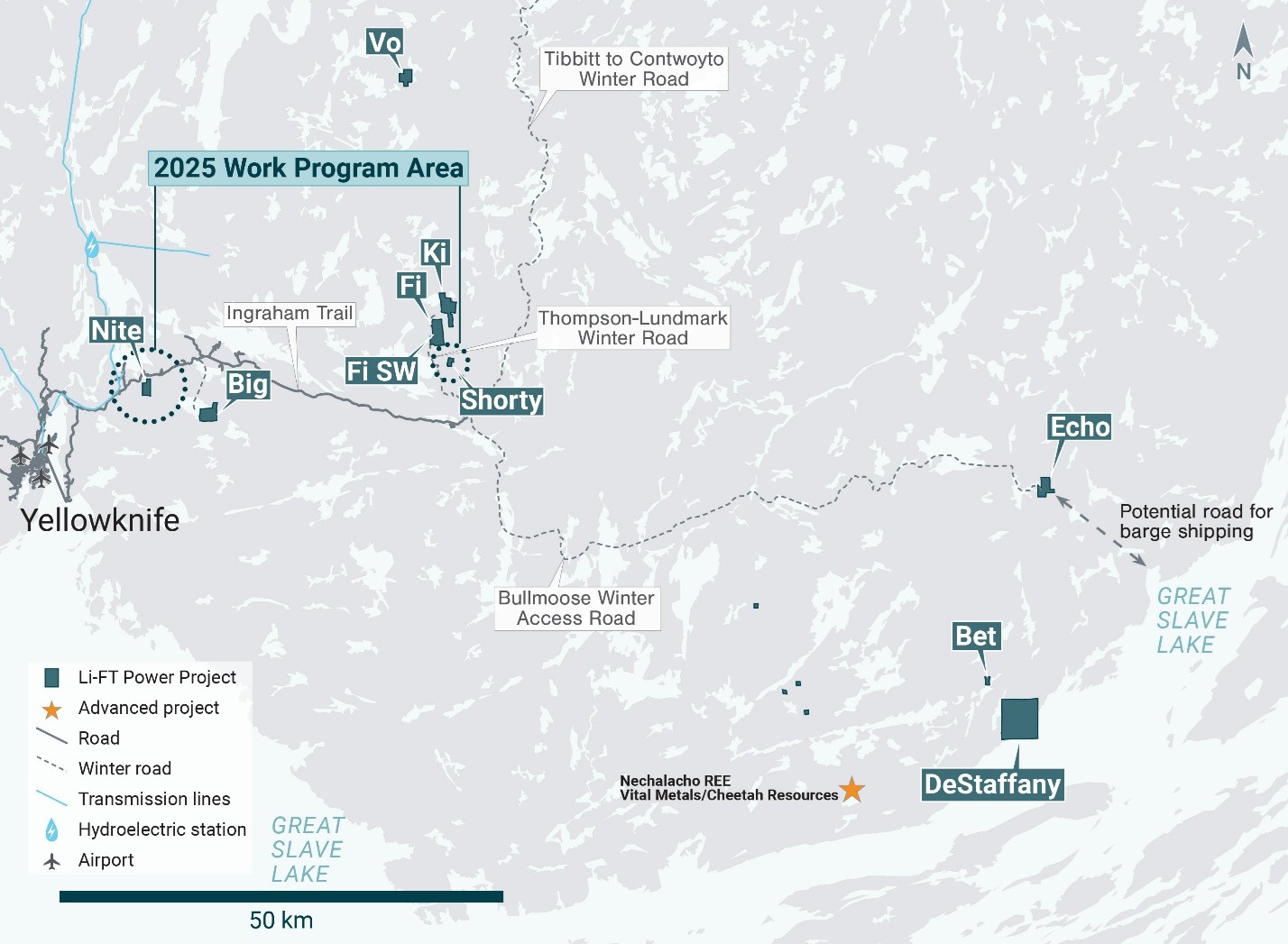
VANCOUVER, British Columbia, Jan. 15, 2026 (GLOBE NEWSWIRE) — Li-FT Power Ltd. (“LIFT” or the “Company”) (TSXV: LIFT) (OTCQX: LIFFF) (Frankfurt: WS0) is pleased to report results from the 2025 work program completed at the Yellowknife Lithium Project (“YLP”), located outside the city of Yellowknife, Northwest Territories (Figure 1).

THIS CONTENT IS RESERVED FOR SUBSCRIBERS ONLY
Subscribe now to read the latest news in your city and across Canada.
- Exclusive articles from Barbara Shecter, Joe O'Connor, Gabriel Friedman, and others.
- Daily content from Financial Times, the world's leading global business publication.
- Unlimited online access to read articles from Financial Post, National Post and 15 news sites across Canada with one account.
- National Post ePaper, an electronic replica of the print edition to view on any device, share and comment on.
- Daily puzzles, including the New York Times Crossword.
SUBSCRIBE TO UNLOCK MORE ARTICLES
Subscribe now to read the latest news in your city and across Canada.
- Exclusive articles from Barbara Shecter, Joe O'Connor, Gabriel Friedman and others.
- Daily content from Financial Times, the world's leading global business publication.
- Unlimited online access to read articles from Financial Post, National Post and 15 news sites across Canada with one account.
- National Post ePaper, an electronic replica of the print edition to view on any device, share and comment on.
- Daily puzzles, including the New York Times Crossword.
REGISTER / SIGN IN TO UNLOCK MORE ARTICLES
Create an account or sign in to continue with your reading experience.
- Access articles from across Canada with one account.
- Share your thoughts and join the conversation in the comments.
- Enjoy additional articles per month.
- Get email updates from your favourite authors.
THIS ARTICLE IS FREE TO READ REGISTER TO UNLOCK.
Create an account or sign in to continue with your reading experience.
- Access articles from across Canada with one account
- Share your thoughts and join the conversation in the comments
- Enjoy additional articles per month
- Get email updates from your favourite authors
Sign In or Create an Account
or
Article content
The 2025 YLP work program comprised 18 drill holes totalling 3,171 m, including six holes (2,378 m) for purposes of resource delineation, three holes (546 m) for geotechnical studies, and nine groundwater monitoring wells totalling 247 m. This news release summarizes results from the five resource holes drilled at the Shorty pegmatite as well as one of the groundwater wells.
Article content
Article content
Article content
Article content

Article content
Article content
Figure 1 – Location of LIFT’s Yellowknife Lithium Project (YLP) in the NWT.
Article content
By signing up you consent to receive the above newsletter from Postmedia Network Inc.
Article content
Discussion of Results
Article content
Five of the six resource delineation holes, for 1,868 m, were drilled on the Shorty pegmatite as well as three groundwater wells for 66 m. One of the groundwater holes was drilled into the Shorty pegmatite, assayed, and is described here. A table of composite calculations, general comments related to this discussion, and a table of collar headers are provided towards the end of this section.
Article content
Article content
Article content
Article content
Figure 2 – Location of LIFT’s Shorty and Nite pegmatites within the YLP.
Article content
The Shorty pegmatite is composed of several sub-parallel dykes that, together, define a spodumene pegmatite corridor that is at least 1.4 km long, and up to 100 m wide. The corridor is north-northeast striking, and dips between 50° and 70° to the west (Figure 3). The corridor itself consists of both country rock and pegmatite, with pegmatite occurring as either a single 10-40 m wide dyke or as 2-4 dykes with a similar cumulative width spread over 50-100 m of core length.
Article content
YLP-0302 and YLP-303 were each collared within a few metres of the northern lease boundary to test the Shorty corridor at approximately 150 and 200 m below the surface, respectively, and approximately 50 to 100 m downdip of previously released YLP-0284 (1.24% Li₂O over 53 m from 3 intervals, 7-29 m apart). Both holes intersected a 13- to 14-m-wide pegmatite dyke at its expected position below the surface, but with negligible spodumene besides one sample that returned 0.6% Li2O over one metre (Table 1).
Article content
Article content
YLP-290 and YLP-296 were designed to test the Shorty Corridor approximately 100 m southwest, along strike, of holes YLP-0302 and YLP-0303, as well as 200-300 m below the surface, and 100-200 m down dip of previously released YLP-0097 (0.97% Li₂O over 33 m from 2 intervals, 60 m apart). YLP-0290 intersected two pegmatite dykes approximately 60 m apart, with the deeper dyke assaying 1.24% Li₂O over 13 m (Figure 4). YLP-0296 intersected a single, 32 m wide, pegmatite dyke at 400 m below the surface that returned negligible assays.
Article content
Groundwater well YLP-0295 was drilled on section with holes YLP-0290 and -0296, collared within the Shorty pegmatite, drilled vertically to a depth of 31 m, and located 25 m up-dip from previously reported YLP-0091 (1.28% Li2O over 17 m). Most of the water well comprises spodumene pegmatite that returned a composite of 1.56% Li2O over 26 m, with the true dyke width estimated at 50 to 60% of the drilled width.
Article content
YLP-0301 was drilled on a section 100 m southwest of YLP-0290/0296 to test the Shorty corridor approximately 300 m below the surface and 100 m downdip of previously released YLP-0111 (0.52% Li₂O over 11 m from one dyke). Drilling intersected pegmatite at the expected depth but assay results were negligible.
 English (US)