
.jpg) 1 hour ago
3
1 hour ago
3
Article content
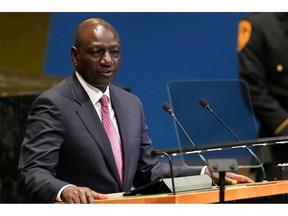
(Bloomberg) — Kenyan President William Ruto ruled out further cuts to fuel taxes, even after deadly protests over the high cost of diesel brought the nation’s capital to a standstill this week.

THIS CONTENT IS RESERVED FOR SUBSCRIBERS ONLY
Subscribe now to read the latest news in your city and across Canada.
- Exclusive articles from Barbara Shecter, Joe O'Connor, Gabriel Friedman, and others.
- Daily content from Financial Times, the world's leading global business publication.
- Unlimited online access to read articles from Financial Post, National Post and 15 news sites across Canada with one account.
- National Post ePaper, an electronic replica of the print edition to view on any device, share and comment on.
- Daily puzzles, including the New York Times Crossword.
SUBSCRIBE TO UNLOCK MORE ARTICLES
Subscribe now to read the latest news in your city and across Canada.
- Exclusive articles from Barbara Shecter, Joe O'Connor, Gabriel Friedman and others.
- Daily content from Financial Times, the world's leading global business publication.
- Unlimited online access to read articles from Financial Post, National Post and 15 news sites across Canada with one account.
- National Post ePaper, an electronic replica of the print edition to view on any device, share and comment on.
- Daily puzzles, including the New York Times Crossword.
REGISTER / SIGN IN TO UNLOCK MORE ARTICLES
Create an account or sign in to continue with your reading experience.
- Access articles from across Canada with one account.
- Share your thoughts and join the conversation in the comments.
- Enjoy additional articles per month.
- Get email updates from your favourite authors.
THIS ARTICLE IS FREE TO READ REGISTER TO UNLOCK.
Create an account or sign in to continue with your reading experience.
- Access articles from across Canada with one account
- Share your thoughts and join the conversation in the comments
- Enjoy additional articles per month
- Get email updates from your favourite authors
Sign In or Create an Account
or
Article content
The East African nation spent 28.2 billion shillings ($217 million) since the start of the US-Israeli war on Iran to keep fuel prices artificially low through subsidies and tax breaks, Ruto told reporters in the port city of Mombasa on Friday. While the authorities will lower diesel prices by 10 shillings per liter next month, there’ll be no more reductions in levies, he said.
Article content
Article content
Article content
“There are those asking government to remove all taxes and levies on fuel immediately, but we must ask ourselves, honestly, if we stop collecting these revenues entirely, what public services shall we stop funding?” Ruto said. “The reality is that no country can completely escape the global oil shock of this magnitude.”
Article content
By signing up you consent to receive the above newsletter from Postmedia Network Inc.
Article content
Kenyan public transport operators staged a two-day strike this week over the high cost of diesel that sparked protests in which at least four people died. Despite the Kenyan authorities’ interventions, diesel costs have jumped 40% and gasoline prices 20% since the start of war in Iran on Feb. 28. The conflict has disrupted shipping through the Strait of Hormuz — a conduit for about a fifth of the world’s oil supply.
Article content
The protests followed similar unrest in Comoros. Last week a transport strike over steep fuel-price increases paralyzed the Indian Ocean archipelago and forced the government to temporarily backtrack.
Article content
Rising fuel prices have intensified pressure on Kenya’s import-dependent economy, which the International Monetary Fund already considers at high risk of debt distress.
Article content
Article content
The public-transport operators called off their strike after meeting the president, Edwin Mukabane, chairman of the Federation of Public Transport Sector, said at the briefing.
Article content
The nationalization of Kenya’s oil imports has ensured security of supply and eased pressure on foreign-exchange demand, Ruto said. The country is also determined to bring into production oil deposits in the north of the country and is working with neighbors to develop a regional refinery, he said.
Article content
That will help Kenya and eastern Africa build “necessary resilience,” Ruto said. The nation is also accelerating investments in renewable energy, modern public transport and energy security infrastructure “so that future generations of Kenyans are less exposed to global fuel instability.”
Article content
Ruto announced that the authorities will allow duty-free imports of the first 100,000 electric vehicles shipped into Kenya. The government has already ordered 3,000 electric vehicles for use by security agencies, he said.
Article content
Banks should also consider temporary relief on loans to public-transport operators, the president said.
Article content
Sign up here for the daily Next Africa newsletter and subscribe to the Next Africa podcast on Apple, Spotify or anywhere you listen.
Article content
 English (US)