
.jpg) 1 hour ago
4
1 hour ago
4
Article content
(Bloomberg) — Iran has reorganized its military to be more aggressive abroad as talks on ending the war with the US remain mired in stalemate, a sign that Tehran is preparing for a protracted era of regional conflict.

THIS CONTENT IS RESERVED FOR SUBSCRIBERS ONLY
Subscribe now to read the latest news in your city and across Canada.
- Exclusive articles from Barbara Shecter, Joe O'Connor, Gabriel Friedman, and others.
- Daily content from Financial Times, the world's leading global business publication.
- Unlimited online access to read articles from Financial Post, National Post and 15 news sites across Canada with one account.
- National Post ePaper, an electronic replica of the print edition to view on any device, share and comment on.
- Daily puzzles, including the New York Times Crossword.
SUBSCRIBE TO UNLOCK MORE ARTICLES
Subscribe now to read the latest news in your city and across Canada.
- Exclusive articles from Barbara Shecter, Joe O'Connor, Gabriel Friedman and others.
- Daily content from Financial Times, the world's leading global business publication.
- Unlimited online access to read articles from Financial Post, National Post and 15 news sites across Canada with one account.
- National Post ePaper, an electronic replica of the print edition to view on any device, share and comment on.
- Daily puzzles, including the New York Times Crossword.
REGISTER / SIGN IN TO UNLOCK MORE ARTICLES
Create an account or sign in to continue with your reading experience.
- Access articles from across Canada with one account.
- Share your thoughts and join the conversation in the comments.
- Enjoy additional articles per month.
- Get email updates from your favourite authors.
THIS ARTICLE IS FREE TO READ REGISTER TO UNLOCK.
Create an account or sign in to continue with your reading experience.
- Access articles from across Canada with one account
- Share your thoughts and join the conversation in the comments
- Enjoy additional articles per month
- Get email updates from your favourite authors
Sign In or Create an Account
or
Article content
A raft of top military appointments by Supreme Leader Mojtaba Khamenei marks a shift to an “offensive doctrine,” Mohammad Reza Naqdi, a general in the Islamic Revolutionary Guard Corps who advises the force’s new commander, said in an interview on state TV late Tuesday.
Article content
Article content
Article content
“Whenever the conditions are favorable and the order is issued, we must be able to take the operation into enemy territory,” he said, contrasting the approach with a pre-war doctrine that was “primarily based on defense and the preservation of the country.”
Article content
By signing up you consent to receive the above newsletter from Postmedia Network Inc.
Article content
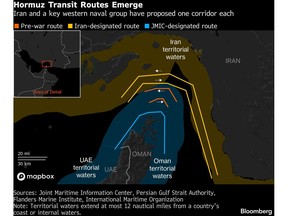
His comments came amid little sign of a breakthrough between Iran and the US over the Strait of Hormuz, with both sides claiming control of the critical waterway and demanding concessions that are unlikely to be met. While hostilities have eased in a war that’s into its sixth month, a durable peace sought by mediators Pakistan and Qatar looks increasingly elusive.
Article content
US President Donald Trump has oscillated for months between threatening to resume attacks on Iran and expressing confidence that talks to end the war are progressing. He claimed “total control over the Hormuz Strait” in comments late Tuesday, an assertion Iran has repeatedly dispelled by attacking ships transiting the passage.
Article content
About a fifth of the world’s oil and liquefied natural gas was transported through the strait before the US and Israel started attacking Iran on Feb. 28. Traffic continues to flow, but at a much lower rate than before the war, with producers using a variety of workarounds to get energy supplies to the global market.
Article content
Article content
Pakistan Defense Minister Khawaja Asif told Bloomberg in Islamabad on Tuesday that the US and Iran are “close to some sort of arrangement,” without giving details.
Article content
On Wednesday, Pakistani Interior Minister Mohsin Naqvi’s office said he had delivered a message from Prime Minister Shehbaz Sharif and army chief Field Marshal Asim Munir to the Iranian leadership. Naqvi is assisting Munir, who is leading the negotiations.
Article content
An interim peace deal was agreed between the sides in June but intermittent clashes and maritime traffic disruptions continue, rendering the accord effectively obsolete. One of the terms was for a 60-day negotiating period, now close to its expiry date. Pakistan Foreign Ministry spokesperson Tahir Andrabi said Wednesday it could be extended.
Article content
“We are definitely at a stalemate,” Wendy Sherman, former US deputy secretary of state, told Bloomberg TV. “Unless the US is ready to either allow Iran and perhaps Oman to have voluntary tolls or to give Iran so much relief from sanctions and frozen assets that it’s worth their while, I don’t think we’ll get it open for any sustainable period of time.”
 English (US)