
.jpg) 1 hour ago
2
1 hour ago
2
Article content
(Bloomberg) — The risk that Iran is covertly pursuing nuclear weapons is higher today than before the US and Israel launched their first military attacks on the Islamic Republic a year ago, according to western officials who cited new data circulated by the United Nations atomic watchdog.

THIS CONTENT IS RESERVED FOR SUBSCRIBERS ONLY
Subscribe now to read the latest news in your city and across Canada.
- Exclusive articles from Barbara Shecter, Joe O'Connor, Gabriel Friedman, and others.
- Daily content from Financial Times, the world's leading global business publication.
- Unlimited online access to read articles from Financial Post, National Post and 15 news sites across Canada with one account.
- National Post ePaper, an electronic replica of the print edition to view on any device, share and comment on.
- Daily puzzles, including the New York Times Crossword.
SUBSCRIBE TO UNLOCK MORE ARTICLES
Subscribe now to read the latest news in your city and across Canada.
- Exclusive articles from Barbara Shecter, Joe O'Connor, Gabriel Friedman and others.
- Daily content from Financial Times, the world's leading global business publication.
- Unlimited online access to read articles from Financial Post, National Post and 15 news sites across Canada with one account.
- National Post ePaper, an electronic replica of the print edition to view on any device, share and comment on.
- Daily puzzles, including the New York Times Crossword.
REGISTER / SIGN IN TO UNLOCK MORE ARTICLES
Create an account or sign in to continue with your reading experience.
- Access articles from across Canada with one account.
- Share your thoughts and join the conversation in the comments.
- Enjoy additional articles per month.
- Get email updates from your favourite authors.
THIS ARTICLE IS FREE TO READ REGISTER TO UNLOCK.
Create an account or sign in to continue with your reading experience.
- Access articles from across Canada with one account
- Share your thoughts and join the conversation in the comments
- Enjoy additional articles per month
- Get email updates from your favourite authors
Sign In or Create an Account
or
Article content
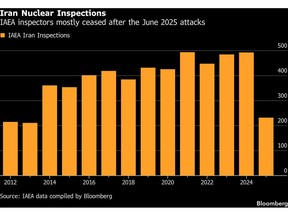
The International Atomic Energy Agency has warned member countries about new nuclear proliferation dangers posed by Iran’s large inventory of near-bomb-grade uranium, according to a restricted document seen by Bloomberg. Before the June 2025 air assault that began a 12-day-war, that material was subject to weekly IAEA inspection to ensure it wasn’t diverted for weapons. That’s no longer the case.
Article content
Article content
Article content
The IAEA’s report underscores how the US-Israeli war on Iran has created new nuclear dilemmas that didn’t previously exist, according to two senior diplomats familiar with the report, who asked not to be identified discussing sensitive data. The longer the material remains outside of IAEA safeguards, the higher the risks grow that the material could be diverted for non-peaceful uses, they said.
Article content
By signing up you consent to receive the above newsletter from Postmedia Network Inc.
Article content
Now, the Agency “can’t draw any conclusion regarding this nuclear material,” reads the 119-page restricted document circulated last month in Vienna. “This gives rise to a proliferation concern as this nuclear material, which the agency was not able to verify, includes a large amount of high- enriched uranium.”
Article content
Eliminating Iran’s nuclear ambitions has been Trump’s key objective, and the IAEA report landed as markets whipsawed over faltering efforts to reach a deal. The warning underscored that even if an extended ceasefire takes hold, the path to a lasting nuclear accord remains long, fraught and vulnerable to breakdown — tempering hopes that diplomacy will quickly stabilize energy flows through the Strait of Hormuz.
Article content
Article content
Inspections plummeted by more than half last year after Iran imposed new restrictions following the 12-day war. Monitors have yet to return to damaged sites in Fordow, Isfahan and Natanz, where Iran’s 440.9 kilograms (972 pounds) and 8,599.6 kilograms of lower enriched material was last seen.
Article content
While the White House maintains Iran’s nuclear program has been obliterated, it’s sought to negotiate access to the uranium. US President Donald Trump has alternately suggested the material could be exported from Iran or domestically rendered inert under IAEA supervision.
Article content
But officials have grown concerned the US administration’s failure to involve the IAEA in the most recent rounds of talks may create new risks and raise unrealistic expectations.
Article content
“We are not a party to this negotiation. We participated until the last round which ended in February,” IAEA Director General Rafael Mariano Grossi told Al Jazeera in an interview on Tuesday. “Something that is not verifiable will lead to a bad agreement.”
Article content
With a key IAEA board meeting set to convene June 8 in the Austrian capital, markets are closely watching for new information about Iran’s nuclear program. The US and Israel attacked Iran, sparking the current war, less than 24 hours after the agency’s Feb. 27 report suggesting activity near bombed nuclear sites. Last June’s strikes followed a day after the IAEA’s board censured Iran over stonewalling its inspectors.
Article content
 English (US)