
.jpg) 1 hour ago
2
1 hour ago
2
Article content
It has been a volatile stretch for United States equities as Wall Street tries to wrap its arms around the war in Iran. But with the fighting now in its third week, investors are becoming more sanguine about the stock market as they see signs emerging that the worst may be over.

THIS CONTENT IS RESERVED FOR SUBSCRIBERS ONLY
Subscribe now to read the latest news in your city and across Canada.
- Exclusive articles from Barbara Shecter, Joe O'Connor, Gabriel Friedman, and others.
- Daily content from Financial Times, the world's leading global business publication.
- Unlimited online access to read articles from Financial Post, National Post and 15 news sites across Canada with one account.
- National Post ePaper, an electronic replica of the print edition to view on any device, share and comment on.
- Daily puzzles, including the New York Times Crossword.
SUBSCRIBE TO UNLOCK MORE ARTICLES
Subscribe now to read the latest news in your city and across Canada.
- Exclusive articles from Barbara Shecter, Joe O'Connor, Gabriel Friedman and others.
- Daily content from Financial Times, the world's leading global business publication.
- Unlimited online access to read articles from Financial Post, National Post and 15 news sites across Canada with one account.
- National Post ePaper, an electronic replica of the print edition to view on any device, share and comment on.
- Daily puzzles, including the New York Times Crossword.
REGISTER / SIGN IN TO UNLOCK MORE ARTICLES
Create an account or sign in to continue with your reading experience.
- Access articles from across Canada with one account.
- Share your thoughts and join the conversation in the comments.
- Enjoy additional articles per month.
- Get email updates from your favourite authors.
THIS ARTICLE IS FREE TO READ REGISTER TO UNLOCK.
Create an account or sign in to continue with your reading experience.
- Access articles from across Canada with one account
- Share your thoughts and join the conversation in the comments
- Enjoy additional articles per month
- Get email updates from your favourite authors
Sign In or Create an Account
or
Article content
Of course, concerns remain. Surging oil prices driven by the shutdown of the Strait of Hormuz threaten to spur inflation, reducing the odds of an interest-rate cut from the U.S. Federal Reserve and raising the chances of an economic slowdown or a recession. Supply chains for various products, from metals and materials to food and pharmaceuticals, are at risk. And then there are the worries about artificial intelligence disruption and private credit exposure that were weighing on sentiment before the war began.
Article content
Article content
Article content
But even as the hostilities show little sign of letting up, investing pros are seemingly learning to roll with the geopolitical uncertainty. The S&P 500 index is up 1.3 per cent this week, its best two-day performance since the U.S. and Israel began their bombing campaign, and is down just 3.8 per cent from its all-time high in January. Meanwhile, options traders have been unwinding some of their bearish bets. And a recent decline in investors’ equity exposure may be a sign that the market is finding a floor.
Article content
By signing up you consent to receive the above newsletter from Postmedia Network Inc.
Article content
“The question is: Why have they not been spooked by it?” said Sam Stovall, chief investment strategist at CFRA, adding that the losses are below the threshold for a pullback. “I think, in many ways, investors are encouraged by the resilience of the market and (it) likely points to a continued improvement in earnings growth estimates as the reason for the underlying support.”
Article content
Article content
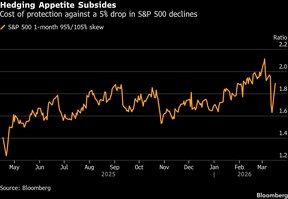
The cost of using options to protect against a five per cent decline in the State Street SPDR S&P 500 ETF, better known by its ticker SPY, relative to a similar rally has been subsiding after hitting the highest level in more than a year earlier this month.
Article content
Article content
A relative sense of calm is apparent in the Cboe Volatility index, or VIX, which traded as high as 35 on March 9, a sign of rising market distress, but has since retreated, closing Tuesday at around 22. Subdued demand for options betting on a jump in the VIX coupled with outflows from long VIX exchange-traded products, point to a lack of panic by investors, according to derivatives strategists at Barclays.
Article content
Article content
Declines in the S&P 500 have been “comparatively modest” despite the volatility, said Noah Weisberger, chief strategist at BCA Research. Steeper losses are still possible, but the amount of time it has taken to get to just a five per cent pullback could be a good sign. Futures on the S&P 500 index were up 0.5 per cent at 7:13 a.m. in New York on Wednesday.
Article content
Should the index suffer a five per cent drop from its recent high by the end of the week it will have taken more than 47 days. Since the Second World War, the S&P 500 has never fallen into a bear market when it has taken more than 40 days to decline five per cent, CFRA data show.
Article content
Time may also be be playing a role in the improving market sentiment.
 English (US)