
.jpg) 1 hour ago
2
1 hour ago
2
We know that AI is transforming modern life in myriad ways – influencing everything from scientific research to student education.
But it's less clear how we're all affected as consumers, with the growing use of these advanced tools in customer service settings, such as retail and healthcare.
A new theoretical paper published in AI & Society argues that spending a lot of time interacting with customer-support AIs could lead us to adopt patterns these robotic agents can more easily process, including mimicking how they communicate.
Ironically, the study authors suggest that as these AI bots are getting more human-like and more difficult to distinguish from real people – at least in a typing-out-messages way – we might be reflecting back other characteristics of the machines we're chatting with, and becoming less like ourselves.
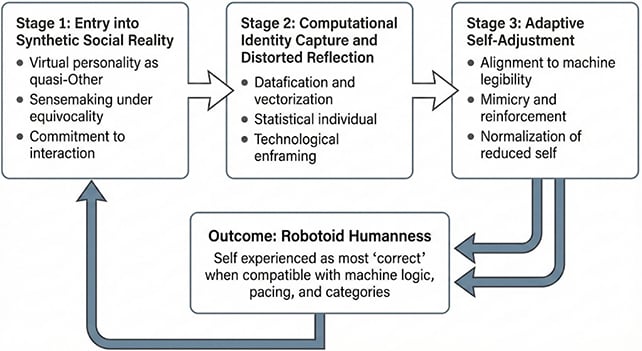 The researchers use the term "robotoid humanness" to describe a proposed way that repeatedly interacting with AI could change our sense of self. (Ozturkcan et al., AI Soc., 2026)
The international team of researchers behind the study theorizes that we make ourselves more 'AI-compatible' through repeated interactions with the technology, limiting our quirks, idiosyncrasies, and unpredictability.
"Social robots for customer service settings are designed to mimic gestures, speech, and emotional cues to elicit cognitive and emotional responses from customers," says Inci Toral-Manson, a marketing researcher at the University of Birmingham in the UK.
"Our research explores how dealing with these anthropomorphized robots can create a bidirectional influence, where robots become more like people, and people become more like robots, which we call 'robotoid humanness'."
The study is entirely theoretical, so there were no tests done on people over time to measure the effects of interactions with AI. However, the team's framework draws on previous studies into human and robot interactions.
At the core of the argument here is that AI has reached a stage where it can do a passable job of providing customer support and holding a natural conversation. Not only that, it can personalize itself to individual users (by remembering what's been said, for example).
That blurs the line between bot and person, and can make the exchange feel more social, or the AIs seem more 'alive' than ever.
 Millions of us are interacting with apps like ChatGPT every day. (Solen Feyissa/Unsplash)
"The consumer acts, the robot responds, and with repeated exposure, in time the consumer internalizes the exchange," says Selcen Ozturkcan, a management engineer at Linnaeus University in Sweden.
"Machine learning and AI can amplify this process, adjusting robot behavior based on user input, enabling more personalized and human-like mimicry from the robot."
The researchers go on to posit that our sense of 'self', and the profile we construct of ourselves as individuals, is influenced by this.

Whereas the feedback from real people that we get to inform our sense of self is often unexpected and uncontrolled from our perspective, with AI robots it's affirming, based on statistics, and algorithm-driven. Their hypothesis is that over time, we may begin to reflect some of the patterns the algorithm rewards.
"For people, the innate instinct to mirror can lead to people returning the robot's communicative behaviors, making them more robot-like," says Ozturkcan.
To put it another way, the AI is designed to respond best to a version of ourselves that has the (human) edges smoothed off. The study proposes that, with repeated encounters, we may implicitly drift toward that identity to get the best responses and advance the conversations.
Clearly, all of this needs to be tested experimentally, but these researchers aren't the first to suggest that AI interactions risk changing our thinking and how we express ourselves as flesh-and-blood people.
The human brain remains distinct from AI in a multitude of ways, and the team behind the study is concerned that AI-mediated services could narrow the range of very human ways people understand and present themselves.
For now, this could prompt us to notice when a helpful tool starts shaping the terms of the conversation.
Related: There's a Hidden Risk of Letting AI 'Discover' New Biology
"Robots and AI are now commonplace in customer service," says Jean-Paul de Cros Peronard, a business development scientist at Aarhus University in Denmark.
"So it is important that we understand how people interact with them for businesses to use the technology at their disposal to best effect, whilst remaining ethical."
The research has been published in AI & Society.
This article was fact-checked by Rebecca Dyer and edited by Rebecca Dyer. While we pride ourselves on our process, we are only human. If you spot a mistake, please let us know.
 English (US)