An AI-generated image illustrating the concept of a geothermal plant drilling into a volcano’s magma chamber.
 An initiative that sounds a lot like Jules Verne‘s Journey to the Center of the Earth could open a new frontier in geothermal energy by deliberately drilling into magma, the molten rock beneath Earth’s surface.
Iceland’s Krafla Magma Testbed (KMT) project aims to establish the world’s first dedicated magma observatory, allowing scientists to investigate molten rock directly while exploring ways to harness the extraordinary heat surrounding it. Initially expected to begin drilling in 2026, the project subsequently set 2027 as a target for its first dedicated superhot geothermal well.
The endeavor could eventually unlock far more energy from geothermal wells than conventional technology allows. But the technology remains experimental, and whether magma-adjacent geothermal energy can be harnessed commercially is still an open question.
And no, this won’t cause the currently active Krafla volcano to erupt.
Harnessing the Earth’s heat
Geothermal energy, a technology harnessed by Iceland for years, involves drilling into hot underground regions to produce steam from heated water. This steam drives turbines, generating electricity.
Today, at least 90% of all homes in Iceland are heated with geothermal energy and 70% of all energy used in the island nation comes from geothermal sources.
However, these systems tap into relatively cooler geothermal energy, yielding lower efficiency. Tapping into the magma chamber’s higher temperatures could significantly boost the energy supply, making it more powerful than conventional wells.
One particularly promising approach involves extracting energy from superhot water under extreme pressure. At temperatures above 374°C (705°F) and pressures exceeding roughly 22 megapascals, water enters a state known as “supercritical,” where the distinction between liquid and gas disappears. Such fluids can carry tremendous amounts of heat, potentially allowing individual wells to deliver substantially more energy than ordinary geothermal wells.
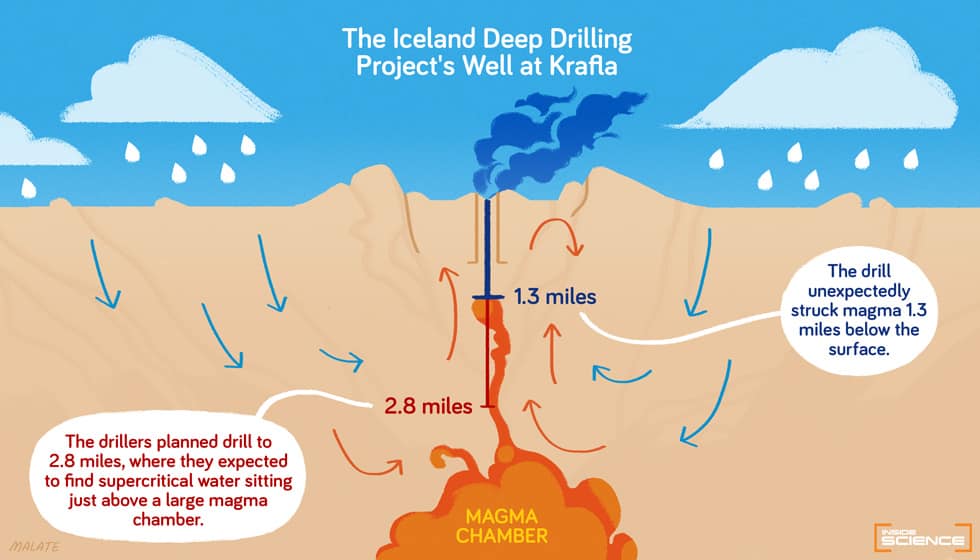
And there is already evidence of that potential. In 2009, the Iceland Deep Drilling Project accidentally encountered magma at Krafla. The resulting well was later tested at more than 100 megawatts of thermal output, according to KMT’s project history. That is an impressive amount of heat.
The larger question is whether engineers can reliably extract that energy for years without destroying the equipment, exhausting the accessible heat too quickly, or driving costs beyond what a power plant could economically justify.
Formidable technical challenges
Krafla stands as one of the world's most active volcanic areas, straddling the Mid-Atlantic Ridge tectonic boundary. It has witnessed numerous eruptions, the latest being in 1984. Despite its volatile nature, Krafla's unique geological position makes it an ideal site for this pioneering geothermal project.
At Krafla, magma has been encountered about 2.1 kilometers (1.3 miles) beneath the surface, with temperatures approaching 900°C (1,650°F) at the point of contact. The relatively shallow depth makes the target accessible by modern drilling standards. The extreme heat makes keeping a functioning well open another matter altogether.
But we know for sure it can be done because in 2009 a nearby Icelandic geothermal plant accidentally drilled into Krafla's magma chamber. The drilling operation had to stop, but researchers recovered valuable material and subsequently demonstrated that exceptionally hot geothermal fluids could be produced from the well.
The encounter also showed that reaching magma doesn't necessarily trigger an eruption. Still, constructing a permanent, instrumented borehole near molten rock poses challenges far beyond a brief accidental encounter.
This wasn't the first time something like this had happened. The first documented case was actually at the Puna Geothermal Venture in Hawaii in 2005. At the time, from the energy companies' point of view, exposing magma rather than hot steam was seen as a failure. That's mighty ironic given how hard volcanologists tried to accomplish the same thing in years past. But later it became apparent even for the energy companies that the economic potential is immense.
KMT is attempting to turn those accidents into a carefully controlled scientific experiment. Its plans involve specialized well materials, improved monitoring systems and technologies capable of surviving extreme temperatures, corrosive fluids and tremendous mechanical stress.
Slow and steady progress
The project has also made progress institutionally. In September 2024, the Icelandic government, national power company Landsvirkjun and Reykjavík Energy joined KMT in a financing agreement covering the following two years. In 2025, the project described plans to drill a dedicated superhot geothermal energy well in 2027, targeting temperatures above 400°C (752°F).
The plan was to have something up and running in 2026. However, as of October 2026, available project information doesn't establish that the new magma-drilling campaign has begun.
If successful, KMT could provide a testing ground for energy technologies that might eventually be used in other volcanic regions. But its immediate purpose is research and technology development, not the construction of a commercial magma-powered electricity plant.
Ultimately, magma chamber drilling will provide an unprecedented opportunity to observe a volcanic eruption from its source. Volcanologists have long relied on indirect methods to study magma. The KMT project will allow scientists to study magma up close through direct sampling for the first time.
As such, Iceland's journey to the magma's heart is not just about energy. The KMT project could revolutionize our understanding of volcanic activity, continental formation, and even geothermal energy. Whether it ultimately transforms electricity generation remains to be seen. For now, the prospect of placing scientific instruments beside molten rock is an extraordinary ambition in its own right.
Updated October 10, 2026: This article was originally published on January 5, 2024. It has been revised as part of our ongoing effort to keep older coverage accurate and useful, incorporating new information about the Krafla Magma Testbed's funding, drilling timetable and technical challenges. We have also clarified the difference between geothermal heat potential and demonstrated electricity generation.