When I last spoke to Citizen Sleeper creator Gareth Damian Martin, it was on the eve of Citizen Sleeper 2's release. Like its predecessor, the game was a critical hit, cemented Damian Martin's reputation as one of the most successful independent game developers around. But they weren't content. They wanted to do more, to push more, to stretch the idea of what a role-playing video game could be.
"I feel a certain responsibility that comes with success," Damian Martin - also known by their studio name Jump Over the Age - told me at the time. "I feel lots of things about this medium, and I feel if I'm in the one percent of indie developers - and the even smaller percent of solo developers - who manage to make something and have that thing be successful, then I have responsibility towards putting things into the industry and into the world that contribute somehow to whatever I think the industry should be doing."
They wanted the definition of RPGs to be "expanded", to make them as varied as "rich and varied" as tabletop RPGs can be. Citizen Sleeper was a step towards realising that goal but even it had limitations, which is why Damian Martin has returned to take things a step further with their next game Signet City. Announced during this year's somewhat samey-feeling Summer Game Fest, it's a startlingly original work.
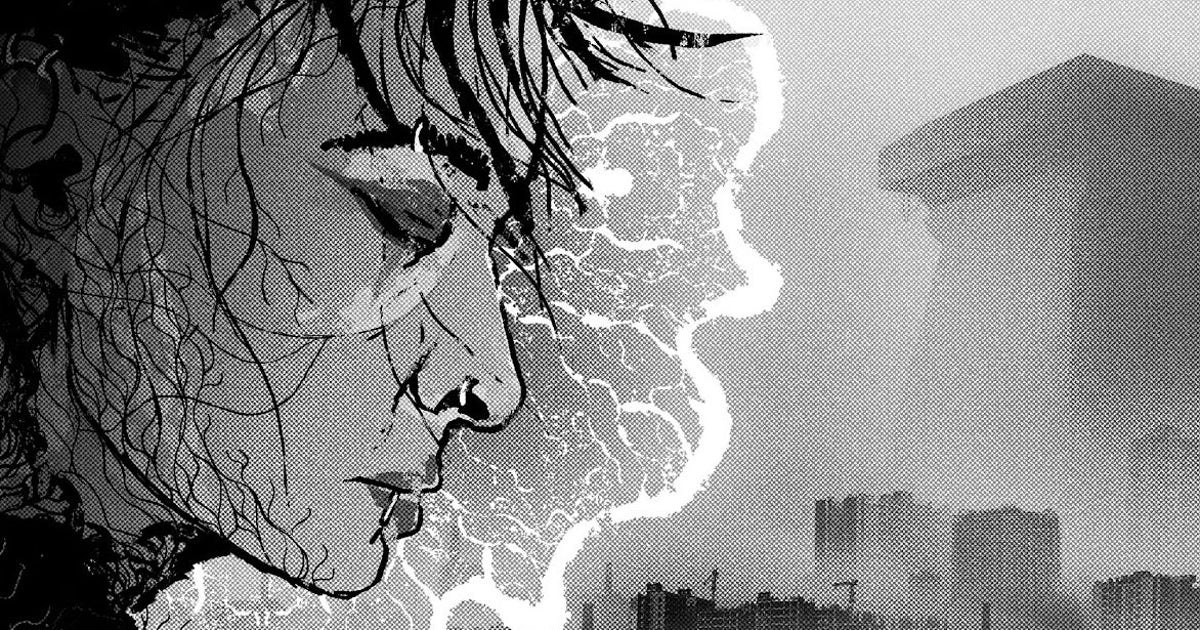
Signet City was enigmatic. Revealed in a cinematic trailer, it was black and white, bleak, thick-lined, smoggy, and dirty; choked in industrial decay and brimming with post-punk non-conformance. It was also first-person, a notable change for Damian Martin, whose games have, up until now, been zoomed out and abstracted. Most eye-catching of all, though, was the descriptor "fungalpunk" - a game in which we'd play as a parasite in someone's mind. As far as expanding the scope of RPGs goes: "100 percent that is exactly what I'm trying to do here," Gareth Damian Martin tells me now.
We talk in a video call in the immediate aftermath of Signet City's announcement - apologies for not writing this until Not-GTA Week, though what an opportunity that presented - and Damian Martin is as calm and eloquent and thoughtful as ever, nestled in a compact office decorated with collages of their current influences. This room looked different when we spoke about Citizen Sleeper 1, looked different when we spoke about Citizen Sleeper 2, and it looks different again now. Damian Martin is a visual person, as someone with a visual design background would be.
With Signet City only just announced, questions abound. The announcement trailer doesn't reveal much (not much has come out since, either), but we do know it takes place in the North of England in the 80s. It's a setting I'm not sure we've ever had in games, and one that's woefully overlooked in entertainment in general, barring BBC TV shows like Our Friends in the North and Boys from the Blackstuff, which Damian Martin directly references. We know there are themes like industrial decay, welded as they are to that time and place. But there's been no talk of how the game plays, or what being a parasite in someone's mind means.
After speaking with Damian Martin, I've got a much better idea. But first, to the beginning. Signet City is an idea they've had floating around their head for a very long time. This was the game they pitched to their publisher Fellow Traveller after Citizen Sleeper 1 came out, but decided to hold in favour of making Citizen Sleeper 2 - a decision driven partly by a desire "to build myself a bigger platform" to launch a new game idea from. The idea originated in a very unexpected place: the musician Sting. Damian Martin was doing theatre design for Sting's musical show The Last Ship before they became a full-time game-maker (go back even further in Damian Martin's life and you'll find a degree in puppetry there). They had to research Newcastle in the 1980s because of it. The Last Ship is about Sting's upbringing in Wallsend, a town near Newcastle, in the wake of a shipyard being closed there - the town's source of sustenance. And it was while working on the project that the 80s imprinted on Damian Martin's mind.
"I was looking at these pictures of these massive gleaming ships hanging over the top of little terraced houses" -Gareth Damian Martin"I was looking at these pictures of these massive gleaming ships hanging over the top of little terraced houses," they say, "and this conflict between time periods and ideas of society, and I remember thinking at the time: that was science-fiction somehow. When you look at those images, it could be a spaceship; that ship that's being built in Newcastle might as well be a spaceship, especially science-fiction of the 80s - a lot of it was about that.
"It just stuck in my brain and I started to work up this fictional 1980s British city that would be in that period of de-industrialisation and social change," they continue. "But would be based on a completely different kind of industrial background and have this weird kind of fungalpunk technology layered into it. So that's been sitting around in my head for almost 10 years slowly accruing material and reference points and things."
Fungalpunk: there's that word again, but what does it mean? I've heard of cyberpunk and steampunk, not that I could tell you easily what they mean, but I've never heard of fungapunk - I don't think anyone has. Thankfully, in this case, it's fairly literal. "You are fungal in a very true sense," Damian Martin says. You are a fungal parasite and there are themes of decay and reinvigoration, things fungi are closely tied to. One of the phrases Damian Martin has been using as a north star for the project - something they do on all of their projects - is the idea of being "a fungal superhero", which makes me giggle. I've definitely not heard that before either.
It's an idea inspired by a 1989 Japanese film called Tetsuo: The Iron Man - about a salary man who's slowly turning into metal - that Damian Martin adores. "I love it so much," they say. "It's an amazing movie, a beautiful movie, and really strange. And so I wanted to do something that was in that vibe. The way that that film commits to the idea of a body becoming metal and the visceral kind of strangeness of that. I wanted to do something that was about humans and becoming fungal; which we already are, we already have lots of bits of bacteria and fungal nail infections - we are multitudes."
"Post-punk was this engagement with structural politics and transgressive fiction and all kinds of interesting big ideas getting into pop culture through music"The punk side of the equation is, again, fairly literal. It refers to the post-punk cultural and musical scene at the time. The scene is often overshadowed by the brasher, more aggressive punk movement, but it's one that's just as anti-establishment, albeit in perhaps in a deeper, darker, more nihilistic way. Think Joy Division referencing novelist JG Ballard in its songs, for example. "Post-punk was this engagement with structural politics and transgressive fiction and all kinds of interesting big ideas getting into pop culture through music," Damian Martin says.
Now watch the game's trailer again; you can feel all these things oozing through it. The aesthetic, the music, the setting. There are also big clues - although they're not obvious - about how the game plays. We see the start of a character called Sid's story in the trailer, who's one of the hosts we can inhabit in the game. We choose an area of the city we want to play in, then drop into a person's head who lives or operates there. And in Sid's case, she wakes up in a river just as we - the parasite - wake in her mind. Twins!
We control Sid as we would a character in another first-person game - Dishonored or Skyrim are two examples Damian Martin uses - and we see a bit of this in the trailer. What we don't see are any other mechanics, which are, once more, dice rolls related to skills, as in Citizen Sleeper. In order to do something in the world that isn't insignificantly easy, we need to roll a dice and add modifiers to see if we can achieve it.
"So the way it works is you drop into someone's head for the day. Let's say we drop into this worker's head for the day and we want to get to a certain part of the city, and let's say we need to kick down a door to get there," says Damian Martin. "Well, we're going to have to make this character really angry to get them to kick down that door, so we're going to maybe get them in an argument with some other fellow workers, and maybe we're going to choose to provoke that argument and then they'll get really angry. Then that will have narrative effects, but also it will have mechanical effects in the sense of, like, okay, now we have a modifier that makes physical strength more powerful, so we can do these physical strength actions."
"So the way it works is you drop into someone's head for the day..."Skills are tied to a person's emotions, intriguingly, and your job as the parasite is to find things that affect these emotions so you can amplify them and increase your chances of achieving things. Then at the end of the day, all of that emotion gets "extracted out" and becomes a resource you can permanently improve your host's skills with. "So you start to adjust each of your hosts in a direction you think will be helpful for you to do what you need each day in these hub locations," Damian Martin explains. But this has consequences. Push someone towards angry actions and they'll become a more angry person, understandably. "And that will shape their future even when you're no longer controlling them."
Which begs the question: what exactly does a parasite need to do? What is a parasite's objective in the game? This is an answer Damian Martin isn't quite ready to give, though they do their best to attempt it. "You have your own objectives as a parasite," they say. "You don't have an objective like: this is your mission, parasite. But there are some bigger offers coming to you through your sensorium, through your experience of voices and attractions and tastes and smells, that are leading you in different places as a parasite. That's your objective, to grow and gain power, although to what end you don't initially know."
It's in this parasitical difference Signet City starts to stand apart. For starters, it's just appealing weird to be a parasite, though as Damian Martin muses, aren't we often parasites in relation to characters in tabletop role-playing games? "We push them around; sometimes we talk for them and sometimes we listen to them; sometimes we use our name and sometimes we use their name." Here, it's simply out in the open. "I wanted to create an RPG where I acknowledged and then also played that into the fiction," they say.
Being in a thing in someone's mind allows a host character autonomy, to a degree, so they can have their own motivations and stories and struggles besides yours. They don't have to be thoughtless mannequins awaiting our direction. Dropping into their minds allows us to drop straight into a tense scenario. "Stories for me that are very exciting in fiction and literature are stories about people who are in it," Damian Martin says. "They're in the situation already, they're in the shit, they're having to deal with everything."
"What does it feel like to be a parasite and how do I make that comprehensible to a human?"The ability to read their minds also lets us know them more intimately than we know characters in other games, who usually, you know, need to speak to us in order for us to understand them. It also circumvents the need for an NPC to suddenly and unnaturally open up to you about their lives, the first moment they meet you, and to provide you with "a neatly packaged challenge". That's not needed here. "The core relationships of the game are actually between you and your hosts," Damian Martin says.
There's a layer that exists on top of the character's thoughts where the parasite lives and functions - a layer of feelings and emotions and sensory reactions to a world outside. A hopefully quite bizarre and alien layer, which presents challenges of its own, because how do you describe the experiences of a parasite in someone's mind? "What does it feel like to be a parasite and how do I make that comprehensible to a human?" Damian Martin wonders. They are good questions I can't wait to experience the answers to.
But when will that be? There's no release date yet, and when we talked in the summer, Signet City was only halfway through development. It was announced early partly to make sure people understood it wasn't Citizen Sleeper 3, and partly because people could probably use some time to sit with the idea for a bit and digest it. "We can't just drop it all on everyone's heads," Damian Martin says, "because I think the potential for it being misunderstood or just ignored is high."
And that's a telling admission for a project which has been characterised by Damian Martin multiple times as a risk - as even "the biggest swing I have ever taken". They seemed genuinely nervous about announcing it, though some of those nerves were subsiding by the time we talked. They're not entirely gone, mind you. There's a lingering awareness that Signet City is new and different enough that people might not gel with it, though that's the price of pushing at boundaries, I suppose.
"What worries me more is have I still got it?""What worries me more," Damian Martin says, "is have I still got it? Am I able to produce things that are appealing and exciting to people just based on my own tastes and obsessions and interests? When it comes to announcing something like Signet City, that's what makes me really nervous - more than industry, more than money, more than anything. Is this actually interesting?"
Of course, it's easy for me to say they shouldn't worry. It's exciting when a game blares as loudly and uniquely as Signet City did during Summer Game Fest, though that is obviously no guarantee it'll find an audience. But I think it will. I'm convinced there are more people like me who it will appeal to. Gareth Damian Martin is betting on it. "I'm betting on the sickos," they say. "The thing I've learned is that my obsessions are sticky and they stick to other people, and I think there's something in art where we really like to be tourists in other people's obsessions - that's a fun place to be. That's what I'm hoping for."