
.jpg) 1 hour ago
3
1 hour ago
3
Article content

Article content
Even though the IPO market hasn’t been as robust as in the U.S., more companies are coming to the market or are contemplating to do so, which has been “great to see,” said Jackie Nixon, who heads the Canadian Equity Capital Markets division at the Royal Bank of Canada.
Article content
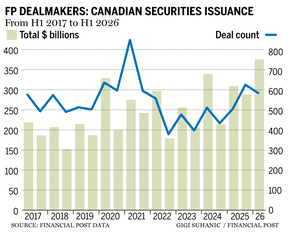
On the whole, businesses have been relying more on equity to raise capital compared to recent years. The amount of capital raised through share sales in the first half of 2026 increased 46.8 per cent to $17.86 billion, compared to $12.16 billion in the first half of 2025.
Article content
The increase in equity issuance also signals more activity compared to the glut between 2022 and 2024 following the peak of 2021.
Article content
In 2021, businesses raised $58.1 billion through 861 deals in the equities space, according to FP Data, but it subsequently declined to $20.5 billion in 432 deals in 2022, $19.7 billion in 334 deals in 2023 and $18.4 billion in 300 deals in 2024.
Article content
Back then, some analysts said the uncertainty in the economy and the poor performances of companies after their IPOs during the pandemic impacted the stock price of issuers, which made them less likely to want to issue shares.
Article content
Article content
Now, thematic tailwinds have been driving performance, Nixon said. For example, the current geopolitical scenario and Prime Minister Mark Carney’s focus on critical minerals and defence has led to more activity in those sectors.
Article content
Of the 239 deals in the equities space, 154 were related to the materials sector, according to FP Data. These companies raised about $7.8 billion, nearly half the equity total of $17.9 billion.
Article content
Looking ahead, Nixon said there’s a “growing pipeline of companies across sectors” hoping to come to the market in the second half of the year. Some Canadian companies are also contemplating adding a U.S. listing, she said. MDA Space Ltd did something similar in March this year when the TSX-listed company launched an IPO in the U.S.
Article content
The total amount of debt raised by corporate companies also increased to $178.9 billion through 171 deals in the first half of 2026 from $151.7 billion raised during the same time last year.
Article content
Decision-makers in the debt space were a little bit more selective at the start of the year, but there was a pickup in activity in the last few months of the first half of 2026, which stabilized the overall numbers, Peter Wiazowski, a corporate finance lawyer and partner at law firm Norton Rose Fulbright Canada LLP, said.
Article content
Article content
“There were some periods where making decisions on opportunistic refinancings led people to go a little slower in order to see how the rate environment settles out,” he said. “We had some months, for example, of almost no new corporate issuance and then over the last couple of months, things have sort of come to a sort of a stability.”
Article content
Article content
Patrick MacDonald, co-head of Canadian debt capital markets at RBC, said issuers accessed the market during windows of stability and investor appetite kept pace.
Article content
The highlight of the year, he said, has been so-called maple bonds, or money raised in Canada by foreign companies.
Article content
Amazon.com Inc.’s $14-billion offering and Alphabet Inc.’s $8.5-billion deal rank as the first and second largest corporate bond transactions in Canadian market history, MacDonald said.
Article content
So far, there has been $35.8-billion worth of maple bonds issued by 15 companies, which is already more than twice the 15.8 billion raised in 2025, he said.
Article content
Overall, the strong performance of Canadian capital markets has taken place despite the uncertainty related to the trade tensions with the U.S., global geopolitical concerns and a stuttering economy.
 English (US)