
.jpg) 2 hours ago
3
2 hours ago
3
Article content
(Bloomberg) — Just when it looked like emerging-market bonds would catch a break from falling energy prices, along came Federal Reserve Chairman Kevin Warsh to spoil the party.

THIS CONTENT IS RESERVED FOR SUBSCRIBERS ONLY
Subscribe now to read the latest news in your city and across Canada.
- Exclusive articles from Barbara Shecter, Joe O'Connor, Gabriel Friedman, and others.
- Daily content from Financial Times, the world's leading global business publication.
- Unlimited online access to read articles from Financial Post, National Post and 15 news sites across Canada with one account.
- National Post ePaper, an electronic replica of the print edition to view on any device, share and comment on.
- Daily puzzles, including the New York Times Crossword.
SUBSCRIBE TO UNLOCK MORE ARTICLES
Subscribe now to read the latest news in your city and across Canada.
- Exclusive articles from Barbara Shecter, Joe O'Connor, Gabriel Friedman and others.
- Daily content from Financial Times, the world's leading global business publication.
- Unlimited online access to read articles from Financial Post, National Post and 15 news sites across Canada with one account.
- National Post ePaper, an electronic replica of the print edition to view on any device, share and comment on.
- Daily puzzles, including the New York Times Crossword.
REGISTER / SIGN IN TO UNLOCK MORE ARTICLES
Create an account or sign in to continue with your reading experience.
- Access articles from across Canada with one account.
- Share your thoughts and join the conversation in the comments.
- Enjoy additional articles per month.
- Get email updates from your favourite authors.
THIS ARTICLE IS FREE TO READ REGISTER TO UNLOCK.
Create an account or sign in to continue with your reading experience.
- Access articles from across Canada with one account
- Share your thoughts and join the conversation in the comments
- Enjoy additional articles per month
- Get email updates from your favourite authors
Sign In or Create an Account
or
Article content
Warsh’s hawkish pivot at the Fed’s meeting this month cut short a rally in developing-nation debt, limiting the drop in yields fueled by Iran peace talks to much smaller moves than after the April 8 ceasefire.
Article content
Article content
Article content
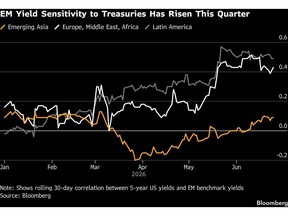
Now, the key risk for the securities has shifted to the US central bank, instead of the oil market, say top Wall Street banks including Citigroup Inc. and Goldman Sachs Group Inc. That’s reinforced by a rising correlation between Treasury yields and emerging-market ones.
Article content
By signing up you consent to receive the above newsletter from Postmedia Network Inc.
Article content
“The path for US interest rates has been repriced much higher,” said Philip Fielding, a portfolio manager at Fidelity International in London. “This has led to broad-based US dollar strength, creating an obvious headwind for dollar-funded emerging-market local currency positions.”
Article content
A hawkish Fed leading to a broad tightening in financing conditions would affect countries relying more heavily on foreign capital inflows, such as Turkey and Colombia, Fielding said.
Article content
Warsh’s comments at his first policy meeting as Fed chair that the central bank won’t tolerate high inflation sent Treasury yields and the dollar higher. The greenback is now on track for its best monthly performance in a year, while the US five-year yield remains more than 60 basis points above where it stood before the Iran conflict began.
Article content
Article content
“Close on the heels of the signing of a US-Iran agreement to end the war, EM local rates are now fighting a new adversary – a hawkish Fed,” writes Goldman Sachs strategists including Kamakshya Trivedi and Danny Suwanapruti in a note on June 18.
Article content
The US-Iran peace agreement this month removed one of the biggest headwinds for developing economies by pushing crude prices lower, easing inflation pressures and giving emerging-market central banks more flexibility over monetary policy. That’s generally positive for developing-nation bonds, as slower inflation raises the prospect of future rate cuts, boosting the prices of existing debt while improving the outlook for many oil-importing economies.
Article content
But the stronger dollar is making emerging-market central banks more cautious about signaling policy easing, limiting the scope for local-currency bonds to extend their gains.
Article content
“The baton of risk factors will only get passed from oil to Fed and El Nino,” Citigroup strategists including Luis Costa wrote in a note published June 18. “Central banks are likely to remain cautious in signaling all clear which could keep risk premia elevated in EM local currency.”
 English (US)