
.jpg) 1 hour ago
3
1 hour ago
3
Article content
(Bloomberg) — Gulf Arab states are facing tough choices in the coming hours and days including the possibility of going to war with Iran, with the Islamic Republic intensifying its attacks on US allies across the region.

THIS CONTENT IS RESERVED FOR SUBSCRIBERS ONLY
Subscribe now to read the latest news in your city and across Canada.
- Exclusive articles from Barbara Shecter, Joe O'Connor, Gabriel Friedman, and others.
- Daily content from Financial Times, the world's leading global business publication.
- Unlimited online access to read articles from Financial Post, National Post and 15 news sites across Canada with one account.
- National Post ePaper, an electronic replica of the print edition to view on any device, share and comment on.
- Daily puzzles, including the New York Times Crossword.
SUBSCRIBE TO UNLOCK MORE ARTICLES
Subscribe now to read the latest news in your city and across Canada.
- Exclusive articles from Barbara Shecter, Joe O'Connor, Gabriel Friedman and others.
- Daily content from Financial Times, the world's leading global business publication.
- Unlimited online access to read articles from Financial Post, National Post and 15 news sites across Canada with one account.
- National Post ePaper, an electronic replica of the print edition to view on any device, share and comment on.
- Daily puzzles, including the New York Times Crossword.
REGISTER / SIGN IN TO UNLOCK MORE ARTICLES
Create an account or sign in to continue with your reading experience.
- Access articles from across Canada with one account.
- Share your thoughts and join the conversation in the comments.
- Enjoy additional articles per month.
- Get email updates from your favourite authors.
THIS ARTICLE IS FREE TO READ REGISTER TO UNLOCK.
Create an account or sign in to continue with your reading experience.
- Access articles from across Canada with one account
- Share your thoughts and join the conversation in the comments
- Enjoy additional articles per month
- Get email updates from your favourite authors
Sign In or Create an Account
or
Article content
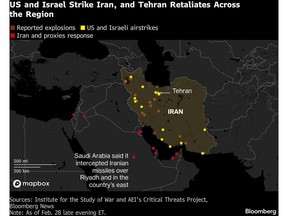
Iran has launched waves of missiles across the Middle East since the start of US-Israeli attacks on Saturday, saying the primary targets are American military bases. That’s meant strikes on wealthy Gulf nations that are not just global financial hubs and major energy exporters, but hosts to US forces.
Article content
Article content
Article content
Saudi Arabia and the United Arab Emirates have both criticized Tehran over the attacks, but with blasts impacting Dubai’s airport — the world’s busiest — and landmarks such as the iconic Palm Jumeirah Island they face mounting pressure to respond more forcefully.
Article content
By signing up you consent to receive the above newsletter from Postmedia Network Inc.
Article content
Those countries, as well as Qatar, have spent the past year mediating to avoid a war because they built their reputations as investment, tourism and expatriate destinations on their ability to remain peaceful in a volatile region. The UAE and Qatar are now privately lobbying allies to help them persuade Trump to reach for an off-ramp, according to people familiar with the matter.
Article content
“Entering the war as military parties is a serious escalation that comes with huge costs,” said Sanam Vakil, director of the Middle East and North Africa program at the London-based Chatham House.
Article content
“They may not have a choice if Iran continues to widen its attacks on them,” she said. “We will know where they stand in the next 24 to 48 hours.”
Article content
A suspected Iranian drone attack halted operations at Saudi Arabia’s largest refinery on Monday, while QatarEnergy ceased liquefied natural gas production at the world’s largest export facility after military attacks. Explosions have been heard in Bahrain, Kuwait, Qatar and the UAE, most likely caused by defense systems intercepting missiles launched by Tehran. Iran attacked an Omani port on Sunday, a move Qatar described as “cowardly.”
Article content
Article content
Iran appears to be widening the scope of its attacks to vital energy infrastructure, ports and airports. Debris from intercepted Iranian missiles has hit residential and tourist areas in several Gulf capitals, resulting in a number of fatalities and material damage.
Article content
“I didn’t expect they would escalate this fast,” said Maha Yahya, director of the Beirut-based Malcolm H. Kerr Carnegie Middle East Center, referring to Iran’s attacks on Gulf states. “They felt it’s now or never, this is an existential war so let’s turn it into a regional conflict.”
Article content
The UAE closed its embassy in Tehran and summoned Iran’s ambassador to Abu Dhabi to convey its “condemnation in the strongest terms of Iran’s terrorist attacks and assaults,” according to a statement issued by the foreign ministry.
Article content
On Monday, the UAE’s ministry of defense said Iran has launched 174 ballistic missiles, eight cruise missiles and nearly 700 drones toward its territories since Saturday. It said the vast majority have been intercepted and destroyed by its air defenses and fighter jets. Qatar said it has shot down two aircraft from Iran.
 English (US)