
.jpg) 1 hour ago
3
1 hour ago
3
Article content
(Bloomberg) — The fate of the global economy hinges on the conflict in the Middle East that has already stifled growth and could yet trigger recessions and significantly stronger inflation, the OECD said.

THIS CONTENT IS RESERVED FOR SUBSCRIBERS ONLY
Subscribe now to read the latest news in your city and across Canada.
- Exclusive articles from Barbara Shecter, Joe O'Connor, Gabriel Friedman, and others.
- Daily content from Financial Times, the world's leading global business publication.
- Unlimited online access to read articles from Financial Post, National Post and 15 news sites across Canada with one account.
- National Post ePaper, an electronic replica of the print edition to view on any device, share and comment on.
- Daily puzzles, including the New York Times Crossword.
SUBSCRIBE TO UNLOCK MORE ARTICLES
Subscribe now to read the latest news in your city and across Canada.
- Exclusive articles from Barbara Shecter, Joe O'Connor, Gabriel Friedman and others.
- Daily content from Financial Times, the world's leading global business publication.
- Unlimited online access to read articles from Financial Post, National Post and 15 news sites across Canada with one account.
- National Post ePaper, an electronic replica of the print edition to view on any device, share and comment on.
- Daily puzzles, including the New York Times Crossword.
REGISTER / SIGN IN TO UNLOCK MORE ARTICLES
Create an account or sign in to continue with your reading experience.
- Access articles from across Canada with one account.
- Share your thoughts and join the conversation in the comments.
- Enjoy additional articles per month.
- Get email updates from your favourite authors.
THIS ARTICLE IS FREE TO READ REGISTER TO UNLOCK.
Create an account or sign in to continue with your reading experience.
- Access articles from across Canada with one account
- Share your thoughts and join the conversation in the comments
- Enjoy additional articles per month
- Get email updates from your favourite authors
Sign In or Create an Account
or
Article content
Price pressures and weakened demand are set to be felt for some time, and may even worsen beyond a potential reopening of the Strait of Hormuz, the Paris-based organization said in its latest economic outlook.
Article content
Article content
Article content
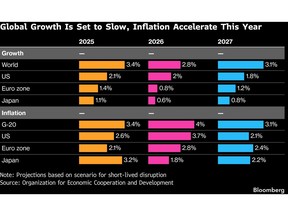
Even in a scenario of time-limited disruption, the organization revised up its inflation estimates for 2027 and only slightly tweaked already feeble growth projections it announced in March.
Article content
By signing up you consent to receive the above newsletter from Postmedia Network Inc.
Article content
It also presented a bleaker scenario of prolonged confrontation and economic fallout that would trigger the deepest global slowdown for 40 years, outside of the Covid pandemic and the 2009 financial crisis. The world’s inflation would be 0.4 percentage point higher this year and 1.3 points in 2027.
Article content
“The conflict in the Middle East has become the dominant force shaping the global economic outlook,” Chief Economist Stefano Scarpetta said. “The global economy is now again under pressure.”
Article content
The latest assessment from the club of advanced economies is a stark warning of what’s at stake for other countries the world over if the US and Iran can’t find a path to deescalation. Predicting the extent to which that is possible is hazardous, as optimism on a deal on opening Hormuz is repeatedly punctuated by renewed threats of attacks and diplomatic setbacks.
Article content
Should disruptions persist into 2027, global growth would slip to 1.8%, tipping some economies into or close to recession, driving up unemployment, weakening investment — including in artificial intelligence — and increasing the risk of repricing on financial markets, the OECD said.
Article content
Article content
The severity of the fallout and the potential for exacerbation will make policy decisions particularly difficult.
Article content
Fiscal expansions will likely shoulder most of the burden, according to the OECD, but governments have little space to intervene due to elevated public debt. It also warned that the broad support many states have already provided has undesirable effects of encouraging energy consumption in a supply crunch.
Article content
Meanwhile, central banks face challenges weighing the need for tighter policy to rein in inflation while avoiding unnecessary economic harm. In the OECD’s milder scenario, it expects some interest-rate increases followed by cuts in 2027 as price pressures retreat.
Article content
But the picture becomes more complex if the disruption is prolonged and inflation reaches the more acute projections. The OECD expects policy rates would then likely rise by 50 to 75 basis points in most countries, only to be reduced again in 2027 as the drag on growth intensifies.
Article content
If there is severe tightening of market conditions, the organization said central banks may have to reconsider further reductions in holdings of sovereign bonds acquired in past crises and even reboot quantitative easing or — in the case of the ECB — long-term refinancing operations.
Article content
“Central banks can look through the supply-driven rise in prices as long as inflation expectations remain well anchored and second-round effects are contained,” Scarpetta said. “However, a policy response may become necessary if price pressures broaden, or if growth weakens significantly.”
Article content
 English (US)