
.jpg) 4 hours ago
4
4 hours ago
4
Unicorns, Bigfoot, and banshees have been scientifically debunked, but ghosts are real – kind of.
The exceptionally elusive neutrinos and their counterpart antineutrinos are known as ghost particles because they almost never interact with matter, due to their lack of electric charge and near-nonexistent mass.
Yet these phantasmal fundamental particles can help improve nuclear safeguards by providing a non-intrusive way to examine the goings-on inside nuclear reactors – including the spectral flux of antineutrinos after a power plant has been switched off.
In a recent breakthrough, physicists measured this residual emission for the first time, detecting the dim, eerie glow of electron antineutrinos emanating from the darkness of slumbering nuclear reactor cores in France.
Led by physicists from the Max Planck Institute for Nuclear Physics (MPIK), researchers from the Double Chooz Collaboration have experimentally validated this predicted flux, emanating from burnt fuel inside two reactors as well as the removed waste material placed in cooling pools. This flux has been theoretically constrained but never measured.
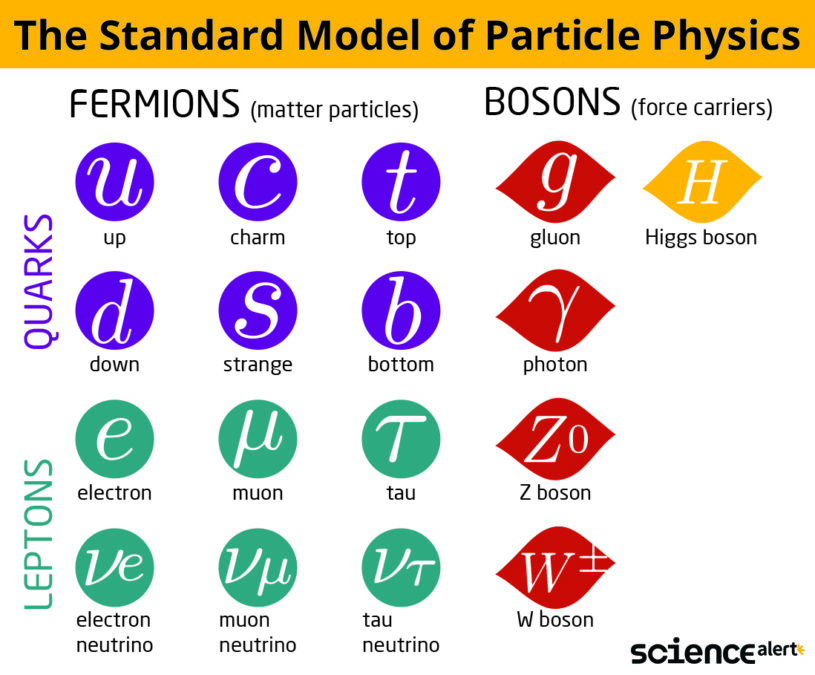 The Standard Model that describes the fundamental make-up of the Universe and its myriad particles. (ScienceAlert)
"Until now, reactor antineutrino experiments have mainly focused on operating reactors, where the antineutrino flux is much larger," says Anthony Onillon, a physicist at MPIK and one of the study's co-leaders.
"Detecting the tiny residual signal after shutdown required exceptionally low backgrounds and careful analysis techniques developed by the Double Chooz collaboration over many years."
The Double Chooz experiment operated from 2011 to 2017, exploring the unimaginably immense amount of antineutrinos produced at the Chooz Nuclear Power Station in northern France.
 An illustration of the site of the experiment, detailing the reactors and the detectors. (Double Chooz Collaboration)
Double Chooz utilized two underground detectors at average distances of 400 meters (1,300 feet) and 1,050 meters (3,400 feet) from the power station's two operating reactors to study a weird property incomprehensible in the macroscopic world.
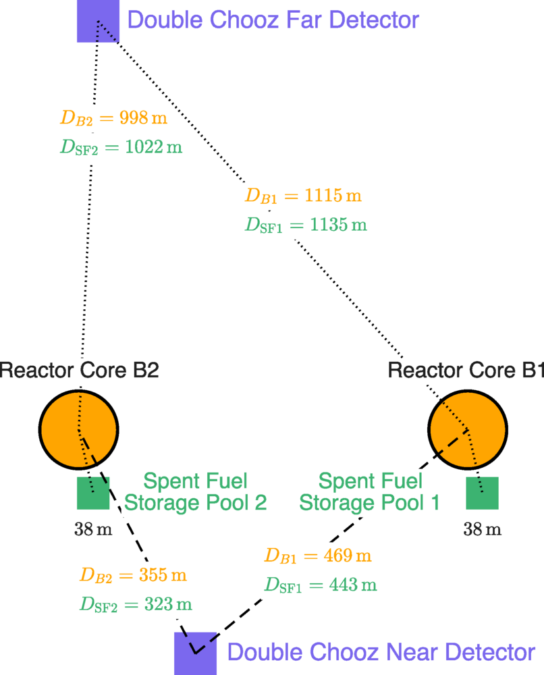 A schematic illustration showing the Double Chooz setup. (Abrahão et al., Physical Review Letters, 2026)
Neutrinos and antineutrinos change their flavor, or their type, as they travel, through a process called oscillation.
It's like buying chocolate ice cream and having it morph into vanilla and then into strawberry as it goes from store, to home, to bowl, Fermilab physicists explain, inventing Quantum Neapolitan in the process.
But physicists can't actually 'see' antineutrinos; they can only tease out their existence based on their interaction with other particles within delicately designed detectors.
"Antineutrinos interact only extremely rarely with matter," explains Thierry Lasserre, a physicist at MPIK.
"However, when one interacts within the Double Chooz detector, a characteristic double-light signal is produced that can be distinguished from background events."
For another food-based analogy, picture a collision between a truck full of Mentos and one full of cola, creating a telltale fountain of fizz.
When a neutrino or antineutrino passes through the Double Chooz detector, it sometimes smashes into a proton within the "liquid scintillator" in the detectors' inner chamber.
This collision generates a neutron and a positron, the antimatter counterpart of an electron. The positron instantly annihilates with a surrounding electron, generating a flash of light facilitated by the scintillator.
The neutron is captured by gadolinium, a silvery, rare-earth metal element within the scintillator, producing a second flash of light to offer 'two-factor authentication' of the antineutrino event.
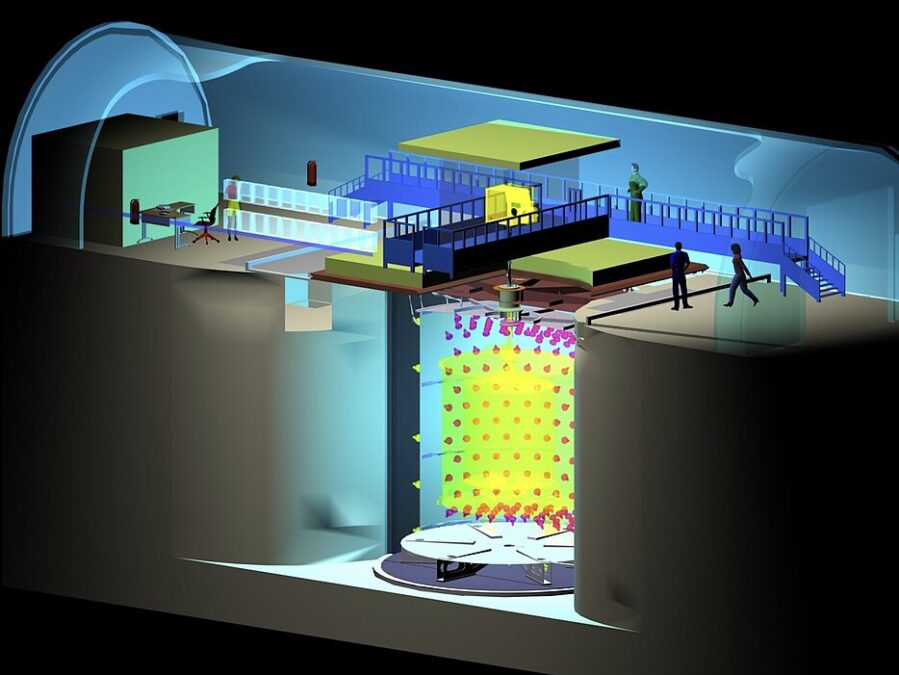 An illustration of a Double Chooz detector. (Double Chooz Collaboration)
This event is called inverse beta-decay (IBD), and it happens a lot in reactors during the fission of elements like uranium and plutonium. It represents the biggest source of human-made antineutrinos, and tracking this flux can prove invaluable to informing nuclear safety and perhaps analyzing the shifting composition of these fuel materials.
In the study, the researchers observed an excess of IBD events across the energy range where the desired residual emission signal is likely to peak.

During 17.2 days of observation during which both Chooz reactor cores were switched off, the researchers found a "very good agreement" between the measured and expected antineutrino events – specifically, 106 ±18 measured events compared with 88 ±7 predicted events. This may represent less than 1% of the flux signal during reactor core operation.
Related: All Those Nuclear Tests Decades Ago Have Revealed Something New About Our Planet's Core
The precision of this technique can still be improved. It's sensitive to large changes in flux but maybe couldn't tell if, say, a few spent fuel assemblies had gone missing, the researchers note.
Yet overall, this work serves as an invaluable proof-of-concept for direct, non-intrusive nuclear testing, to potentially inform future nuclear safeguard standards.
This research was published in Physical Review Letters.
This article was fact-checked by Fiona MacDonald and edited by Fiona MacDonald. While we pride ourselves on our process, we are only human. If you spot a mistake, please let us know.
 English (US)