
.jpg) 2 hours ago
3
2 hours ago
3
We all dread getting trapped in a conversation with that neighbor who won't shut up about his gym routine – but a new study suggests we don't actually hate it as much as we assume we will.
In a series of experiments, pairs of people chatted about a variety of given topics. Before each conversation, they were asked to rank how interesting or boring they expected it to be, then afterward they reported how much they actually enjoyed the chat.
Surprisingly, it turns out you might be more invested in your coworker's cat than you realized. Participants consistently reported that they enjoyed the interactions more than they assumed they would, even for topics they thought would be a snoozefest.
They were also often surprisingly willing to have another chat with the same person about the same subject in the future.
"We tend to assume that if a topic sounds dull, the conversation will be dull too," says University of Michigan social scientist Elizabeth Trinh, co-lead author of the research. "But that's not what people actually experience."
In their study of 1,800 participants, Trinh and colleagues at Cornell University in the US and INSEAD business school in France ran nine different versions of the same basic experiment, to help check a few variables.
In the first, participants were asked to rank how interested they were in 10 topics, including sport, movies, social media, AI, music, travel, history, sustainability, books, and fitness. People were then paired up for a 5-minute chat, with one person having ranked the topic interesting and the other believing it boring.
Predicted and actual enjoyment of the conversation was recorded for each participant, taken before and after the chat respectively.
Unsurprisingly, people who were interested in a topic enjoyed shooting the breeze about as much as they expected to in advance. But intriguingly, those who weren't into the subject still had a good time, and said they'd be happy to talk again.
Okay, so maybe the person interested in the topic knows how to make the topic engaging for the other person? To check for that, the researchers next ran versions of the experiment where both participants thought the topic was boring – and the effect still held.
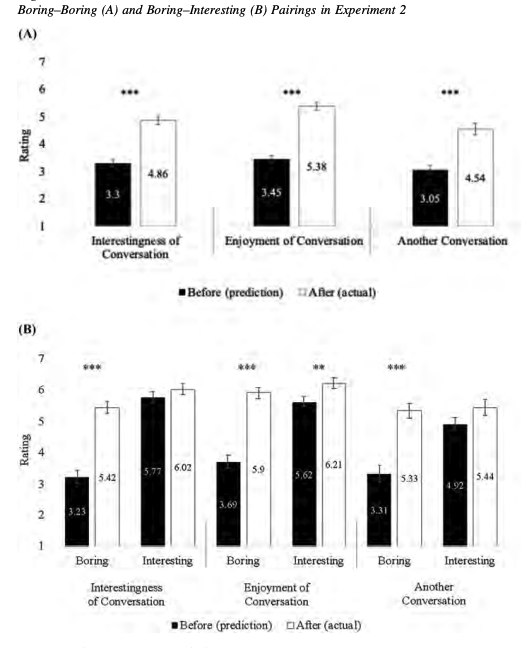 The gap between participants' predicted enjoyment (black bars) and actual enjoyment (white bars) of a conversation remained large, regardless of whether their conversation partner thought the topic was boring or interesting. (Trinh et al., J. Pers. Soc. Psychol., 2026)
Well, maybe people are changing the subject to something they are interested in, and that's why they remember the conversation as enjoyable? Another version of the experiment tested that hypothesis by instructing some pairs of people to stay on topic, while others were free to ramble about whatever they liked.
Again, the majority of participants underestimated how enjoyable those chats would be, regardless of whether they could change the subject or not.
Maybe talking to your friends is more fun than talking to strangers? Nope, the effect still held strong in another set of experiments, whether participants knew each other beforehand or had just met.
"We were both surprised and excited by how robust the effect was," says Trinh. "People consistently expected conversations about seemingly boring topics to be less interesting than they turned out to be."
In another experiment, people read a transcript or watched a video of a conversation on a topic they'd ranked as boring – and that experience turned out to be just as boring as they expected.

Related: Being Bored Could Actually Be Good For Your Brain, Scientists Reveal
The researchers conclude that it's probably the very act of conversing with another human that we enjoy, regardless of what's on the agenda.
As much as we assume we don't want to hear about the minutiae of the stock market or a deep dive into Pokémon strategies, avoiding those interactions could be depriving us of something special.
"If we skip talking to a coworker at the coffee machine, a neighbor in the elevator, or a stranger at an event, we may be missing small moments of connection," says Trinh.
"Even a brief conversation about everyday life may be more rewarding than we expect."
The research was published in the Journal of Personality and Social Psychology.
 English (US)