
.jpg) 1 hour ago
3
1 hour ago
3
Article content
(Bloomberg) — After storied Austrian motorcycle manufacturer KTM AG presented an insolvency plan to creditors last year, several of them convened a video conference to discuss a counter-proposal. More than 100 parties joined, but none of the usual big corporate lenders were involved. Instead, the group featured a motley crew of backers from tiny German towns, Chinese banks and European pension funds, all with wildly varying knowledge of the case at hand. The call was raucous, according to people briefed on the meeting, but the investor pressure ultimately encouraged the company to improve its terms.

THIS CONTENT IS RESERVED FOR SUBSCRIBERS ONLY
Subscribe now to read the latest news in your city and across Canada.
- Exclusive articles from Barbara Shecter, Joe O'Connor, Gabriel Friedman, and others.
- Daily content from Financial Times, the world's leading global business publication.
- Unlimited online access to read articles from Financial Post, National Post and 15 news sites across Canada with one account.
- National Post ePaper, an electronic replica of the print edition to view on any device, share and comment on.
- Daily puzzles, including the New York Times Crossword.
SUBSCRIBE TO UNLOCK MORE ARTICLES
Subscribe now to read the latest news in your city and across Canada.
- Exclusive articles from Barbara Shecter, Joe O'Connor, Gabriel Friedman and others.
- Daily content from Financial Times, the world's leading global business publication.
- Unlimited online access to read articles from Financial Post, National Post and 15 news sites across Canada with one account.
- National Post ePaper, an electronic replica of the print edition to view on any device, share and comment on.
- Daily puzzles, including the New York Times Crossword.
REGISTER / SIGN IN TO UNLOCK MORE ARTICLES
Create an account or sign in to continue with your reading experience.
- Access articles from across Canada with one account.
- Share your thoughts and join the conversation in the comments.
- Enjoy additional articles per month.
- Get email updates from your favourite authors.
THIS ARTICLE IS FREE TO READ REGISTER TO UNLOCK.
Create an account or sign in to continue with your reading experience.
- Access articles from across Canada with one account
- Share your thoughts and join the conversation in the comments
- Enjoy additional articles per month
- Get email updates from your favourite authors
Sign In or Create an Account
or
Article content
Article content
Such scenes are becoming more common in debt restructuring situations in Germany and Austria as businesses falter under the weight of higher energy prices and increasing competition. That’s because many of the region’s medium-sized companies, the so-called Mittelstand, rely on a niche type of debt known as Schuldscheine. While long seen as a safe haven for investors, it comes with one significant quirk – creditors must be in unanimous agreement before any modifications can be made to the debt terms, and there is no central figure to act as a voice for all lenders. Just a few holdouts can thwart a deal, threatening the company with the risk of insolvency.
Article content
Article content
By signing up you consent to receive the above newsletter from Postmedia Network Inc.
Article content
Schuldschein have traditionally been arranged by state-backed lenders and sold as investment-grade in chunks as small as €500,000, which make it attractive to risk-averse investors. The downside is that this can saddle companies with hundreds of creditors, creating huge administrative challenges if things get tough. Lawyers report having to call up individual lenders multiple times a day just to figure out whether somebody owns a chunk of debt. Trying to deal with a €500,000 exposure — very small-fry in the debt financing world — can take weeks. During its debt overhaul last year, agricultural conglomerate BayWa AG had to deal with over 250 creditors.
Article content
Article content
The typical issuers of Schuldscheine are family-owned businesses, many of which are industrial and have been hardest hit by economic volatility. During the low-interest-rate period, companies with poorer credit ratings were also able to issue Schuldschein. All this has made what was once seen as a conservative investment look increasingly risky.
Article content
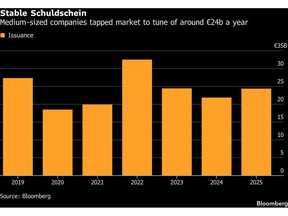
Over the last three years, at least €5 billion of Schuldschein have become entangled in distressed situations, according to Bloomberg calculations of reported cases. While the market sees roughly €20 billion of debt issued each year, that’s nonetheless causing some wariness. More lenders are heading for the exit, with brokers reporting increased interest in selling out of troubled Schuldschein positions.
Article content
“If you sign the paper and think, ‘Oh it’s investment grade, I can put it under the pillow and go to sleep and in five years get my money back’ — you might be very, very, very surprised,” said Andreas Naujoks, a partner at law firm Noerr.
Article content
Schuldschein loans are typically considered buy-and-hold investments — a way for cash-rich savings banks to put money to work — so under normal circumstances, trading is very limited. When trades do happen, they generally fall into one of two categories: lenders either selling the debt of prospering companies in stressed sectors, like automotive or chemicals, or lenders trying to offload distressed assets.
 English (US)