
.jpg) 2 hours ago
4
2 hours ago
4
Article content
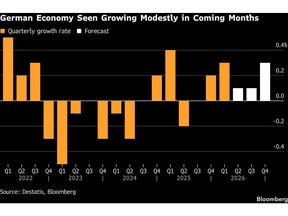
(Bloomberg) — Germany’s economy probably saw modest expansion in the second quarter that will continue into the third, according to the Bundesbank.

THIS CONTENT IS RESERVED FOR SUBSCRIBERS ONLY
Subscribe now to read the latest news in your city and across Canada.
- Exclusive articles from Barbara Shecter, Joe O'Connor, Gabriel Friedman, and others.
- Daily content from Financial Times, the world's leading global business publication.
- Unlimited online access to read articles from Financial Post, National Post and 15 news sites across Canada with one account.
- National Post ePaper, an electronic replica of the print edition to view on any device, share and comment on.
- Daily puzzles, including the New York Times Crossword.
SUBSCRIBE TO UNLOCK MORE ARTICLES
Subscribe now to read the latest news in your city and across Canada.
- Exclusive articles from Barbara Shecter, Joe O'Connor, Gabriel Friedman and others.
- Daily content from Financial Times, the world's leading global business publication.
- Unlimited online access to read articles from Financial Post, National Post and 15 news sites across Canada with one account.
- National Post ePaper, an electronic replica of the print edition to view on any device, share and comment on.
- Daily puzzles, including the New York Times Crossword.
REGISTER / SIGN IN TO UNLOCK MORE ARTICLES
Create an account or sign in to continue with your reading experience.
- Access articles from across Canada with one account.
- Share your thoughts and join the conversation in the comments.
- Enjoy additional articles per month.
- Get email updates from your favourite authors.
THIS ARTICLE IS FREE TO READ REGISTER TO UNLOCK.
Create an account or sign in to continue with your reading experience.
- Access articles from across Canada with one account
- Share your thoughts and join the conversation in the comments
- Enjoy additional articles per month
- Get email updates from your favourite authors
Sign In or Create an Account
or
Article content
Output is likely to have “increased slightly” between April and June, the central bank said Tuesday. That’s better than its previous prediction for stagnation, though growth in the three months through September is set to be weaker.
Article content
Article content
Article content
A first estimate of second-quarter gross domestic product is due on Thursday, with a Bloomberg poll of analysts pointing to a slowdown to 0.1% from 0.3% in the previous period.
Article content
By signing up you consent to receive the above newsletter from Postmedia Network Inc.
Article content
“Overall, the current set of indicators points to a slightly higher underlying economic-growth rate than anticipated” in June’s projection, the Bundesbank said in its monthly report.
Article content
The forecast underscores the resilience of Europe’s largest economy to the Middle East conflict and its fallout on energy prices, even if activity is easing compared with the surprisingly strong start to the year.
Article content
Both the Bundesbank and the government forecast expansion of just 0.5% for the full 12 months, a blow to Chancellor Friedrich Merz who’d predicted 2026 would be a “year of growth” following a lengthy malaise.
Article content
There have been positive signs of late. A key index of business expectations brightened much more than expected in July, while separate surveys suggested private-sector activity is growing again.
Article content
The Bundesbank said manufacturers are benefiting from strong foreign demand and rising exports, while consumers are “relatively unfazed” by high energy costs. Major government outlays on infrastructure and defense, meanwhile, are supporting activity.
Article content
Merz’ coalition has also announced reforms of pensions, income tax and bureaucracy. A separate Bundesbank study published Tuesday found red tape costs German firms about 7% of revenue a year, up from 5% between 2022 and 2024. That’s caused productivity growth to weaken by approximately half a percentage point, it said.
Article content
Turning to inflation, the Bundesbank said a slight acceleration beyond the current level of 2.4% is expected in the coming months.
Article content
 English (US)