 Image via Disney+

Published Nov 21, 2026, 3:09 PM EST
TanChun is a traveling film director and screenwriter who believes in positive Asian representation in Hollywood. She aspires to create more stories in Western media that give Asian actors a chance to star in all types of feature roles! TanChun knows how to take reality and manifest it into a world of imagination that stuns the mind and questions the soul.
Sign in to your Collider account
When one master storyteller praises the work of another, it would be wise to check out what all the buzz is about. For A Song of Ice and Fire's George R.R. Martin, an Emmy-nominated sci-fi series recently caught the attention of the Game of Thrones author, who called it 2025's biggest "highlight." Andor, the acclaimed Star Wars spin-off from Tony Gilroy, has done something rare in a franchise known for its mythic scale and grand scope. The Disney+ series is something altogether different: intimate, political, and unflinchingly honest.
On his Not a Blog, Martin praised the show for its “realism and tension." He singled out Diego Luna’s performance and the show’s visual beauty, but what he responded to most was what Andor represents — a reimagining of science-fiction storytelling that favors slow-burn character drama over fan service and emotional complexity over nostalgia.
'Andor' Is a Star Wars Series Not About Heroes, but Real People
Set over the course of two seasons, Andor is not the story of an epic hero. The canon Star Wars series follows the story of Cassian Andor (Luna), a drifter, thief, and survivor who has long learned to keep his head down under the shadow of the Empire. Since the series occurs before the events of Rogue One, there’s no rebellion in him yet. Andor takes a man who wants nothing to do with a cause and shows us, bit by bit, what it takes to turn someone like him into a revolutionary. Cassian's full ideological shift doesn't come via a single moment. His personal arc is displayed through exhaustion, loss, and a growing awareness that no one else is coming to save the galaxy.
Collider Exclusive · Star Wars Quiz
Which Force User
Are You?
Light Side · Dark Side · Or Somewhere Between
The Force is not a binary. It is a spectrum — from the serene halls of the Jedi Temple to the shadowed corridors of Sith space. Ten questions will reveal where you truly fall. The Force has always known. Now you will too.
🔵Jedi Master
🟡Padawan
🔴Sith Lord
⚫Inquisitor
⚪Grey Jedi
IGNITE YOUR SABER →
01
What is the Force to you? Your relationship with the Force defines everything else.
AA living energy I must be worthy of — it is not mine to control. BSomething vast and mysterious I'm only beginning to understand. CNeither light nor dark — just a current I choose to ride. DPower. Pure and simple. The strong take it; the weak don't.
NEXT QUESTION →
02
When you feel strong emotions — anger, grief, love — what do you do? The Jedi suppress. The Sith feed. Others choose differently.
AAcknowledge them, then release them. Attachment leads to suffering. BFeel them fully, then decide what to do — they're not the enemy. CBury them. Emotion is a liability I can't afford to indulge. DUse them. Passion is the engine of the dark side for good reason.
NEXT QUESTION →
03
The Jedi Council gives you an order you disagree with. You: How you handle authority reveals your alignment.
AFollow it. The Council's wisdom surpasses my own perspective. BVoice my objection clearly, then defer to the decision. CComply outwardly while doing what I think is right. DIgnore it. The strong don't answer to committees.
NEXT QUESTION →
04
You are offered forbidden knowledge that could give you enormous power. The cost is crossing a moral line. You: The dark side's pull is never more than a choice away.
ARefuse without hesitation. There is no cost worth that price. BWeigh it carefully — sometimes darkness holds real answers. CFeel the pull but walk away — for now. DAccept it. Power justifies the method used to obtain it.
NEXT QUESTION →
05
Your approach to training and learning is: A student's habits become a master's character.
ADedicated but humble. There is always more to learn from my masters. BRigorous and patient. Mastery is earned through years of discipline. CEclectic — I draw from every tradition, not just one. DRelentless and brutal. Pain accelerates growth. Rest is weakness.
NEXT QUESTION →
06
In a duel, your lightsaber fighting style reflects: Combat is the purest expression of a Force user's philosophy.
ADefense and composure — I wait for my opponent to overcommit. BFast and instinctive — I trust the Force to guide my movements. CUnpredictable — I blend styles to keep enemies off-balance. DOverwhelming aggression — I end fights before they begin.
NEXT QUESTION →
07
A defeated enemy lies at your feet, powerless. You: Mercy — or its absence — is the truest test of alignment.
AStrike them down — compassion toward enemies is naïve and costly. BNeutralize them permanently. I can't afford loose ends. CSpare them if I can — but stay clear-eyed about the risks. DOffer them a chance to surrender. Every being deserves that.
NEXT QUESTION →
08
The Jedi Code forbids attachment. Your honest view on love and bonds: The source of the greatest falls in the galaxy.
AThe Code is right. Attachment clouds judgment and invites suffering. BLove is not a weakness — the Jedi Code got this one wrong. CI have no attachment — only loyalty to my master's mission. DI feel it deeply but struggle to reconcile it with my training.
NEXT QUESTION →
09
Why do you use the Force at all? What's the point? Purpose is the difference between a knight and a weapon.
ATo learn. I'm still figuring out what I'm capable of. BTo protect and serve. The Force is a responsibility, not a gift. CTo survive — and maybe carve out something worth having. DTo dominate. Strength demands to be expressed, not contained.
NEXT QUESTION →
10
At the final moment — light side or dark side pulling at you — what wins? In the end, every Force user faces this moment. What does yours look like?
AThe light. I choose peace, even when darkness would be easier. BNeither fully — I carve my own path through the middle. CWhoever I serve — my loyalty defines me more than my morality. DThe dark. Power is the only thing that's ever actually been real.
REVEAL MY ALIGNMENT →
Your Alignment Has Been Determined Your Place in the Force
The scores below reveal how the Force sees you. Your highest number is your true alignment. Read on to understand what that means — and what it will cost you.
🔵 Jedi Master
🟡 Padawan
🔴 Sith Lord
⚫ Inquisitor
⚪ Grey Jedi
Disciplined, compassionate, and deeply attuned to the living Force, you have walked the path long enough to understand its demands — and accept them. You lead not through authority alone, but through example. You have felt the pull of the dark side and chosen otherwise, every time. That is not certainty. That is courage.
You are earnest, powerful, and brimming with potential — and you know it, which is both your greatest asset and your most dangerous flaw. You act before you think, trust your gut over your training, and sometimes confuse impatience for bravery. The Masters see something in you, though. The question isn't whether you have what it takes — it's whether you'll be patient enough to find out.
You are not simply dangerous — you are certain, and that is worse. You have decided what the galaxy needs, and you have decided you are the one to deliver it. Your power is genuine and formidable, earned through sacrifice that would have broken lesser beings. But examine your victories carefully. Every Sith believed their cause was righteous. The dark side's cruelest trick is that it agrees with you.
You were forged in fire and reshaped by those who found you at your lowest. You serve, because service gave you structure when you had none. Your allegiance is not to an ideology — it is to survival and to the master who gave you purpose. But there is something buried beneath the conditioning. The Jedi you hunt? You recognize them. Because you remember what it felt like before the choice was taken from you.
You have looked at the Jedi Code and the Sith Code and found both of them incomplete. You walk the line not out of indecision but out of conviction — you genuinely believe both extremes miss something essential. The Jedi don't fully trust you. The Sith think you're wasting your potential. They're both partially right. But so are you.
↻ RETAKE THE QUIZ
This is a kind of character evolution that Martin has long specialized in. Think of Arya Stark, who spends entire seasons slowly shedding childhood ideals, or Jaime Lannister, whose moral unraveling and reassembly play out across years of war and self-doubt. Martin builds his characters brick by brick, trauma by trauma. In this way, part of what makes Andor so unique is that it explores how the Empire functions. Through the corridors of the Imperial Security Bureau, the clerical dread of Ferrix, or the soul-crushing labor of Narkina 5, the series paints a portrait of authoritarian control that is chilling because of how mundane it is.
Andor's prison arc, especially, feels like something pulled from the pages of a dystopian novel. On Narkina 5, prisoners work in silence, assembling unknown components, surrounded by electrified floors that punish disobedience with instant agony. The fear becomes internalized. When Kino Loy (Andy Serkis) finally leads the inmates in revolt, he delivers one of the most iconic moments of the series — only to reveal, as freedom rushes toward them, that he can’t swim. That is Andor in a nutshell: sacrifice without reward. For the GOT author, obsessed with the high cost of power, this is exactly the kind of storytelling that likely resonates with him.
George R.R. Martin's Praise for 'Andor' Highlights Its Quality Sci-Fi Storytelling
Luthen Rael (Stellan Skarsgård) is perhaps the purest example of Andor's brilliance. Luthen isn’t a warm revolutionary; he’s a man whose given up every scrap of personal happiness to serve a cause that will never remember his name in the years to come. In Season 1 Episode 10, Luthen delivers a monologue as powerful as a line coming from A New Hope. “I burn my life to make a sunrise I know I’ll never see,” he says. “I share my dreams with ghosts.”
While Cassian’s journey sits at the center of the series, Andor’s acclaim lies within its side characters, especially the women caught in the Empire’s chokehold. Mon Mothma (Genevieve O’Reilly) is recontextualized from a distant figure in the original trilogy into a woman unraveling from the inside out. Trapped in a gilded cage of political optics, financial manipulation, and a failing marriage, she must navigate the illusion of control while secretly financing a rebellion. There’s even a moment where she considers marrying off her daughter for access to under-the-table funding. Andor asks what resistance actually demands and doesn’t let its characters off the hook for choosing the harder path.
Similarly, Bix Caleen (Adria Arjona) is a mechanic-turned-resistance collaborator, eventually broken by Imperial torture. We never see what’s done to her. The audience just hears the screams of aliens weaponized as psychological trauma. It’s one of the most disturbing scenes in any Star Wars film because of the sheer rawness. Even in HBO's Game of Thrones, characters often endure these kinds of soul-damaging decisions—Sansa (Sophie Turner) in King’s Landing, Theon (Alfie Allen) in the Dreadfort. It's no wonder Martin recognizes that kind of trauma-laced storytelling when he sees it.
In the end, Andor feels like a Star Wars story that has grown up. There are still droids, space travel, and the struggle between tyranny and freedom, but it replaces prophecy with politics. It’s less about chosen ones, and more about the people history forgets. “It’s nice to see someone doing science fiction right,” George R.R. Martin writes. And in a sea of franchise content that tends to blur together, Andor earns its place as one of the most meaningful genre stories of the last decade.
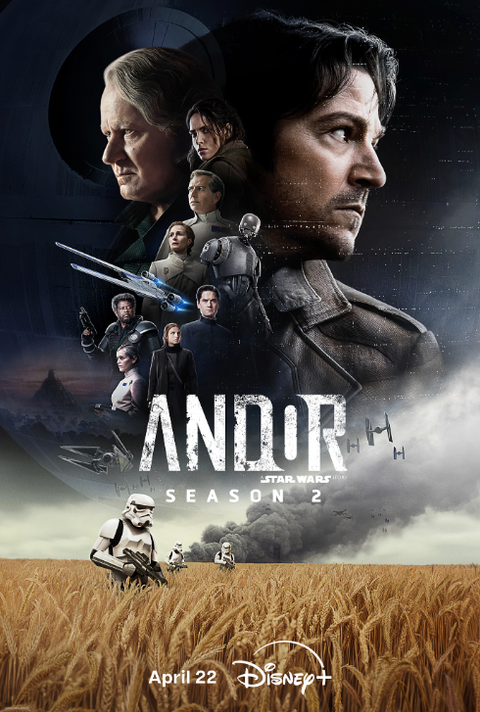
Release Date 2022 - 2025-00-00
Network Disney+
Showrunner Tony Gilroy
Directors Susanna White
Writers Dan Gilroy
Franchise(s) Star Wars