
.jpg) 1 hour ago
2
1 hour ago
2
Article content
(Bloomberg) — The French government has slightly scaled back plans to expand solar and onshore wind capacity as the country grapples with a power surplus driven by a slower-than-expected shift away from fossil fuels.

THIS CONTENT IS RESERVED FOR SUBSCRIBERS ONLY
Subscribe now to read the latest news in your city and across Canada.
- Exclusive articles from Barbara Shecter, Joe O'Connor, Gabriel Friedman, and others.
- Daily content from Financial Times, the world's leading global business publication.
- Unlimited online access to read articles from Financial Post, National Post and 15 news sites across Canada with one account.
- National Post ePaper, an electronic replica of the print edition to view on any device, share and comment on.
- Daily puzzles, including the New York Times Crossword.
SUBSCRIBE TO UNLOCK MORE ARTICLES
Subscribe now to read the latest news in your city and across Canada.
- Exclusive articles from Barbara Shecter, Joe O'Connor, Gabriel Friedman and others.
- Daily content from Financial Times, the world's leading global business publication.
- Unlimited online access to read articles from Financial Post, National Post and 15 news sites across Canada with one account.
- National Post ePaper, an electronic replica of the print edition to view on any device, share and comment on.
- Daily puzzles, including the New York Times Crossword.
REGISTER / SIGN IN TO UNLOCK MORE ARTICLES
Create an account or sign in to continue with your reading experience.
- Access articles from across Canada with one account.
- Share your thoughts and join the conversation in the comments.
- Enjoy additional articles per month.
- Get email updates from your favourite authors.
THIS ARTICLE IS FREE TO READ REGISTER TO UNLOCK.
Create an account or sign in to continue with your reading experience.
- Access articles from across Canada with one account
- Share your thoughts and join the conversation in the comments
- Enjoy additional articles per month
- Get email updates from your favourite authors
Sign In or Create an Account
or
Article content
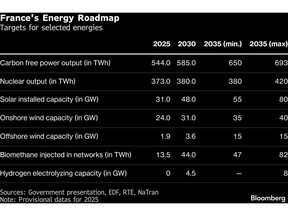
The long-awaited energy roadmap, outlining 2030 and 2035 production targets across sources ranging from nuclear and hydropower to biofuels and geothermal, is expected to pave the way for the government to resume subsidy auctions for renewable projects. However, the plan’s future could be short-lived if the National Rally, which opposes wind and solar power, wins next year’s presidential election.
Article content
Article content
Article content
“Let’s try to have a roadmap that takes us at least until the presidential election and avoids a toxic standstill,” Prime Minister Sebastien Lecornu said during the presentation of his energy plan at a hydro dam in eastern France on Thursday. “Our industrial, climate and geopolitical interests match the interest of consumers.”
Article content
By signing up you consent to receive the above newsletter from Postmedia Network Inc.
Article content
A surge in renewable capacity and sluggish consumption since the 2022 energy crisis have pushed French power exports to record levels and driven prices sharply lower. While that’s good news for consumers, it’s squeezing profits at state-run nuclear operator Electricite de France SA, complicating efforts to finance plans for six new reactors to replace the country’s aging fleet.
Article content
Under the plan unveiled Thursday, photovoltaic capacity is set to reach 48 gigawatts by 2030, 6 gigawatts less than envisaged in March last year. The 2030 target for onshore wind was reduced by 2 gigawatts, while the 2035 offshore wind goal was cut by 3 gigawatts.
Article content
While past additions of solar and wind capacities have inflated government subsidies paid to renewable energy producers, the annual bill should peak in coming years at about €9 billion ($10.7 billion), before being halved by 2040 under a median power price scenario, the government said Thursday.
Article content
Article content
“We’re broadly satisfied with all these decisions,” said Jules Nyssen, president of Syndicat des Energies Renouvelables, the country’s biggest renewable energy lobby. However, he called for scrapping impediments to the installation of taller wind turbines.
Article content
State-owned EDF also welcomed the plan to build six new large scale reactors and to study the construction of eight extra units. The French government reiterated plans to support the construction of small and advanced nuclear reactors.
Article content
While nuclear power is needed to provide power on demand round-the-clock, the first new reactor is not expected to come online until 2038, Finance Minister Roland Lescure said on Thursday. That underscores the need for more solar and wind capacity, which can be built more quickly, he added. All targets will be reviewed as early as next year.
Article content
The additions, along with several new hydro-pumped projects, should lift France’s power output by about 20% by 2035, Lescure said. The government will also present a plan later this year to accelerate the adoption of electric vehicles, heat pumps and electrified industrial processes, as well as to attract more data centers.
Article content
 English (US)