
.jpg) 1 hour ago
3
1 hour ago
3
A stroll through any garden center is likely to turn up decorative objects inspired by the classical world.
A concrete statue based on the Venus de Milo, terracotta plant pots shaped like Grecian urns, and herb beds in a 2,000-year-old bas-relief style – all are popular choices for the landscaper of refined tastes.
But for one garden, that dream of classical style was not, in the end, a fantasy.
In the grounds of Blenheim Palace in England, built in the 18th century, a marble-fronted tub that had been used as a tulip pot turned out to be far older than a first glance might have suggested.
In 2017, conservators and palace staff revealed that the marble façade was part of a real, ancient Roman sarcophagus, dating back to around the third century CE.
The carved marble panel had spent nearly two centuries serving as a garden ornament, first as a water feature and later as a planter. Yet despite its humble role, the artifact had once been part of an elaborate stone coffin crafted for a wealthy Roman during the empire's heyday.
Now, it has been carefully restored and placed on display indoors.
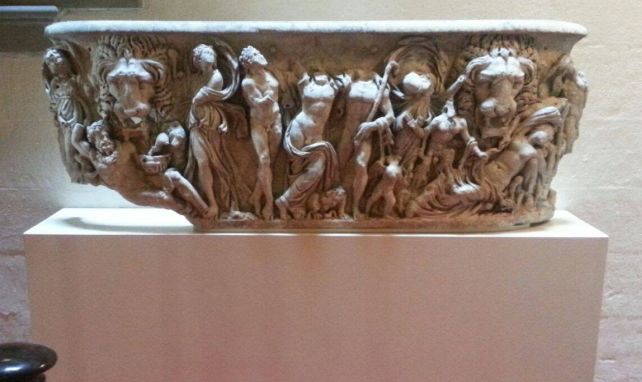 The sarcophagus on display in Blenheim Palace. (Cliveden Conservation/Facebook)
"The piece is actually in remarkable condition considering it has withstood seemingly aggressive environments; particularly that of a fountain receptacle," said conservator Nicholas Banfield of Cliveden Conservation, who oversaw the restoration.
"Following an initial in-situ inspection, we were able to unbolt it from the lead cistern to which it was attached and take it back to our workshops for full cleaning, repair, and stabilization."
It sounds like the tale of an obscure, rare object finally receiving the recognition to which it is due – but the tale of this particular artifact is far stranger.
The Blenheim Sarcophagus, as it came to be known, was neither unknown nor obscure.
Classicist Zahra Newby of Warwick University in the UK discussed the artifact in a book chapter on portraiture on Roman sarcophagi.
Its bas-relief carving depicts a drunken Dionysus reveling with Hercules and Ariadne, flanked by lion heads.
"An example in Blenheim shows the drunken Dionysus standing in the center of the sarcophagus…" she wrote.
In fact, references to the sarcophagus stretch back centuries.
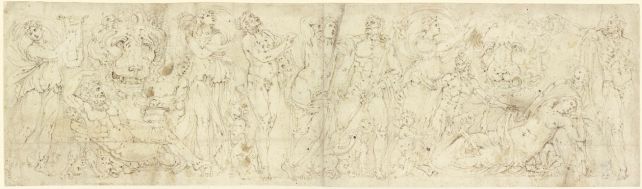 Battista Franco Veneziano's sketch. (Städel Museum)
Its scene was sketched by the Italian artist Battista Franco Veneziano before 1530; the sketch is currently housed at the Städel Museum in Germany.
The Metropolitan Museum of Art in the US also has a 16th-century sketch of the sarcophagus, attributed to an unknown artist.
In 1882, it was included in the book Ancient Marbles in Great Britain by Adolf Michaelis.
In 2010, an anonymous visitor posted a picture of the object in the Blenheim grounds to TripAdvisor with the caption, "a flower bed that looks like a Roman lenos sarcophagus". A lenos sarcophagus is one that is shaped like a bathtub.
It seems to have been hiding in plain sight – but, according to media reports in 2017, Blenheim Palace was unaware of its provenance until an antiquities expert visiting on other business in 2016 urged staff to investigate.
The marble panel – the only surviving part of the sarcophagus – had been attached to a tub to serve as a garden feature. Once removed, it measured some 2 meters (6.6 feet) in length and weighed close to 400 kilograms (880 pounds).
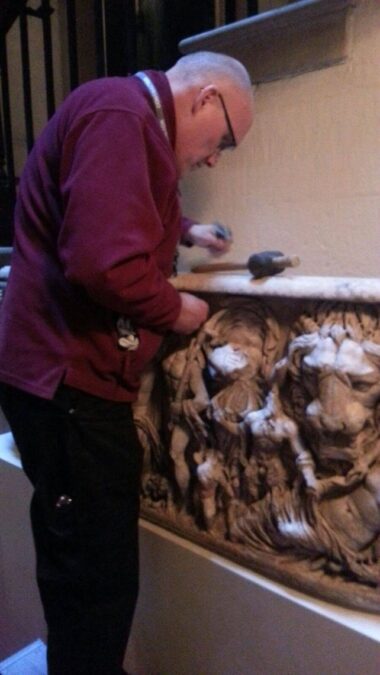 A conservator working on the sarcophagus. (Cliveden Conservation/Facebook)
Experts reportedly estimated its worth at £300,000 (US$400,000 at current exchange rates at time of writing).
So how did it evade notice for so long, with so many visitors regularly passing it by?
It's likely that many assumed it was a reproduction, as can be found in so many gardens and estates.
But many, according to ancient historian and archaeologist Christopher Dickenson of Oxford University in the UK, probably just assumed, as he did, that Blenheim staff already knew what they had.

"The truth must surely be that everybody who saw it and recognized it simply assumed that the people at Blenheim were fully aware what it was," Dickenson wrote. "That was certainly my assumption."
Related: Mysterious Stone in US Backyard Turned Out to Be an Archaeological Treasure
People visiting Blenheim can now see the artifact in a more appropriate setting and appreciate it for what it truly is: a relic of ancient funerary traditions that has survived for centuries, not a receptacle for tulips.
"Now it is in a consistent indoor climate away from the natural elements, we are hoping it will remain in good condition and survive for many more centuries to come," said Blenheim Palace House Manager Kate Ballenger.
And a big mystery still remains unresolved.
The object is only known to have come into the hands of the 5th Duke of Marlborough, who owned the palace at the time, sometime in the 19th century.
How he acquired it, and when, may never be discovered.
 English (US)