

Godzilla is a very busy kaiju. Since his first iconic appearance in Ishirō Honda’s eponymous 1954 film—which is credited with launching the kaiju subgenre—the huge reptilian creature has starred in a truly colossal number of movies, TV shows, books, comic books, video games, and even songs. Godzilla’s most recent outing is Godzilla Minus Zero—a spectacular film that combines jaw-dropping monster mayhem with tear-inducing character arcs.
But Godzilla isn’t the only kaiju known for stomping through cities, and I think he’s earned a bit of a rest. Here are five books and short stories that offer up some alternative big beasts—some of which follow fairly closely in Godzilla’s massive footsteps and some of which blaze their own (often very destructive) trail.
“The Fog Horn” by Ray Bradbury (1951)

While Godzilla may be the kaiju that has left the biggest mark on the subgenre, he wasn’t the first huge monster on the scene. One of the earlier beasts who beat Godzilla to the punch appears in Ray Bradbury’s “The Fog Horn.”
Originally titled “The Beast from 20,000 Fathoms,” (it partly inspired the 1953 film of the same name, although the movie’s plot is very different), this short story follows two men who work at an isolated lighthouse. It’s a cold November night and old-timer McDunn attempts to prepare newbie Johnny for the unbelievable: the arrival of a massive sea creature. For the past two years on this very night, the aquatic kaiju has risen from the depths of the ocean—seemingly attracted by the lighthouse’s fog horn—and McDunn expects the same this year.
As much as “The Fog Horn” is about a big scary monster, it’s also a deeply poignant story about loneliness and longing—and, of course, it’s told in Bradbury’s signature lyrical style.
“Heresies of the Huge God” by Brian Aldiss (1966)

It’s a given that kaiju are absolutely massive, but the beast in “Heresies of the Huge God” takes things to another level entirely. The short story is written as a historical account by Harad IV, Chief Scribe of the Orthodox Universal Sacrificial Church, documenting the 910 years since a supersized lizard-like kaiju landed on Earth. To give a sense of the creature’s size, imagine it as a gecko and the world as an orange.
The arrival of such a titanic being obviously caused havoc: entire countries were crushed, the climate changed, and humanity was thrown into such disarray that a new overly zealous religion took over—one that dubbed the kaiju the “Huge God.” The story is told with an entirely straight-face—our scribe is a worshipper of the Huge God after all—but there’s a playful undercurrent of humor running through the whole thing.
Iron Widow by Xiran Jay Zhao (2021)
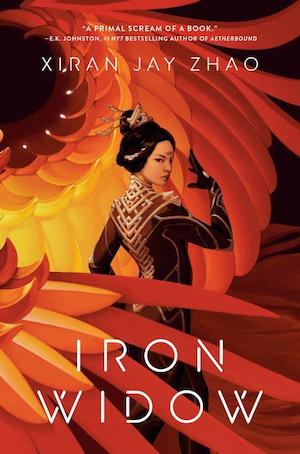
Iron Widow is the story you get if you take a fictionalized version of Wu Zetian, the only female ruler in Chinese history, and drop her into the world of Pacific Rim (2013). But while in Pacific Rim the mental bond between mecha pilots is one of harmonious connection, in Iron Widow it usually leads to death—specifically the death of the female concubine-pilot, whose spiritual energy is used to boost that of the male pilot.
Zetian signs up to be a pilot not because she wants to help in the fight against the Hunduns—giant aliens that are constantly attacking Huaxia’s Great Wall—but because she wants revenge on the pilot who sacrificed her sister. When she survives the encounter with him, surprising everyone, she finds herself on a mission to dismantle the entire patriarchal system. Oh, and she fights off plenty of Hunduns while doing it.
Iron Widow has all of the subtlety of a hammer, but if female rage let loose in a kaiju-infested SFF world is what you’re after, then it definitely delivers.
The Kaiju Preservation Society by John Scalzi (2022)

Jamie Gray is barely scraping by working as a food delivery driver, so when an acquaintance offers him a mysterious higher-paid job that involves large animals (the main requirement apparently involves lifting things), he jumps at the chance. Once he’s signed on, Jamie learns that he’s actually been hired by the Kaiju Preservation Society—a secret organization dedicated to researching and protecting mountain-sized kaiju on an alternate version of Earth.
If you’ve ever spent time thinking about how kaiju biology might work, then The Kaiju Preservation Society is the book for you. John Scalzi spends the majority of the story’s word count on worldbuilding—covering everything from the parasites that live on the kaiju and the atmosphere that they thrive in to the weapons that humans have developed to deal with the dangers of this strange alternate world (which includes the aforementioned parasites).
The story is pure fun, with Scalzi’s trademark style of humor—plenty of quips, banter, and snark—present on pretty much every single page.
The Big Bad Book of Kaiju edited by Jonathan Maberry and Henry Herz (2026)

The Big Bad Book of Kaiju is a short story anthology that provides a creative array of bite-sized kaiju tales. Each author takes the giant creature concept in a completely different direction, so if you’re looking to read something that goes beyond the bounds of a typical Godzilla story, you’ll find it here (although a few of the stories do stick a bit more closely to the classic big monster storylines!).
Since I can’t give a summary of each short story (and there are a few poems too), I’ll instead tempt you with descriptions of just a few of my favorites. Ai Jiang’s “Shedding Season” is about a society that lives on the back of a kaiju that periodically sheds its outer layer. Kelley Armstrong’s “Kaiju, Theoretically” follows the R&D stage of creating Jurassic Kaiju Park. And finally, Scott Sigler’s “Kaiju Poo-Poo” is set in a world where kaiju poop is an essential resource for humanity and a team have to fly up a kaiju’s butt to see why it’s not, uh… producing.
If you’ve got any of your own kaiju story recommendations, please feel free to leave them in the comments below! All giant monsters are welcome—whether they’re classic characters like Godzilla and Mothra or whether they’re original creations smashing their way onto the scene!


