
.jpg) 2 hours ago
3
2 hours ago
3
Once upon a time, billions of years ago, the Universe was shrouded in darkness. It wasn't until the first stars began to shine that space turned transparent and light flowed.
It's a curious thing, but not a single one of those very first stars, known as Population III, has ever been found.
Now, astronomers have identified the next best thing: A star so chemically anemic that it must have formed hard on the heels of the generation that transformed the Universe.
Such stars are known as Population II stars, and they're extremely rare. This anemic one, named PicII-503, is particularly exciting – it's the most iron-poor star ever found outside of the Milky Way, in an ancient dwarf galaxy more than 10 billion years old.
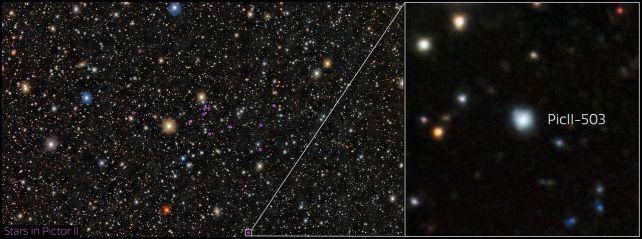 The location of PicII-503. (CTIO/NOIRLab/DOE/NSF/AURA)
"Discovering a star that unambiguously preserves the heavy metals from the first stars was at the edge of what we thought possible, given the extreme rarity of these objects," says astrophysicist Anirudh Chiti of Stanford University.
"With the lowest iron abundance ever derived in any ultra-faint dwarf galaxy, PicII-503 provides a window into initial element production within a primordial system that is unprecedented."
The Universe doesn't have a center, so if the first stars in the Universe were still hanging around, they'd be distributed fairly evenly throughout spacetime.
However, scientists think that Population III stars were much more massive than any stars around today, and consequently had extremely brief lifespans.
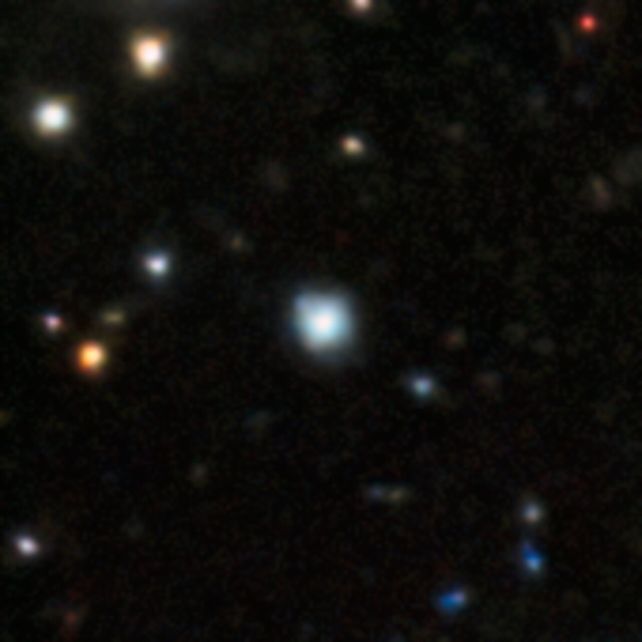 PicII-503 could be around 13 billion years old. (CTIO/NOIRLab/DOE/NSF/AURA)
Now, an interesting thing about stars is that back when the Universe was newborn, there wasn't much variety in the available star-forming material. There was just hydrogen and helium, pretty much.
However, once stars burst into being, they started smashing atoms together in their cores to create elements as heavy as iron.
When the stars ran out of fusion material, they would have spectacularly exploded, releasing and spraying all those fused elements out into space. Supernova explosions, in addition, are violent furnaces in which elements heavier than iron form.
These heavier elements – what astronomers call 'metals' – then mix into the gas that will form the next generation of stars, and so on. The younger a star is, the more pronounced its metal content. The older a star is, by contrast, the less metal it has.
PicII-503 is a star located about 150,000 light-years away, in a tiny, faint dwarf galaxy orbiting the Milky Way called Pictor II. Pictor II is what is known as a fossil galaxy – all of the stars in it are extremely old, and it hasn't undergone star formation or accreted new stars in billions of years.

This makes it an excellent place to search for stars that may have formed from the guts of Population III stars, as Chiti and his colleagues did.
They used data from the Mapping the Ancient Galaxy in CaHK (MAGIC) Survey, collected using the Dark Energy Camera on the US National Science Foundation's Víctor M. Blanco 4-m Telescope, to look for stars with extremely low metal abundances.
PicII-503 stood out. According to an analysis of its spectrum, the star has around 43,000 times less iron than the Sun, and about 160,000 times less calcium. However, its carbon abundance was huge – around 3,000 times higher relative to those elements.
So low is that heavy metal abundance that the researchers say the star best fits our understanding of the Universe if it's a Population II star. It suggests that the star formed from gas enriched by the very first stars.
That imbalance is a clue: It suggests the star formed from the debris of an unusually faint supernova, where heavier elements like iron and calcium fell back into the remnant while lighter ones like carbon escaped.
Related: We May Have Finally Laid Eyes on The Universe's Very First Stars
If the supernova were higher energy, the elements would have been blasted out at speeds faster than escape velocity for a small galaxy like Pictor II, and PicII-503 would not have been able to form.
This could also tell us something about the ancient stars that are lurking in the halo of our own galaxy. The Milky Way has absorbed many smaller galaxies over the course of its lifetime, and it's still doing so. Eventually, Pictor II may succumb to the same fate.
"What excites me the most is that we have observed an outcome of the very initial element production in a primordial galaxy, which is a fundamental observation!" Chiti says.
"It also cleanly connects to the signature that we have seen in the lowest-metallicity Milky Way halo stars, tying together their origins and the first-star-enriched nature of these objects."
The research has been published in Nature Astronomy.
 English (US)