
.jpg) 1 hour ago
2
1 hour ago
2
Alzheimer's disease is such a challenging condition to study because it presents researchers with a complex mesh of risk factors, causes, and symptoms that need untangling – and sleep is a prime example.
We know that poor sleep can raise the risk of Alzheimer's, and that the disease itself interferes with normal sleep processes, but understanding the various contributors and consequences at play is difficult.
Now, we may have a bit more clarity on the relationship between Alzheimer's and sleep, thanks to a new study published in Alzheimer's & Dementia, led by researchers from the University of Kentucky.
The researchers identified brain immune cells called microglia as being potential candidates for stealing sleep in people with Alzheimer's – effectively putting the brain on high alert as the disease takes hold, in a way that interferes with natural rest.
It shifts the focus away from the toxic clumps of amyloid-beta protein that build up in the brain alongside Alzheimer's disease progression.
As far as disrupted sleep goes, these plaques might be the trigger, rather than what's doing the actual damage.
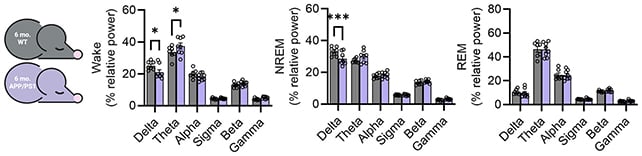 The researchers looked at how amyloid-beta plaques (purple) affected sleep quality through brainwave frequencies. (Constantino et al., Alzheimer's & Dementia, 2026)
"Basically, we showed that it is not the plaques themselves, or solely dysfunctional neurons, that cause sleep loss but actually microglia," says physiologist Shannon Macauley from the University of Kentucky.
"Microglia are immune cells that, when they respond to plaques, kick off this elaborate cascade of inflammation, as if the microglia are partying all night, and keeping the brain awake."
The researchers compared two groups of mice for the study: mice genetically engineered to develop amyloid-beta plaques similar to those found in Alzheimer's patients, and a healthy control group.
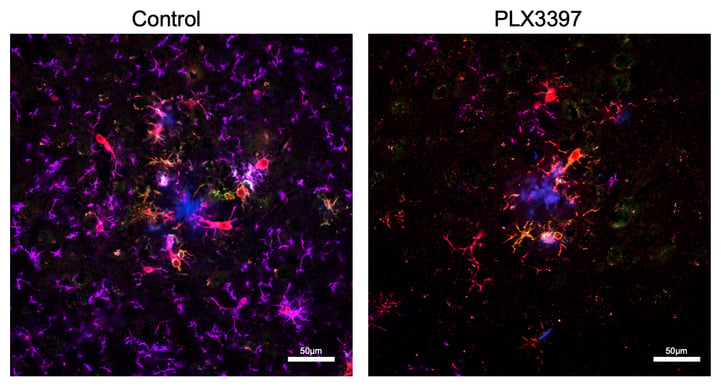 Brain tissue scans, showing the effects of immune cells being turned off (right) on microglia and amyloid plaques. (Nicholas Constantino)
Sleep cycles, brain activity, and amyloid-beta plaque build-up were monitored in the animals, specifically at six months old when the disease was just getting started, and at 18 months when it was well developed.
The data showed that the appearance of plaques cost the mice 1.5-2 hours of sleep per night, right away. This was consistent between six and 18 months, even though substantially more plaque accumulated over that time.
"I expected that as plaque burden became more severe, sleep disruption would also worsen," says neuroscientist Nicholas Constantino from the University of Kentucky.
"The disruptions in sleep and cortical EEG activity that occur at six months, when plaques first emerge, did not worsen by 18 months, despite more than double the amount of plaque burden."
In a subsequent experiment based on a similar premise with a different group of mice, the researchers introduced dosages of microglia-blocking drugs.
This returned the headline finding: disabling the microglia reaction gave the Alzheimer's mice an extra two hours of sleep per night, extending their restorative sleep periods.

"That restorative sleep is super important for physical repair, learning and memory and washing out the toxins of the day," says Macauley.
"When Alzheimer's patients lose this stage, they lose their brain's primary cleaning cycle, creating a feed-forward loop that may drive further damage."
The drug dosage had no effect on the amyloid-beta plaques, which were unchanged. It's previously been suggested that the death of neurons in the brain or the accumulation of amyloid-beta proteins is what's causing poor sleep in Alzheimer's patients.
By tackling the sleep problem through microglia, we could make some progress on slowing down or limiting Alzheimer's.
Clearly there's a lot of work to do – this has only been tested in mice so far, and wiping out an army of brain immune cells isn't really an option. Potential treatments would most likely try to calm down the microglia, rather than removing them.
Related: Alzheimer's Brains Harbor a Previously Unknown Plaque, Study Finds
What's also significant is the data collected on these mice over time. The researchers were able to spot early brain changes at the six-month mark that could, in the future, be used to flag up Alzheimer's progression ahead of time.
"Portable EEG systems could allow us to monitor people in their home environments and potentially screen for changes associated with Alzheimer's disease, without the initial need for expensive or invasive tests," says Macauley.
The research has been published in Alzheimer's & Dementia.
This article was fact-checked by Rachel Garner and edited by Peter Dockrill. While we pride ourselves on our process, we are only human. If you spot a mistake, please let us know.
 English (US)