
Exceptional assays show why high-grade core stands to super-charge early production profile at FireFly’s Green Bay

1 hour ago 3

Article content

APPENDIX B – Significant Intersection Table

Article content

Collar co-ordinates and orientation are listed in the local Ming Mine grid, which is rotated +35 degrees from NAD83 True North.  Significant intersections reported are those above a 1% copper cut-off or 0.5g/t gold, and contain a maximum of 6 metres of internal waste. Please refer to the compliance statements for further details on parameters used in the copper equivalent calculation. All results are approximate true width (TW) unless otherwise noted.

Article content

Hole NumberEastingNorthingRLAziDipDrilled Length (m)From (m)To
(m)
Width
(m)
AssayCuEq %
Cu %Au g/tAg g/tZn %
MUG25_235 1,206.9  2,355.8-917.0182– 68234Abandoned due to excessive downhole deviation
MUG25_2421,137.51,972.0-842.4210515Abandoned due to excessive downhole deviation
MUG25_246 1,117.0 2,190.3-894.0215-67 357314.3318.44.15.402.013.81.147.33
MUG25_247 1,255.5 2,355.8-916.9176-70 690441.8444.12.33.685.964.80.629.12
       498.0501.53.51.330.51.80.071.75
       533.2539.05.91.520.21.70.151.71
       555.0579.024.01.000.11.00.011.06
       602.5622.019.61.400.11.90.011.45
MUG25_248 1,137.5 1,972.0-842.4224-5 45Abandoned due to excessive downhole deviation
MUG25_250 1,222.1 2,255.1-906.4162-63 615505.9511.85.91.560.11.40.041.64
       528.8539.010.21.790.11.50.021.87
       546.3562.416.21.310.11.30.021.37
       567.5579.411.91.590.11.70.031.66
MUG25_251 1,117.0 2,190.3-894.0223-75 15Abandoned due to excessive downhole deviation
MUG25_255 1,117.0 2,190.3-894.0223-57 357319.8330.310.53.051.816.51.504.86
MUG25_256 1,255.5 2,355.8-916.9172-76 45Abandoned due to excessive downhole deviation
MUG25_257 1,137.5 1,972.0-842.4226-9 363285.1287.42.3
(1.6m TW)
3.204.931.31.367.68
       291.4296.75.3
(4.8m TW)
0.801.66.20.242.17
MUG25_258 1,255.5 2,355.8-916.9172-76 696517.0529.012.01.330.21.30.101.51
       557.3566.08.71.820.21.90.032.04
       598.0603.25.21.390.11.20.011.46
       611.0614.03.01.200.00.90.011.24
       628.8660.031.31.970.12.40.012.07
MUG25_260 1,117.0 2,190.3-894.0227-64 381322.8332.59.85.041.812.91.346.80
MUG25_261 1,056.9 2,298.9-899.7185-79 450400.3403.43.17.992.619.01.6510.55
MUG25_262 1,137.5 1,972.0-842.4229-15 375262.9269.26.3
(4.4m TW)
1.721.411.70.833.08
MUG25_263 1,117.0 2,190.3-894.0235-70 414342.1345.02.91.250.53.30.601.78
MUG25_264 1,137.5 1,972.0-842.4234-22 375254.8261.66.8
(4.8m TW)
2.492.528.72.245.12
MUG25_265 1,117.0 2,190.3-894.0227-51 360326.5330.33.82.431.213.91.983.82
MUG25_266 1,185.8 2,352.2-916.1175-74 641457.0459.92.91.810.910.33.563.19
       476.7478.72.01.910.33.90.052.21
       484.6486.82.21.660.12.60.091.77
       512.0529.817.81.860.42.60.022.18
       536.3573.036.81.980.11.80.112.08
MUG25_267 1,056.9 2,298.9-899.7193-74 429390.1399.49.35.101.620.32.947.00
MUG25_268 1,096.0 2,286.3-899.1162-72 48Abandoned due to excessive downhole deviation
MUG25_269 1,255.5 2,355.8-916.9187-75 210Abandoned due to excessive downhole deviation
MUG25_270 1,117.0 2,190.3-894.0233-57 375329.4338.89.42.661.412.52.034.26
       340.5348.07.50.031.17.40.561.08
MUG25_271 1,096.0 2,286.3-899.1162-72 147Abandoned due to excessive downhole deviation
MUG25_272 1,137.5 1,972.0-842.4223 7 540465.2489.824.7
(16.0m TW)
1.392.620.80.383.74
       501.4504.02.6
(1.7m TW)
4.389.938.31.8013.14
MUG25_273 1,056.9 2,298.9-899.7197-68 408375.9378.22.34.041.414.90.565.41
       391.1396.95.81.950.84.20.172.66
MUG25_274 1,255.5 2,355.8-916.9187-75 15Abandoned due to excessive downhole deviation
MUG25_275 1,096.0 2,286.3-899.1162-72 143Abandoned due to excessive downhole deviation
MUG25_276 1,255.5 2,355.8-916.9187-75 711464.3469.04.80.871.513.60.902.38
       473.0479.06.03.532.128.90.585.58
       543.9547.03.11.310.11.10.161.42
       567.0599.032.01.410.11.50.181.50
       607.0613.06.01.620.12.50.151.74
MUG25_277 1,117.0 2,190.3-894.0230-64 375329.5341.311.82.321.211.21.563.62
MUG25_278 1,185.8 2,352.2-916.1175-78 642460.8468.27.42.141.28.60.823.33
       484.1519.835.73.070.23.20.043.27
       531.1548.717.61.640.11.20.041.74
MUG25_279 1,096.0 2,286.3-899.1162-72 471384.2401.917.85.401.315.80.366.69
       413.0415.02.01.850.11.70.061.99
       423.1426.02.91.360.11.10.181.49
MUG25_280 1,056.9 2,298.9-899.7205-64 411383.5387.74.22.711.113.42.964.20
MUG25_281 1,255.5 2,355.8-916.9190-83 753509.2518.49.21.794.921.50.496.09
       580.5588.58.02.090.21.70.112.33
       595.0598.03.01.270.11.10.091.38
       612.8642.930.11.920.12.00.322.06
       725.4728.43.01.560.34.60.041.81
MUG25_282 1,185.8 2,352.2-916.1190-78 15Abandoned due to excessive downhole deviation
MUG25_283 1,117.0 2,190.3-894.0236-43 438365.3369.23.91.391.216.80.672.62
MUG25_284 1,056.9 2,298.9-899.7206-78 36Abandoned due to excessive downhole deviation
MUG25_285 1,185.8 2,352.2-916.1190-78 575461.1506.445.32.610.44.30.293.01
MUG26_001 1,137.5 1,972.0-842.42328547526.8528.82.0
(1.2m TW)
1.170.11.20.061.26
MUG26_002 964.7 2,163.4-877.5192-20357308.2315.27.0
(5.6m TW)
4.622.727.30.407.09
MUG26_003 1,056.9 2,298.9-899.7206-78432404.0416.812.83.022.012.63.335.28
MUG26_004 1,096.0 2,286.3-899.1159-7372Abandoned due to excessive downhole deviation
MUG26_005 1,255.5 2,355.8-916.9179-73690452.9457.34.40.792.626.80.593.23
       513.3519.05.71.570.22.70.131.79
       546.5550.03.51.550.21.90.041.70
       570.1582.012.01.270.11.10.011.33
       595.0602.87.81.120.01.10.011.17
       607.2634.026.81.350.11.70.011.42
MUG26_006 1,096.0 2,286.3-899.1155-7315Abandoned due to excessive downhole deviation
MUG26_007 1,056.9 2,298.9-899.7209-729Abandoned due to excessive downhole deviation
MUG26_008 1,185.8 2,352.2-916.1191-89620484.2489.95.82.900.46.00.253.30
       513.3538.525.33.540.33.80.063.79
       561.1568.06.91.880.11.50.061.98
MUG26_009 1,056.9 2,298.9-899.7209-72423No Significant Assays
MUG26_010 1,096.0 2,286.3-899.1155-736Abandoned due to excessive downhole deviation
MUG26_011 1,096.0 2,286.3-899.1155-7322Abandoned due to excessive downhole deviation
MUG26_012 964.7 2,163.4-877.5191-38330No Significant Assays
MUG26_013 1,096.0 2,286.3-899.1155-73453375.0395.720.75.901.914.10.747.71
       411.0416.85.83.390.23.80.223.63
MUG26_014 1,137.5 1,972.0-842.4230-4429No Significant Assays
MUG26_015 1,056.9 2,298.9-899.7213-67414389.5400.010.63.721.720.03.575.82
MUG26_016 964.7 2,163.4-877.5200-36351No Significant Assays
MUG26_017 1,255.5 2,355.8-916.9190-87111Abandoned due to excessive downhole deviation
MUG26_018 962.6 2,163.8-877.0209-36348No Significant Assays
MUG26_019 1,185.8 2,352.2-916.1197-7551Abandoned due to excessive downhole deviation
MUG26_020 1,056.9 2,298.9-899.7222-75459No Significant Assays
MUG26_021 1,255.5 2,355.8-916.9190-8721Abandoned due to excessive downhole deviation
MUG26_022 1,255.5 2,355.8-916.9190-87657506.2510.13.92.514.365.10.866.72
MUG26_022      550.3553.12.82.190.22.40.052.39
       556.8559.42.61.120.01.20.021.17
       563.3575.912.61.550.42.10.021.88
       588.6608.019.41.840.11.80.141.95
       615.5618.83.31.100.01.00.061.15
MUG26_023 964.7 2,163.4-877.5185-49339273.2281.78.6
(6.4m TW)
1.802.020.72.974.05
MUG26_024 1,096.0 2,286.3-899.1166-7816Abandoned due to excessive downhole deviation
MUG26_025 1,096.0 2,286.3-899.1166-789Abandoned due to excessive downhole deviation
MUG26_026 1,096.0 2,286.3-899.1166-7825Abandoned due to excessive downhole deviation
MUG26_027 1,185.8 2,352.2-916.1197-7512Abandoned due to excessive downhole deviation
MUG26_028 1,185.8 2,352.2-916.1197-75531436.9471.334.43.811.211.00.564.98
      Including436.9451.214.35.162.521.41.217.62
MUG26_029 1,096.0 2,286.3-899.1166-78441377.0390.613.65.721.115.40.406.83
MUG26_030 964.7 2,163.4-877.5199-318Abandoned due to excessive downhole deviation
MUG26_031 1,056.9 2,298.9-899.7205-58408373.5382.79.22.181.014.62.753.56
MUG26_032 1,137.5 1,972.0-842.4235-7414No Significant Assays
MUG26_033 964.7 2,163.4-877.5199-3426No Significant Assays
MUG26_034 1,096.0 2,286.3-899.1171-84444No Significant Assays
MUG26_035 1,137.5 1,972.0-842.4212275Abandoned due to excessive downhole deviation
MUG26_036 1,185.8 2,352.2-916.1187-66555425.9476.150.23.500.45.10.733.97
      Including425.9437.711.82.250.67.42.873.22
MUG26_036     Including443.7476.132.44.520.11.60.024.66
MUG26_037 964.7 2,163.4-877.5205-2441No Significant Assays
MUG26_038 1,062.6 2,299.0-899.2194-62423369.7388.318.64.481.717.20.806.13
MUG26_039 1,137.5 1,972.0-842.42124420340.9347.06.1
(4.3m TW)
4.403.727.91.337.91
MUG26_040 1,255.5 2,355.8-916.940-87780571.0573.02.03.211.97.70.204.89
       604.0612.08.02.060.32.30.102.34
       625.0628.03.04.040.34.30.024.35
MUG26_041 1,137.5 1,972.0-842.42215474No Significant Assays
MUG26_042 1,062.6 2,299.0-899.2206-29477387.3398.811.6
(10.4m TW)
2.942.519.10.785.23
MUG26_043 964.7 2,163.4-877.5210-1477422.8425.32.4
(1.8m TW)
0.382.213.70.062.29
MUG26_044 1,185.8 2,352.2-916.1191-81657468.2494.125.95.481.08.40.216.43
MUG26_045 1,174.0 2,400.0-916.1198-68507453.4457.03.61.960.65.80.332.54
MUG26_046 1,062.6 2,299.0-899.2209-38438391.0395.54.53.053.130.91.616.09
MUG26_047 964.7 2,163.4-877.5196-1215Abandoned due to excessive downhole deviation
MUG26_048 1,137.5 1,972.0-842.4212145Abandoned due to excessive downhole deviation
MUG26_049 1,185.8 2,352.2-916.1198-7015Abandoned due to excessive downhole deviation
MUG26_050 1,174.0 2,400.0-916.1210-65489No Significant Assays
MUG26_051 964.7 2,163.4-877.5196-12411No Significant Assays
MUG26_052 1,185.8 2,352.2-916.1198-7015Abandoned due to excessive downhole deviation
MUG26_053 1,185.8 2,352.2-916.1198-70534413.1455.142.04.741.410.00.846.13
      Including421.6431.49.812.684.027.81.6016.46
MUG26_054 1,255.5 2,355.8-916.9202-51495404.7456.151.53.990.99.00.874.91
      Including415.0432.017.07.481.717.40.729.09
MUG26_055 964.9 2,163.3-877.5198-4915Abandoned due to excessive downhole deviation

Article content

Article content

Article content

APPENDIX C – JORC CODE, 2012 EDITION

Article content

Table 1

Article content

Section 1 – Sampling Techniques and Data (Criteria in this section apply to all succeeding sections)

Article content

CriteriaJORC Code explanationCommentary
Sampling techniques
  • Nature and quality of sampling (eg cut channels, random chips, or specific specialised industry standard measurement tools appropriate to the minerals under investigation, such as down hole gamma sondes, or handheld XRF instruments, etc). These examples should not be taken as limiting the broad meaning of sampling.
  • Include reference to measures taken to ensure sample representivity and the appropriate calibration of any measurement tools or systems used.
  • Aspects of the determination of mineralisation that are Material to the Public Report.
  • In cases where ‘industry standard’ work has been done this would be relatively simple (eg ‘reverse circulation drilling was used to obtain 1m samples from which 3 kg was pulverised to produce a 30 g charge for fire assay’). In other cases, more explanation may be required, such as where there is coarse gold that has inherent sampling problems. Unusual commodities or mineralisation types (eg submarine nodules) may warrant disclosure of detailed information.
  • This deposit is sampled by diamond drilling (DD) completed by FireFly and by previous operators.  A total of 1,636 drill holes for a total of ~389,200m at depths ranging from 6 to 1,771m.  Included within these figures is ~192,000m drilled by FireFly to 31 May 2026.
  • DD sample intervals are based on geological observations. All the core is sampled in 1m intervals with some smaller samples down to minimum core length of 0.3m to accommodate geological and mineralisation contacts. Half NQ diamond drill core was submitted for analysis.
  • DD sampling by previous operators assumed to be to industry standard at that time. 

The following is a summary of the core sampling procedure:

  • All sample collection, core logging, and specific gravity determinations were completed by FireFly under the supervision of a professionally qualified registered geologist.
  • NQ core was marked for splitting during logging and is sawn using a diamond core saw with a mounted jig to assure the core is cut lengthwise into equal halves. Whole core sampling was used for BQ core.
  • Half of the cut core is placed in clean individual plastic bags with the appropriate sample tag.
  • QA/QC samples are inserted into the sample stream at prescribed intervals.
  • The samples are then placed in rice bags for shipment to the offsite laboratory’s facility.
  • The remaining half of the core is retained and incorporated into FireFly’s secure core library located on the property.
  • FireFly drill analysis was completed at ISO-certified Eastern Analytical laboratories.  The samples are dried, crushed, and pulverised. Samples are crushed to approximately -10 mesh and split using a riffle splitter to approximately 300 g. A ring mill is used to pulverize the sample split to 98% passing -150 mesh. Sample pulps and rejects are picked up at Eastern by FireFly staff and returned directly to the Project site. Sample rejects are securely stored at the FireFly site.
Drilling techniques
  • Drill type (eg core, reverse circulation, open-hole hammer, rotary air blast, auger, Bangka, sonic, etc) and details (eg core diameter, triple or standard tube, depth of diamond tails, face-sampling bit or other type, whether core is oriented and if so, by what method, etc).
  • Historic diamond drilling was predominately NQ (47.8 mm diameter) with some BQ (36mm) where grade control programs. 
  • FireFly diamond drilling exclusively NQ (47.8 mm diameter) size with core oriented by REFLEX ACT III core orientation tool.
Drill sample recovery
  • Method of recording and assessing core and chip sample recoveries and results assessed.
  • Measures taken to maximise sample recovery and ensure representative nature of the samples.
  • Whether a relationship exists between sample recovery and grade and whether sample bias may have occurred due to preferential loss/gain of fine/coarse material.
  •  Historic diamond drilling was predominately NQ (47.8 mm diameter) with some BQ (36mm) where grade control programs.  FireFly diamond drilling is exclusively NQ (47.8 mm diameter) size with core oriented by REFLEX ACT III core orientation tool.
  • All care is taken to ensure the full recovery of the core, yet certain drilling conditions, such as broken ground, can impede 100% recovery.
  • There is no known relationship between sample recovery and grade.  Drilling conditions have been noted to be competent in historical reports.  FireFly core recovery averages >95%.
  • Core recovery is recorded for each run and assessed by the logging geologist. Recovery is measured as the length of core recovered divided by the length of the drill run. No systematic relationship between sample recovery and grade has been identified.
  • FireFly does not believe that sample bias has occurred due to preferential loss/gain of fine/coarse material.
Logging
  • Whether core and chip samples have been geologically and geotechnically logged to a level of detail to support appropriate Mineral Resource estimation, mining studies and metallurgical studies.
  • Whether logging is qualitative or quantitative in nature. Core (or costean, channel, etc) photography.
  • The total length and percentage of the relevant intersections logged.
The following steps are completed during the core logging procedure:
  • Sample security and chain of custody start with the removal of core from the core tube and boxing of drill core at the drill site.
  • The boxed core remains under the custody of the drill contractor until it is transported from the drill to the secure onsite core facility.
  • Core boxes are opened and inspected to ensure correct boxing and labelling of the core by the drill contractor.
  • The core is meter marked, cleaned and oriented with the orientation line drawn using the marks form REFLEX ACT III core orientation tool.
  • The drill core is geologically logged, photographed, and then marked and tagged for sampling and splitting.
  • Core logging describes variations in lithology, alteration, and mineralisation.
  • Data associated with core logging and related assay results and other downhole information including orientation surveys are recorded in the AcQuire database system.
  • Measured parameters include structural orientation with respect to core axis, lost core as a percentage of recovered length, and fracture density which are determined by the intensity and thickness of mineralisation at specific intervals.
  • Each core sample is assigned a tag with a unique identifying number. Sample lengths are typically one metre but can be smaller depending on zone mineralogy and boundaries.
  • Sample core that is not mineralised is marked in 1.0 metre lengths.
  • Wing samples are marked at 0.5 metres and sampled at the extremities of mineralised intervals to ensure anomalous grades do not continue into the surrounding wall rock.
  • 100% of the core is logged.
Sub-sampling techniques and sample preparation
  • If core, whether cut or sawn and whether quarter, half or all core taken.
  • If non-core, whether riffled, tube sampled, rotary split, etc and whether sampled wet or dry.
  • For all sample types, the nature, quality and appropriateness of the sample preparation technique.
  • Quality control procedures adopted for all sub-sampling stages to maximise representivity of samples.
  • Measures taken to ensure that the sampling is representative of the in-situ material collected, including for instance results for field duplicate/second-half sampling.
  • Whether sample sizes are appropriate to the grain size of the material being sampled.
  • FireFly drilling is NQ.  Three drill holes were completed with a BQ tail.
  • For NQ diameter the core was sawn in half following a sample cutting line determined by geologists during logging and submitted for analysis on nominal 1m intervals or defined by geological boundaries determined by the logging geologist.
  • Historic diamond drilling has been half core sampled.
  • Samples are dried at approximately 60°C , crushed and pulverised.  Samples are crushed in a Rhino jaw crusher to approximately 80% -10mesh, and split using a riffle splitter to approximately 250-300g. The remainder of the sample is bagged, labelled and stored as coarse reject. A ring mill is used to pulverise the sample split to 95% passing -150 mesh.  Sample pulps are picked up at Eastern Analytical by FireFly staff and returned directly to the Project site.
  • For pre-FireFly samples, sample preparation, analytical procedures and QA/QC used on the property were reviewed by independent consultants WSP in 2018, stating in their report that sampling practices meet industry standards and display acceptable levels of accuracy and precision. 
  • All core sampled in the prospective intervals when required wing samples are marked from 0.5 metres up to 5m and sampled at the extremities of mineralised intervals to ensure anomalous grades do not continue into the surrounding wall rock. 
  • No purpose lab audit has been completed. FireFly personnel have visited the Eastern analytical facilities on several occasions and observed that lab practices and equipment overall cleanliness meet industry standards.
  • Pre-FireFly BQ core was entirely crushed for the assays.
  • Field duplicates were completed using ¼ core and inserted into the sample series at a rate of 2% of samples.  Analysis results were acceptable considering the style of mineralisation being heterogeneous with stockwork stringers of chalcopyrite.
  • Sample sizes are considered appropriate to the grain size of the material being sampled.
Quality of assay data and laboratory tests
  • The nature, quality and appropriateness of the assaying and laboratory procedures used and whether the technique is considered partial or total.
  • For geophysical tools, spectrometers, handheld XRF instruments, etc, the parameters used in determining the analysis including instrument make and model, reading times, calibrations factors applied and their derivation, etc.
  • Nature of quality control procedures adopted (eg standards, blanks, duplicates, external laboratory checks) and whether acceptable levels of accuracy (i.e. lack of bias) and precision have been established.
  • All FireFly and Rambler Metals and Mining PLC (Rambler) results reported in this announcement were analysed by Eastern Analytical in Springdale, NL.
  • 34 elements were determined by Inductively Coupled Plasma (ICP).  A 200mg subsample is totally dissolved in four acids and analysed by ICP-OES. 
  • Ore grade elements, Cu, Zn, Pb, Fe and Ag are dissolved via 3 acid digestion and analysed by atomic adsorption (AA).
  • Gold assays were determined by fire assay with atomic adsorption finish.
  • As part of the QA/QC program duplicate, blank and Certified Reference Material (CRM) samples are inserted alternately. Blanks are inserted one every 50 samples. CRMs are inserted every 20 samples. Field duplicates are taken approximately one every 40 samples. Blanks and CRMs are also randomly inserted in zones of suspected high grades. The minimum insertion rate for CRMs is 5%, which FireFly adheres to.  Historical data collected by Rambler was also subject to a similar rigorous QA/QC regime.
  • In addition to the Company QAQC samples (described earlier) included within the batch the laboratory included its own CRMs (Certified Reference Materials), blanks and duplicates.
  • Sample assay results continue to be evaluated through control charts, log sheets, sample logbook and signed assay certificates to determine the nature of any anomalies or failures and failures were re-assayed at the laboratory. 
Verification of sampling and assaying
  • The verification of significant intersections by either independent or alternative company personnel.
  • The use of twinned holes.
  • Documentation of primary data, data entry procedures, data verification, data storage (physical and electronic) protocols.
  • Discuss any adjustment to assay data.
  • FireFly routinely sends sample pulps for independent umpire lab check to SGS laboratory in Burnaby. Results correlate very well with Eastern Analytical results.
  • There are no purpose twinned holes in the dataset but a comparison of the results of different drilling generations showed that results were comparable.
  • FireFly logging data, assay certificates and other relevant information are stored in an AcQuire database and on a site server.
  • All pre-FireFly logging data was completed, core marked up, logging and sampling data was entered directly into an MX deposit or Fusion database.
  • FireFly has not adjusted assay data and is not aware of any adjustments made by Rambler to the assay data. WSP completed an independent audit in 2018 where a representative number of assay certificates were compared to digital assay database and no discrepancies were found.
Location of data points
  • Accuracy and quality of surveys used to locate drill holes (collar and down-hole surveys), trenches, mine workings and other locations used in Mineral Resource estimation.
  • Specification of the grid system used.
  • Quality and adequacy of topographic control.
  • Drill collars were surveyed by the FireFly mine survey crew upon completion of the drill program.
  • The set-ups for the underground drill collars were marked by the FireFly mine survey crew, and the drilling contractor was expected to set up properly on line. A FireFly geologist checked the underground drill set-up during the drilling program to ensure accuracy.
  • Downhole surveys are completed using a Reflex Sprint IQ gyro multi-shot instrument to provide azimuth and dip reading down the hole. The Reflex Sprint IQ gyro instrument is calibrated at least once a year to ensure accuracy of results.
  • Previous drilling has been set-out and picked up in both national and local grids using a combination of GPS and Survey instruments and are assumed to be to industry standards. Directional surface holes completed using Devico® technology.
  • The underground development has been picked up by surveyors creating high confidence in the topographic control which drill holes, both historical and recent, are referenced against.
  • Collar coordinates are recorded in local mine grid.  Survey data was collected in mine grid and in UTM grid (NAD83 Zone 21).
  • Topographic control is from Digital Elevation Contours (DEM) 2019 and site surveyed DGPS pickups, which is considered adequate.
Data spacing and distribution
  • Data spacing for reporting of Exploration Results.
  • Whether the data spacing, and distribution is sufficient to establish the degree of geological and grade continuity appropriate for the Mineral Resource and Ore Reserve estimation procedure(s) and classifications applied.
  • Whether sample compositing has been applied.
  • Spacing for the exploration data reported in this announcement is variable.  Most of the results are infill drilling, and intersections are typically less than 90m from another drill hole.
  • The data spacing and distribution is considered sufficient to establish geological and/or grade continuity.
  • The data will be incorporated into future Mineral Resource updates.  Appropriate Mineral Resource classifications will be applied at that time. 
  • Core is sampled to geology contacts; sample compositing is not applied until the estimation stage. 
Orientation of data in relation to geological structure
  • Whether the orientation of sampling achieves unbiased sampling of possible structures and the extent to which this is known, considering the deposit type.
  • If the relationship between the drilling orientation and the orientation of key mineralised structures is considered to have introduced a sampling bias, this should be assessed and reported if material.
  • Underground drill hole orientation for FireFly holes reported in this announcement was sub-perpendicular to the mineralisation.  Mineralised intersections are approximate true width unless otherwise noted.
  • Historically this has been variable in places where low angle drilling to the mineralisation has been completed in zones without suitable drilling platforms.
  • No material sampling bias is considered to have been introduced by the relationship between the drilling orientation and the orientation of key mineralised structures.
Sample security
  • The measures taken to ensure sample security.
  • Core was placed in wooden core boxes close to the drill rig by the drilling contractor. The core was collected daily by the drilling contractor and delivered to the secure core logging facility on the Ming Mine site. Access to the core logging facility is limited to FireFly employees or designates.
Audits or reviews
  • The results of any audits or reviews of sampling techniques and data.
  • Regular reviews of DD sampling techniques are completed by Senior Geologists and Resource Geologists and conclude that sampling techniques are satisfactory and industry standard. 
  • All recent FireFly sample data has been extensively QAQC reviewed internally and externally. 
  • Pre FireFly data audits were conducted as part of NI-43-101 resource estimation by independent consultants WSP in 2018. It was WSP’s opinion that the drilling, sampling and logging procedures put in place by Rambler met acceptable industry standards and that the information can be used for geological and resource modelling.

Article content

Article content

Section 2 – Reporting of Exploration Results (Criteria in this section apply to all succeeding sections)

Article content

CriteriaJORC Code explanationCommentary
Mineral tenement and land tenure status
  • Type, reference name/number, location and ownership including agreements or material issues with third parties such as joint ventures, partnerships, overriding royalties, native title interests, historical sites, wilderness or national park and environmental settings.
  • The security of the tenure held at the time of reporting along with any known impediments to obtaining a license to operate in the area.
  • FireFly owns a mineral land assembly consisting of one map-staked mineral license (023175M) and two mining leases (141L and 188L) totalling 955.4 ha and registered in the name of FireFly Metals Canada Limited, a wholly owned subsidiary of FireFly Metals Limited. All of these mineral lands are contiguous and, in some cases, overlapping and are located in the area of the former Ming and Ming West mines. In early 2015 the mineral license 023175M replaced the original license 014692M by claim reduction as requested by Rambler. All lands are in good standing with the Provincial Government, and FireFly is up to date with respect to lease payments (for leases) and required exploration expenditure (for licenses).
  • FireFly holds all the permits required to operate the Ming Mine at its historic production rate.
Exploration done by other parties
  • Acknowledgment and appraisal of exploration by other parties.
  • Ming Mine Early History: Auriferous sulphides and copper were found in the area in 1905 by Enos England.
  • The Main Mine sulphide zone was found in 1935 about 600ft north of the Enos England discovery. In 1940, the Newfoundland government drilled 18 diamond drill holes totalling 5,000ft.
  • An airborne electromagnetic survey was flown from 1955 to 1956.
  • The Ming Mine was discovered in 1970 by a helicopter borne AEM system. A large low grade stringer type copper deposit was later discovered in the footwall 300ft to 500ft below the Ming mineralisation during mining operations and delineated by 36 diamond drill holes. Mining ceased at the Ming Mine in 1982 because of low copper prices.
  • In 1988, the property was awarded to the Rambler Joint Venture Group (a Consortium of Teck Exploration, Petromet Resources Ltd, and Newfoundland Exploration Company Ltd). Exploration consisted of ground geophysics and soil geochemistry, resulting in discovery of the Ming West deposit.  48 diamond drill holes (25,534ft) were completed.
  • Altius Minerals Corporation: Under the terms of an option to purchase agreement with Ming Minerals, Altius conducted exploration on the Rambler property in 2001, 2003, and 2004. In 2001, a litho-geochemical program was initiated to chemically fingerprint rocks of the hanging wall and footwall to the sulphide deposits.
  • Rambler Metals and Mining PLC: Rambler Metals and Mining is a UK-based company listed on London’s Alternate Investment Market (AIM). Rambler held a 100% interest in the Ming property and between 2005 and 2023 and conducted a multi-phase diamond drilling program consisting of surface drilling, directional drilling, and underground delineation drilling. A total of 220,704m from 1,365 diamond drill holes were completed by Rambler. Between 2012 and 2022 the Ming Mine produced 3Mt at 1.86% Cu and 0.71% Au for total of 55Kt of copper and 68Koz of gold.
  • The Ming Mine was placed on care and maintenance in February 2023.
  • In October 2023, AuTECO Minerals Ltd (now FireFly Metals Ltd) acquired the project from the administrator.
  • FireFly conducted drilling to test down plunge extent of VMS lodes.
  • An underground exploration drive is in progress to allow further drilling at more favourable drill angles.
Geology
  • Deposit type, geological setting and style of mineralisation.
  • The Green Bay project is a Noranda-type Volcanogenic Massive Sulphide (VMS) hosted by Cambrian-Ordovician metavolcanic and metasedimentary rocks of the Pacquet Harbour Group. The style of mineralisation, alteration, host rock, and tectonism most closely resembles other VMS deposits throughout the world. The deposit consists of several individual massive sulphide lens and their underlying stockwork zones. It is thought that the stockwork zone represents the near surface channel ways of a submarine hydrothermal system and the massive sulphide lens represents the accumulation of sulphides precipitated from the hydrothermal solutions, on the sea floor, above and around the discharge vent. The Ming deposits are polymetallic (Cu, Au, Ag ± Zn) massive sulphides that occur along the flank of a felsic dome. The Ming deposits have undergone strong deformation and upper greenschist to amphibolite facies metamorphism. The massive sulphide bodies are now thin and elongate down the plunge of the regional lineation (30-35ºNE). Typical aspect ratios of length down-plunge to width exceed 10:1, and the bodies exhibit mild boudinage along the plunge. The foot wall stock work comprises mainly of quartz-sericite-chlorite schist, which hosts disseminated and stringer pyrite and chalcopyrite with minor sphalerite, galena, and pyrrhotite with locally significant gold contents that could represent a discordant stockwork stringer feeder zone. The mineralisation is crosscut by younger mafic dykes.
Drill hole Information
  • A summary of all information material to the understanding of the exploration results including a tabulation of the following information for all Material drill holes:
    • easting and northing of the drill hole collar
    • elevation or RL (Reduced Level – elevation above sea level in meters) of the drill hole collar
    • dip and azimuth of the hole
    • down hole length and interception depth
    • hole length.
  • If the exclusion of this information is justified on the basis that the information is not Material and this exclusion does not detract from the understanding of the report, the Competent Person should clearly explain why this is the case.
  • Refer to Appendix B in this announcement
Data aggregation methods
  • In reporting Exploration Results, weighting averaging techniques, maximum and/or minimum grade truncations (eg cutting of high grades) and cut-off grades are usually Material and should be stated.
  • Where aggregate intercepts incorporate short lengths of high-grade results and longer lengths of low-grade results, the procedure used for such aggregation should be stated and some typical examples of such aggregations should be shown in detail.
  • The assumptions used for any reporting of metal equivalent values should be clearly stated.
  • All drill hole intersections are reported above a lower cut-off grade of 1% copper or 0.5g/t gold.  A maximum of 6m of internal waste was allowed.
  • For samples of varying lengths, a length-weighted average is applied for the reported intersection. The formula is (S(Cu grade % x sample length)/Total Interval Width).  The weighted average of the intersection must exceed the cut-off grades stated above.  Minimum sampling interval of 0.5m is enforced.  Geological contacts are enforced in sampling and frequently provide boundaries for intersections due to grade associated with varying lithotypes.  Maximum internal dilution of 6m below the cut-off grade is incorporated into the reported intersections, stopping smearing of narrow high grades over broad distances. Consideration is also given to potential minimum mining widths as part of the test for prospects of eventual economic extraction.
  • An example of the calculation is from hole MUG24_060, from 191.7m:
    Sample 1: Length – 0.5m; Grade – 1.8% Cu
    Sample 2: Length – 0.75m; Grade – 0.08% Cu
    Sample 3 Length – 1.05m; Grade – 2.02% Cu
    Sample 4: Length – 1.05m; Grade – 2.42% Cu
    Sum of Lengths / Intersection width – 3.35m
    Intersection grade is:
    ((0.5×1.8) + (0.75×0.08) + (1.05×2.02) + (1.05×2.42))/3.35 = 1.68%

The competent person determined to include of the 0.75m @ 0.08% Cu in the intersection because in a mining scenario, it is unlikely that this internal dilution could be separated.  

  • Metal equivalents for the drilling at the Green Bay Project have been calculated at a copper price of US$8,750/t, gold price of US$2,500/oz, silver price of US$25/oz and zinc price of $2,500/t. Individual grades for the metals are set out in Appendix B of this announcement. 
  • The following metallurgical recovery factors have been applied to the calculation of metal equivalents:
    • Copper: 95%
    • Gold/Silver: 85%
    • Zinc: 50%
  • Recovery factors applied are based on historical processing of Ming ore at Nugget Pond and future processing plant configurations based on historical metallurgical test work.
  • It is the Company’s view that all elements in the copper equivalent calculation have a reasonable potential to be recovered and sold.
  • Copper equivalent was calculated based on the formula CuEq(%) = Cu(%) + (Au(g/t) x 0.82190) + (Ag(g/t) x 0.00822) + (Zn(%) x 0.15038)
Relationship between mineralisation widths and intercept lengths
  • These relationships are particularly important in the reporting of Exploration Results.
  • If the geometry of the mineralisation with respect to the drill hole angle is known, its nature should be reported.
  • If it is not known and only the down hole lengths are reported, there should be a clear statement to this effect (eg ‘down hole length, true width not known’).
  • All intersections reported in the body of this announcement are down hole, however they approximate the true thickness of mineralisation.
  • The majority of the drill holes in the database are drilled as close to orthogonal to the plane of the mineralized lodes as possible. A number of drill holes have intersected the mineralisation at high angles.
  • Only down hole lengths are reported, however all holes are drilled ~perpendicular to the known trend of mineralisation.
Diagrams
  • Appropriate maps and sections (with scales) and tabulations of intercepts should be included for any significant discovery being reported These should include, but not be limited to a plan view of drill hole collar locations and appropriate sectional views.
  • Maps and sections are included in the body of this announcement as deemed appropriate by the competent person.
  • Plan view of drill holes reported in this announcement is presented following this table.
Balanced reporting
  • Where comprehensive reporting of all Exploration Results is not practicable, representative reporting of both low and high grades and/or widths should be practiced to avoid misleading reporting of Exploration Results.
  • All significant assays (above a 1% copper or 0.5g/t gold cut-off and containing a maximum of 6m of internal waste) received from the current drill program have been reported in Appendix B.
Other substantive exploration data
  • Other exploration data, if meaningful and material, should be reported including (but not limited to): geological observations; geophysical survey results; geochemical survey results; bulk samples – size and method of treatment; metallurgical test results; bulk density, groundwater, geotechnical and rock characteristics; potential deleterious or contaminating substances.
  • Appropriate plans are included in the body of this announcement.
  • Underground Downhole Electromagnetics (DHEM) was completed by Southern Geoscience & Eastern Geophysics Ltd.  See ASX announcement dated 7 May 2025 for further technical details on the DHEM surveys.
  • The TX surface loop size was 1km x 1km
Further work
  • The nature and scale of planned further work (e.g. tests for lateral extensions or depth extensions or large-scale step-out drilling).
  • Diagrams clearly highlighting the areas of possible extensions, including the main geological interpretations and future drilling areas, provided this information is not commercially sensitive.
  • FireFly will be conducting drill testing of additional mineralisation as well as step-out drilling of existing lodes to further enhance the Mineral Resources quoted in this announcement.  More information is presented in the body of this announcement.
  • Diagrams in the main body of this announcement show areas of possible Mineral Resource extension on existing lodes. The Company is mining an exploration drive to enable effective drill testing of down plunge extensions.

Article content


Plan view of drilling in this announcement

Article content
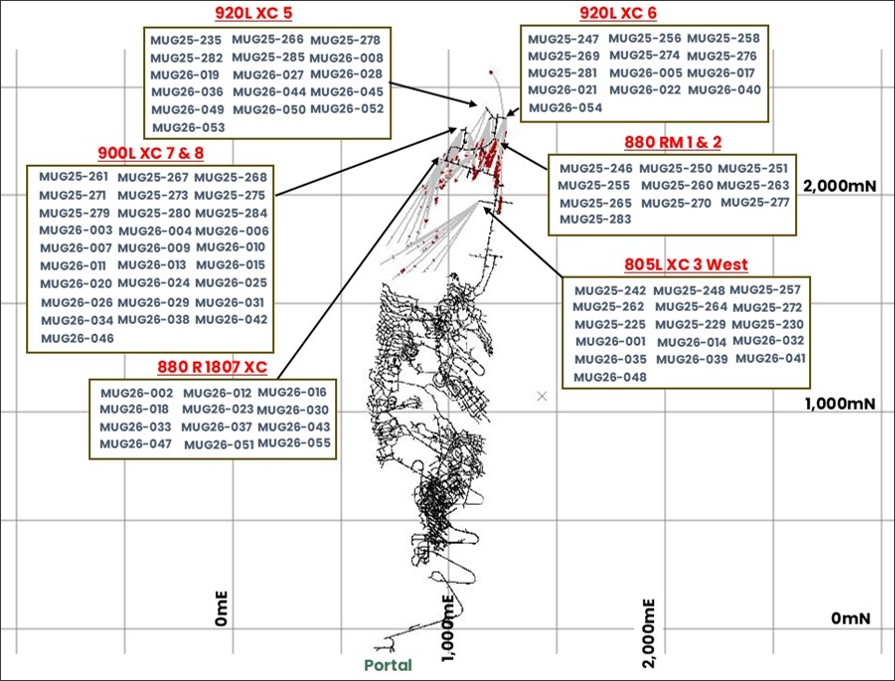
Plan view of drilling in this announcement

Article content

Figures accompanying this announcement are available at:

Article content

Article content

Article content

Article content

Article content

Article content

Article content

Article content

Article content

Article content

Read Entire Article