
.jpg) 2 hours ago
3
2 hours ago
3
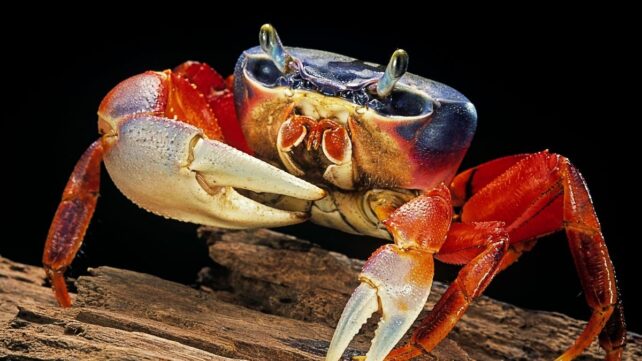 Only the truest of crabs move sideways. (Paul Starosta/Stone/Getty Images)
As you may have heard via a barrage of internet memes, evolution can't get enough of crab-like forms. The body shape of crabs has arisen on many separate occasions in natural history, in a phenomenon known as 'carcinization'.
However, one feature sets true crabs (Brachyura) apart from their lookalikes: their near-exclusive, characteristic sideways walk.
"Sideways locomotion may have contributed significantly to the ecological success of true crabs," says behavioral ecologist Yuuki Kawabata from Nagasaki University in Japan.
New research, conducted by Kawabata and a team from institutions across Japan, Taiwan, and the US, suggests the evolution of this crab walk was a singular event, which may have given the group an advantage that allowed them to rapidly diversify into different habitat niches.
"This single event contrasts starkly with carcinization, which has occurred repeatedly across decapod species," Kawabata explains. "This highlights that while body shapes may converge multiple times, behavioral changes such as sideways walking can be rare."
"There are around 7,904 species of true crabs, far exceeding that of their sister group, Anomura [hermit crabs], or their closest relatives, Astacidea [clawed lobsters and crayfish]; they have colonized diverse habitats around the world, including terrestrial, freshwater, and deep-sea environments," Kawabata points out.
Could it be that the sideways walk is the reason for this survival success story? Kawabata and team think so.
Crabs have no shortage of predators: humans, seals, otters, seabirds, octopuses, sharks, and even other larger crabs all want a bite.
The sideways walk is considered a defensive advantage for crabs to quickly dodge these mostly forward-moving predators, and if you've ever walked along a rocky groin, you'll know how fast they can scuttle away.
Contrary to the memes, evolution's 'goal' is not really to produce more crabs. If it can even be said to have a goal, it would be to produce more diversity, which improves the odds of living things surviving whatever the world throws at them.
"Such innovations can open new adaptive opportunities and yet remain constrained by phylogenetic history and ecological contexts," Kawabata says.
"With direct behavioral observations and a phylogenetic framework, this work expands our understanding of how modes of travel in animals diversify and persist through evolutionary time."
It's slightly unsettling, but some true crabs are actually an exception to the sideways rule.
In lab experiments, the researchers watched the walks of 50 different species of true crab. They found that 35 qualified as predominantly side-walkers, while only 15 walked forwards most of the time.
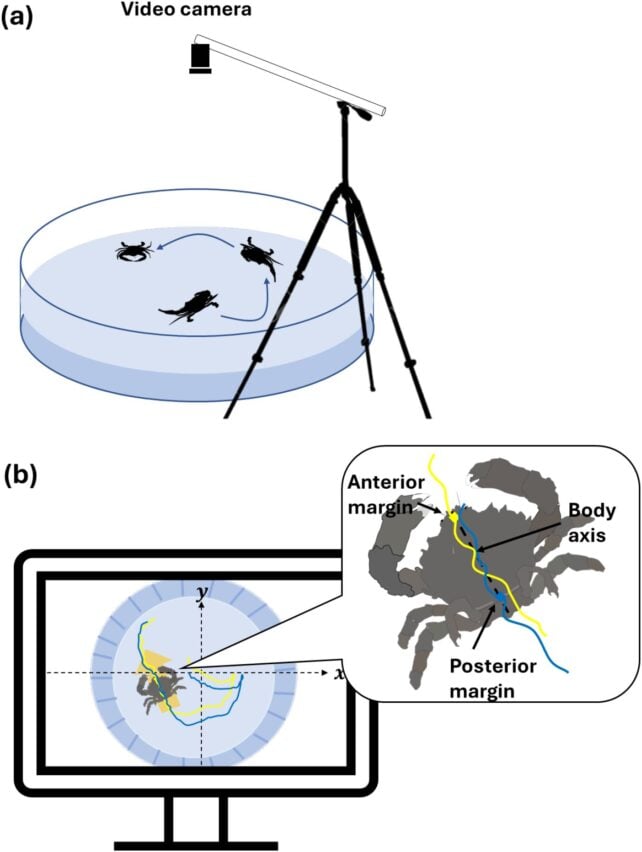 (a) Experimental setup used to record each crab's behavior. (b) Extraction of two-dimensional position coordinates from video frames. (Taniguchi et al., eLife, 2026)
By combining this analysis with a recently-constructed 'family tree' of crab genetics, the researchers found the archetypal sideways walk occurred in a single common ancestor of all true crabs that followed.
This innovation appears to have occurred about 200 million years ago, immediately after the Triassic-Jurassic extinction, when movements in Earth's crust resulted in an expansion of crabs' favorite habitat: shallow marine environments.
This also suggests that any true crabs who are now forward-movers arrived at that locomotion via the sideways route, rather than maintaining it through the millennia.
As one peer-reviewer points out, the experiment did only use one representative for each species, which is a limitation, since there's no guarantee that any one individual walks 'normally' for its kind. Further research could replicate this experiment with greater numbers from each species.
Peer reviewers also note that further detail on the crab species' anatomical differences could reveal whether body plan or locomotion style played more of a leading role in the evolution of true crabs.
They also questioned the way crabs were categorized into forward- or sideways-walkers, based on a boundary set at 60 degrees from the crab's bilateral axis.

"This boundary may be reasonable as a convention, but the paper does not explain why it is the right place to draw the line, and there is a plausible biological concern that a fixed angular cutoff does not mean the same thing across taxa," one reviewer states.
Related: Crabs Aren't The Only Things Evolution Keeps Making. An Expert Explains.
Future research could address these issues and shed more light on evolution's apparent obsession with crabs.
"To disentangle the relative roles of innovation and environmental change, we need further analyses of trait-dependent diversification, fossil-informed timelines, and performance tests that link true crabs' sideways movement to adaptive advantages," Kawabata adds.
The study is available as a peer-reviewed preprint in eLife.
 English (US)