
.jpg) 1 hour ago
4
1 hour ago
4
Article content
(Bloomberg) — The euro zone’s first signs of respite in inflation since the outbreak of the Iran war are forecast for data next week that will reflect the impact of subsiding energy costs.

THIS CONTENT IS RESERVED FOR SUBSCRIBERS ONLY
Subscribe now to read the latest news in your city and across Canada.
- Exclusive articles from Barbara Shecter, Joe O'Connor, Gabriel Friedman, and others.
- Daily content from Financial Times, the world's leading global business publication.
- Unlimited online access to read articles from Financial Post, National Post and 15 news sites across Canada with one account.
- National Post ePaper, an electronic replica of the print edition to view on any device, share and comment on.
- Daily puzzles, including the New York Times Crossword.
SUBSCRIBE TO UNLOCK MORE ARTICLES
Subscribe now to read the latest news in your city and across Canada.
- Exclusive articles from Barbara Shecter, Joe O'Connor, Gabriel Friedman and others.
- Daily content from Financial Times, the world's leading global business publication.
- Unlimited online access to read articles from Financial Post, National Post and 15 news sites across Canada with one account.
- National Post ePaper, an electronic replica of the print edition to view on any device, share and comment on.
- Daily puzzles, including the New York Times Crossword.
REGISTER / SIGN IN TO UNLOCK MORE ARTICLES
Create an account or sign in to continue with your reading experience.
- Access articles from across Canada with one account.
- Share your thoughts and join the conversation in the comments.
- Enjoy additional articles per month.
- Get email updates from your favourite authors.
THIS ARTICLE IS FREE TO READ REGISTER TO UNLOCK.
Create an account or sign in to continue with your reading experience.
- Access articles from across Canada with one account
- Share your thoughts and join the conversation in the comments
- Enjoy additional articles per month
- Get email updates from your favourite authors
Sign In or Create an Account
or
Article content
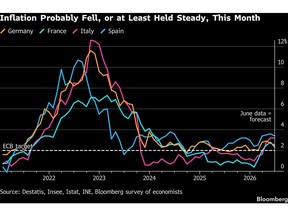
Consumer-price growth weakened to 3% in June from 3.2% the previous month after slowdowns seen across the region, according to analyst estimates. Of the four biggest euro-zone economies, lower outcomes are anticipated in every one apart from Italy.
Article content
Article content
Article content
For European Central Bank policymakers convening for the annual symposium in Portugal from Monday, the result offers an initial glimpse of the last month of data that will be available to them before their next decision.
Article content
By signing up you consent to receive the above newsletter from Postmedia Network Inc.
Article content
They raised borrowing costs earlier in June, becoming the first Group of Seven jurisdiction to do so since the war broke out. But while officials didn’t exclude an immediate follow-up hike, the likelihood of such a move in July has receded with the onset of peace talks, and associated drops in oil prices.
Article content
The 3% inflation level anticipated by economists would offer grounds for both hope and concern. It’s going in the right direction, but is still far off the central bank’s 2% target.
Article content
“Our view is that the inflation overshoot will trigger one more 25-basis-point hike in September,” Bloomberg Economics economists including Simona Delle Chiaie and David Powell wrote in a report. “However, if the decline in commodity prices triggered by the announcement of a deal between Iran and the US is sustained, the risk to our call would shift to the downside.”
Article content
Economists at Morgan Stanley reckon that the headline inflation gauge is now past its peak, though that doesn’t necessarily mean policymakers can relax.
Article content
Article content
“We did not see signs in May of indirect or second-round effects,” analysts led by Jens Eisenschmidt wrote in a note. “But risks are tilted toward some strengthening either this month or next.”
Article content
The underlying inflation measure that strips out volatile elements such as energy is predicted to stay unchanged at 2.6%. Officials have failed to get back down to 2% on that gauge since 2021.
Article content
Executive Board member Isabel Schnabel this week highlighted core inflation as one argument why more rate hikes may be needed. She already warned in May that after an energy price shock, it’s “misleading” to look at the headline measure alone because of base effects.
Article content
However, an ECB survey earlier Friday offered some relief as it showed a sharp drop in consumers’ short-term price expectations even before the recent agreement between Washington and Tehran.
Article content
Of the four big euro-region economies, Spain will be first to release numbers next week. Its result on Monday is predicted at 3.4%, down from 3.6%.
Article content
The other three are due on Tuesday. France is seen coming in at 2.3%, Italy at 3.2%, and Germany at 2.5%. The overall euro-zone outcome will arrive on Wednesday.
Article content
 English (US)