
.jpg) 13 hours ago
3
13 hours ago
3
Article content
(Bloomberg) — The European Union is set to propose softening emissions rules for new cars, scrapping an effective ban on combustion engines following months of pressure from the automotive industry.

THIS CONTENT IS RESERVED FOR SUBSCRIBERS ONLY
Subscribe now to read the latest news in your city and across Canada.
- Exclusive articles from Barbara Shecter, Joe O'Connor, Gabriel Friedman, and others.
- Daily content from Financial Times, the world's leading global business publication.
- Unlimited online access to read articles from Financial Post, National Post and 15 news sites across Canada with one account.
- National Post ePaper, an electronic replica of the print edition to view on any device, share and comment on.
- Daily puzzles, including the New York Times Crossword.
SUBSCRIBE TO UNLOCK MORE ARTICLES
Subscribe now to read the latest news in your city and across Canada.
- Exclusive articles from Barbara Shecter, Joe O'Connor, Gabriel Friedman and others.
- Daily content from Financial Times, the world's leading global business publication.
- Unlimited online access to read articles from Financial Post, National Post and 15 news sites across Canada with one account.
- National Post ePaper, an electronic replica of the print edition to view on any device, share and comment on.
- Daily puzzles, including the New York Times Crossword.
REGISTER / SIGN IN TO UNLOCK MORE ARTICLES
Create an account or sign in to continue with your reading experience.
- Access articles from across Canada with one account.
- Share your thoughts and join the conversation in the comments.
- Enjoy additional articles per month.
- Get email updates from your favourite authors.
THIS ARTICLE IS FREE TO READ REGISTER TO UNLOCK.
Create an account or sign in to continue with your reading experience.
- Access articles from across Canada with one account
- Share your thoughts and join the conversation in the comments
- Enjoy additional articles per month
- Get email updates from your favourite authors
Sign In or Create an Account
or
Article content
The European Commission will lower the requirements that would have halted sales of new gasoline and diesel-fueled cars starting in 2035, instead allowing a number of plug-in hybrids and electric vehicles with fuel-powered range extenders, according to people with knowledge of the matter.
Article content
Article content
Article content
Under the new proposal, tailpipe emissions will have to be reduced by 90% by the middle of the next decade compared with the current goal of a 100% reduction, said the people, who asked not to be identified because talks on the proposal are private. The commission will set a condition that carmakers need to compensate for the additional pollution by using low-carbon or renewable fuels or locally produced green steel.
Article content
By signing up you consent to receive the above newsletter from Postmedia Network Inc.
Article content
The stepback — to be unveiled Tuesday — follows intense lobbying from Stellantis NV, Mercedes-Benz Group AG and others. Germany, home to Mercedes, Volkswagen AG and BMW AG, also pushed for changes to ease political tensions and protect jobs. At the same time, the China-US trade war is sending more automakers into Europe as they face overcapacity and price pressures at home.
Article content
The proposal is set to be adopted by EU commissioners on Tuesday and will then be discussed by the European Parliament and by member states in the EU Council. Each institution has the right to propose their own amendments and the final shape of the measure will be negotiated in the so-called trilogue talks, which will involve the parliament, the council and the commission.
Article content
Article content
The European Commission declined to comment on the proposals.
Article content
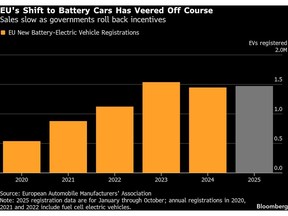
Sales of new battery-electric cars slowed last year after countries including Germany — the EU’s biggest market — withdrew purchase incentives. Although growth is recovering, helped in part by the return of some subsidies, the pace remains well short of what’s required to meet EU targets.
Article content
Uptake across the region remains highly uneven. Registrations of pure EVs accounted for 35% of sales in the Netherlands this year, compared with just 8% in Spain, where patchy charging options and comparatively high prices continue to put off some consumers.
Article content
With automakers now gaining more time to go fully electric, environmental groups are concerned the changes create new loopholes that undermine Europe’s climate ambition and leave key car manufacturers further behind China in the race to battery-powered road transport.
Article content
Italy, Germany
Article content
Earlier this month, six prime ministers including Italy’s Giorgia Meloni and Poland’s Donald Tusk lobbied the commission to allow plug-in hybrids, range extenders and fuel-cell technology after 2035. Germany has also fought to dilute the looming ban in a bid to protect its carmakers as they struggle with US trade tariffs, stiff international competition and waning demand in Europe.
Article content
Meanwhile, the continent’s high energy and labor costs are forcing auto companies to cut jobs and shift investments elsewhere.
Article content
The package will also include steps to increase the uptake of small electric vehicles made in Europe, according to documents seen by Bloomberg News on Saturday. Among them is a 10-year exemption for such cars from certain safety and emissions requirements, as well as incentives in the form of parking spaces and subsidies.
Article content
(Adds detail from seventh paragraph.)
Article content
 English (US)