
.jpg) 1 hour ago
4
1 hour ago
4
Article content
(Bloomberg) — Underneath the glass and wrought iron ceiling of Antwerp’s stock exchange last month, French President Emmanuel Macron addressed a hall full of executives from heavy industries. He wasted no time in diving into the issue everyone cared most about: Europe’s perennially high energy prices.

THIS CONTENT IS RESERVED FOR SUBSCRIBERS ONLY
Subscribe now to read the latest news in your city and across Canada.
- Exclusive articles from Barbara Shecter, Joe O'Connor, Gabriel Friedman, and others.
- Daily content from Financial Times, the world's leading global business publication.
- Unlimited online access to read articles from Financial Post, National Post and 15 news sites across Canada with one account.
- National Post ePaper, an electronic replica of the print edition to view on any device, share and comment on.
- Daily puzzles, including the New York Times Crossword.
SUBSCRIBE TO UNLOCK MORE ARTICLES
Subscribe now to read the latest news in your city and across Canada.
- Exclusive articles from Barbara Shecter, Joe O'Connor, Gabriel Friedman and others.
- Daily content from Financial Times, the world's leading global business publication.
- Unlimited online access to read articles from Financial Post, National Post and 15 news sites across Canada with one account.
- National Post ePaper, an electronic replica of the print edition to view on any device, share and comment on.
- Daily puzzles, including the New York Times Crossword.
REGISTER / SIGN IN TO UNLOCK MORE ARTICLES
Create an account or sign in to continue with your reading experience.
- Access articles from across Canada with one account.
- Share your thoughts and join the conversation in the comments.
- Enjoy additional articles per month.
- Get email updates from your favourite authors.
THIS ARTICLE IS FREE TO READ REGISTER TO UNLOCK.
Create an account or sign in to continue with your reading experience.
- Access articles from across Canada with one account
- Share your thoughts and join the conversation in the comments
- Enjoy additional articles per month
- Get email updates from your favourite authors
Sign In or Create an Account
or
Article content
It is, he said bluntly, “a weakness.”
Article content
Article content
Even before the war in Iran pushed up oil and gas prices and disrupted supplies of key fossil fuels across the globe, energy was a major concern in Europe, where power prices are far higher than in the US and China. Plants have been shut down as costs made them uneconomical, there have been repeated complaints from corporate giants like BASF SE and industries such as steelmaking, and politicians have fretted about how their economic ambitions for the region risk being undone by the problem.
Article content
Article content
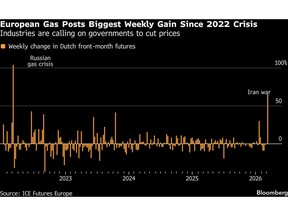
The fallout from Middle East conflict is upping the pressure to act. This week, gas prices in Europe rose to the highest in three years. The spike probably added at least €1.3 billion ($1.5 billion) to the continent’s energy costs, according to calculations by Strategic Perspectives, a climate think tank.
Article content
By signing up you consent to receive the above newsletter from Postmedia Network Inc.
Article content
Though levels are well shy of the peak seen after Russia’s full-scale invasion of Ukraine, the latest moves come amid an increasing drumbeat of calls to cut prices.
Article content
“This is really happening at the wrong time — we are very exposed to the global energy market, both in terms of prices and in terms of volume,” said Anne-Sophie Corbeau, research scholar at the Center on Global Energy Policy in Paris. “Industry is going to be thinking, ‘oh no, not another crisis.’ There aren’t any magical solutions.”
Article content
It’s fueling a frantic rush for action. Proposals have ranged from scrapping taxes to ditching costly climate policies, yet critics say that jeopardizes Europe’s ability lower energy costs in the longer term by building out renewables.
Article content
In Brussels, the scale of the concern is clear. At one meeting this week, senior EU officials warned member states that the Iran war shows that solving energy is “existential” for the bloc, according to a person familiar with the matter.
Article content
Article content
Leaders are set to hold a summit on March 19, when they will direct the European Commission to propose ways to cut prices and help industries.
Article content
One look at the decisions being made in corporate offices bears out the worries. The squeeze from energy costs is reshaping the industrial landscape, pushing companies to slow investment, shelve decarbonization projects and shift capacity elsewhere.
Article content
Versalis, the chemicals unit of Eni, is closing plants, highlighting how energy-intensive industries are reassessing whether Europe remains a competitive place to operate.
Article content
BASF Chief Executive Markus Kamieth has said that Europe “is losing industrial capacity at a speed we have never seen before.”
Article content
Energy Needs
Article content
The EU finds itself at a critical juncture. Not only is it fighting to save industries, boost competitiveness and keep up with the AI revolution — which will require power-hungry data centers — it’s also trying to boost its defense capabilities.
Article content
To meet those objectives, it will require vast amounts of energy in the coming years. Right now, it’s far from clear whether it will have enough, and at a cheap enough price.
 English (US)