
.jpg) 2 hours ago
3
2 hours ago
3
For decades, scientists have been searching for quantum spin liquids (QSLs) – materials thought to possess several special properties that could advance our understanding of magnetism and efforts to develop quantum computers.
In a new study, a material previously thought to be a QSL has turned out to be something else. The discovery suggests we need to rethink how we evaluate QSL candidates; it also reveals a brand new, non-quantum state of matter.
According to the international team of researchers behind the study, the material, cerium magnesium hexalluminate (CeMgAl11O19), has some strange, never-seen-before properties that could be very useful, but it doesn't qualify as a QSL.
"The material had been classified as a quantum spin liquid due to two properties: observation of a continuum of states and lack of magnetic ordering," says physicist Bin Gao, from Rice University in the US.
"But closer observation of the material showed that the underlying cause of these observations wasn't a quantum spin liquid phase."
Scientists have so far searched for QSLs by cooling materials to extremely low temperatures and looking for those two characteristics which CeMgAl11O19 possesses: a blurred continuum of states and chaotic magnetic behavior that doesn't follow the normal rules.
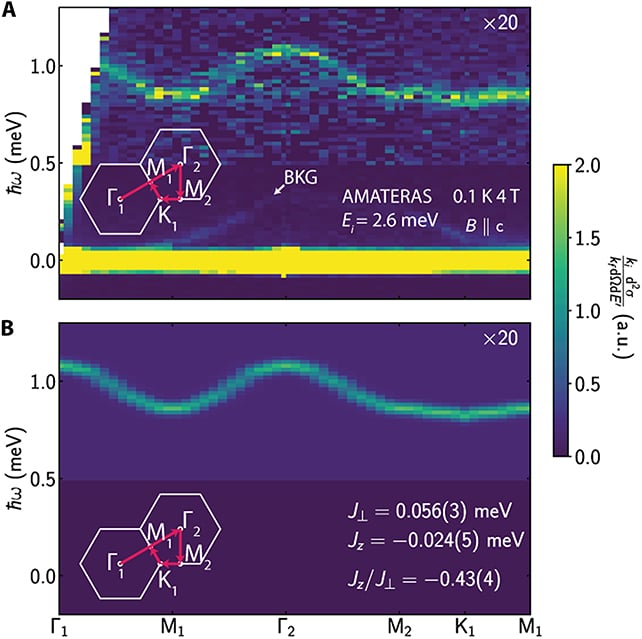 Properties of the material, including its spin waves, were used to ascertain the nature of the material. (Gao et al., Sci. Adv., 2026)
Though these materials (or more specifically, material phases) have long been theorized, and scientists have had some success with synthetic QSLs engineered in the lab, they have yet to find definitive examples occurring in nature.
What CeMgAl11O19 shows is that those two 'tell-tale' trademarks of QSLs aren't as reliable as physicists have thought.
Using a variety of techniques that included bouncing X-rays and neutrons off the crystal material, lowering its temperature, and applying magnetic fields, the researchers found the material wasn't a QSL after all.
Competing magnetic forces inside the material, plus its unusual arrangement of atoms, were in fact causing the QSL-like effects – so while CeMgAl11O19 can be ruled out as a QSL, it's still an intriguing state of matter that's new to science.
"We were interested in this material, which had a collection of characteristics we hadn't seen before," says physicist Tong Chen, from Rice University.
"It was not a quantum spin liquid, yet we were observing what we thought were quantum spin liquid-associated behaviors."

This may not seem particularly relevant to everyday life, but there are some potentially huge breakthroughs associated with QSLs, especially in the field of quantum computing.
These systems promise an exponential leap in terms of processing power, but they're still some way from becoming reality – at least in fully realized forms that are useful outside of laboratory benchmarks.
It's thought that QSLs could help improve the stability of quantum computer systems, which, in their current prototype form, are incredibly fragile and prone to errors. Potentially, QSL particles could make quantum data storage more resilient.
If these computers can be developed and optimized, then there's good reason to believe the boost in performance would benefit climate change modeling, weather forecasting, drug discoveries, and more.
It's the 'spin' in the QSL that's crucial: It refers to a certain type of momentum that a particle shows when it moves through a magnetic state. In a QSL, that momentum is notably disordered, according to current hypotheses.
Progress is definitely being made in identifying QSL candidates, though their rarity makes them challenging to track down.
While there will be some disappointment that CeMgAl11O19 isn't our first, genuine QSL, it nevertheless has a fascinating set of properties – and will serve as a useful benchmark for scientists trying to find these elusive materials.
Related: Atomic Clocks Could Reveal The Hidden Quantum Nature of Time Itself
"This is a new state of matter that, to our knowledge, we are the first to describe," says physicist Pengcheng Dai, from Rice University.
"It underscores the importance of careful observation and thorough investigation of your data."
The research has been published in Science Advances.
 English (US)