
.jpg) 1 hour ago
4
1 hour ago
4
Article content
(Bloomberg) — The European Central Bank kept borrowing costs unchanged, awaiting data to judge whether price pressures unleashed by the Iran war require additional tightening.

THIS CONTENT IS RESERVED FOR SUBSCRIBERS ONLY
Subscribe now to read the latest news in your city and across Canada.
- Exclusive articles from Barbara Shecter, Joe O'Connor, Gabriel Friedman, and others.
- Daily content from Financial Times, the world's leading global business publication.
- Unlimited online access to read articles from Financial Post, National Post and 15 news sites across Canada with one account.
- National Post ePaper, an electronic replica of the print edition to view on any device, share and comment on.
- Daily puzzles, including the New York Times Crossword.
SUBSCRIBE TO UNLOCK MORE ARTICLES
Subscribe now to read the latest news in your city and across Canada.
- Exclusive articles from Barbara Shecter, Joe O'Connor, Gabriel Friedman and others.
- Daily content from Financial Times, the world's leading global business publication.
- Unlimited online access to read articles from Financial Post, National Post and 15 news sites across Canada with one account.
- National Post ePaper, an electronic replica of the print edition to view on any device, share and comment on.
- Daily puzzles, including the New York Times Crossword.
REGISTER / SIGN IN TO UNLOCK MORE ARTICLES
Create an account or sign in to continue with your reading experience.
- Access articles from across Canada with one account.
- Share your thoughts and join the conversation in the comments.
- Enjoy additional articles per month.
- Get email updates from your favourite authors.
THIS ARTICLE IS FREE TO READ REGISTER TO UNLOCK.
Create an account or sign in to continue with your reading experience.
- Access articles from across Canada with one account
- Share your thoughts and join the conversation in the comments
- Enjoy additional articles per month
- Get email updates from your favourite authors
Sign In or Create an Account
or
Article content
The deposit rate remained at 2.25%, as anticipated by economists and investors who expect officials to follow up on June’s hike with another quarter-point move in September.
Article content
Article content
The ECB reiterated it won’t pre-commit but act one meeting at a time based on information as it arrives.
Article content
Article content
- Follow Bloomberg’s TLIV blog here
Article content
By signing up you consent to receive the above newsletter from Postmedia Network Inc.
Article content
“Uncertainty remains high and the full inflationary impact of the energy shock has yet to play out,” officials said in a statement. “The Governing Council is therefore closely monitoring the intensity and duration of the shock, as well as its indirect and second-round effects.”
Article content
Policymakers reiterated that the ECB is “well positioned” to navigate the situation.
Article content
Bonds were little-changed after the decision, leaving the 10-year Bund yield two basis points higher at 3.19%. It earlier touched 3.21%, the highest level since 2011, as surging oil and gas prices fuel inflation concerns.
Article content
Wagers on where interest rates go from here were also steady. Swaps imply a quarter-point hike in September is all but certain, with another almost fully priced by year-end. The euro held losses, down 0.2% against the dollar at around $1.1390.
Article content
The ECB’s hawkish posture preserves its status at the vanguard of Group-of-Seven central banks after it last month became the first in that club to raise rates since the Iran war began.
Article content
Back then, it warned that inflation triggered by the fighting was widening beyond just energy, while the economy stayed resilient. Now policymakers are weighing the need for further tightening measures.
Article content
Article content
The September meeting is widely seen as a natural point to deliver such a move if required, backed by new quarterly staff forecasts, inflation prints for the two prior months and more economic data including several business surveys.
Article content
While some officials were confident earlier in July that efforts toward peace in the Middle East could limit the impact of the war on euro-area consumer prices, renewed fighting has once again reawakened such concerns.
Article content
Energy prices have already surged, with Brent crude oil closing in on $100 a barrel as Iran-backed Houthi militants said they attacked two Saudi Arabian tankers in the Red Sea, threatening deeper supply disruptions. That risks putting renewed upward pressure on inflation that slowed to 2.8% in June.
Article content
When hostilities resumed earlier in July, Greece’s Yannis Stournaras, one of the most dovish Governing Council members, acknowledged that “we are back to square one.” His hawkish German colleague, Bundesbank President Joachim Nagel, stressed that the ECB will “maintain its vigilant stance.”
Article content
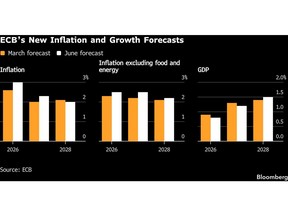
June’s staff baseline projection anticipated 3% inflation this year, followed by a moderation to 2.3% and 2% in 2027 and 2028. But core price growth, excluding energy and food, was seen staying above the ECB’s 2% goal through 2028.
 English (US)