
.jpg) 1 hour ago
3
1 hour ago
3
Article content
Bouts of volatility in the artificial intelligence trade are threatening to snowball into a rout as positioning and crowding levels flash red, with traders steeling themselves for a rollercoaster ride into the summer.

THIS CONTENT IS RESERVED FOR SUBSCRIBERS ONLY
Subscribe now to read the latest news in your city and across Canada.
- Exclusive articles from Barbara Shecter, Joe O'Connor, Gabriel Friedman, and others.
- Daily content from Financial Times, the world's leading global business publication.
- Unlimited online access to read articles from Financial Post, National Post and 15 news sites across Canada with one account.
- National Post ePaper, an electronic replica of the print edition to view on any device, share and comment on.
- Daily puzzles, including the New York Times Crossword.
SUBSCRIBE TO UNLOCK MORE ARTICLES
Subscribe now to read the latest news in your city and across Canada.
- Exclusive articles from Barbara Shecter, Joe O'Connor, Gabriel Friedman and others.
- Daily content from Financial Times, the world's leading global business publication.
- Unlimited online access to read articles from Financial Post, National Post and 15 news sites across Canada with one account.
- National Post ePaper, an electronic replica of the print edition to view on any device, share and comment on.
- Daily puzzles, including the New York Times Crossword.
REGISTER / SIGN IN TO UNLOCK MORE ARTICLES
Create an account or sign in to continue with your reading experience.
- Access articles from across Canada with one account.
- Share your thoughts and join the conversation in the comments.
- Enjoy additional articles per month.
- Get email updates from your favourite authors.
THIS ARTICLE IS FREE TO READ REGISTER TO UNLOCK.
Create an account or sign in to continue with your reading experience.
- Access articles from across Canada with one account
- Share your thoughts and join the conversation in the comments
- Enjoy additional articles per month
- Get email updates from your favourite authors
Sign In or Create an Account
or
Article content
While the long-term AI story remains intact, the immediate picture has become considerably murky. Stretched positioning, massive leverage in exchange-traded funds (ETFs), options-related hedging activity and a sharp rise in both prices and swings across semiconductors are creating a treacherous landscape.
Article content
Article content
Article content
Whether it’s active or passive funds, hedge funds or quantitative strategies, institutions or retail investors, everyone is effectively getting longer AI by the day, according to Goldman Sachs Group Inc. partner Bobby Molavi.
Article content
By signing up you consent to receive the above newsletter from Postmedia Network Inc.
Article content
“The co-correlation of strategies is a point to watch,” he said. “Feels great on the way up, but can be extremely dangerous on the unwind.”
Article content

Article content
The current market is beginning to feel eerily similar to the final months of the dot-com era, Molavi said, when investors typically got used to taking sudden five per cent moves in their stride. This raises the question of “what happens if 10 per cent breaks, and whether there is no floor in sight after that,” he said.
Article content
Doubts about the future returns on the vast investments by the big tech hyperscalers are back at the forefront. This time, however, they are being funded by even larger stock and debt issuance, just as lofty long-term earnings expectations for chipmakers are raising questions about how realistic they really are.
Article content
One of the biggest worries is the rapid proliferation of leveraged ETFs. Accounting for about US$200 billion in assets, every one per cent move in the underlying index triggers roughly US$9 billion of rebalancing in the same direction due to a significant short-gamma effect. Technology and momentum-driven strategies account for roughly 85 per cent of these ETFs, exacerbating swings across the sector.
Article content
Article content
Article content
For Nomura cross-asset strategist Charlie McElligott, the AI trade has become a perpetual motion machine. The unusual combination of rising prices and higher volatility across areas such as chips, memory, servers, opticals and networking is feeding market weightings, creating a powerful feedback loop.
Article content
Article content
Meanwhile, leveraged ETFs are buying the upside, a combination that “exposes us to collapsing under the weight of the delta on even just profit-taking-turned-waterfall,” McElligott said.
Article content
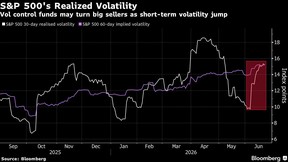
Realized volatility has been rising sharply as well. A continuation of sharp moves like those seen this week is likely to turn volatility-control funds into heavy sellers, according to McElligott. He estimates US$21 billion of selling flows on two weeks of daily one per cent moves in the S&P 500, and US$41 billion on 1.5 per cent moves.
Article content

Article content
Doubts over AI are likely to reinforce the need for rotation into the next trade. Prime brokers, including those at UBS Group AG, are flagging that some hedge funds have started reducing exposure to crowded trades in a bid to diversify.
 English (US)