
.jpg) 1 hour ago
3
1 hour ago
3
Article content
(Bloomberg) — Chinese spies stealing Japanese industrial secrets in boardrooms. Chip smugglers ferrying Nvidia’s prized artificial intelligence semiconductors via Japan. Drug gangs quietly slipping fentanyl across Japan’s borders to a US opioid crisis.

THIS CONTENT IS RESERVED FOR SUBSCRIBERS ONLY
Subscribe now to read the latest news in your city and across Canada.
- Exclusive articles from Barbara Shecter, Joe O'Connor, Gabriel Friedman, and others.
- Daily content from Financial Times, the world's leading global business publication.
- Unlimited online access to read articles from Financial Post, National Post and 15 news sites across Canada with one account.
- National Post ePaper, an electronic replica of the print edition to view on any device, share and comment on.
- Daily puzzles, including the New York Times Crossword.
SUBSCRIBE TO UNLOCK MORE ARTICLES
Subscribe now to read the latest news in your city and across Canada.
- Exclusive articles from Barbara Shecter, Joe O'Connor, Gabriel Friedman and others.
- Daily content from Financial Times, the world's leading global business publication.
- Unlimited online access to read articles from Financial Post, National Post and 15 news sites across Canada with one account.
- National Post ePaper, an electronic replica of the print edition to view on any device, share and comment on.
- Daily puzzles, including the New York Times Crossword.
REGISTER / SIGN IN TO UNLOCK MORE ARTICLES
Create an account or sign in to continue with your reading experience.
- Access articles from across Canada with one account.
- Share your thoughts and join the conversation in the comments.
- Enjoy additional articles per month.
- Get email updates from your favourite authors.
THIS ARTICLE IS FREE TO READ REGISTER TO UNLOCK.
Create an account or sign in to continue with your reading experience.
- Access articles from across Canada with one account
- Share your thoughts and join the conversation in the comments
- Enjoy additional articles per month
- Get email updates from your favourite authors
Sign In or Create an Account
or
Article content
Across a range of industries, Japan’s economic-security vulnerabilities have been on display in a slew of recent incidents. The cases show how foreign actors increasingly see Japan as an attractive target — and, in some instances, a convenient gateway — for espionage and other illicit activities.
Article content
Article content
Article content
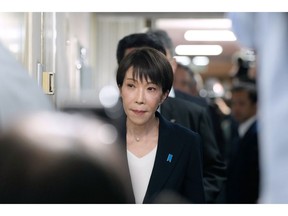
That’s helping drive Japan’s most ambitious economic-security push in years under Prime Minister Sanae Takaichi, a longtime advocate of stronger safeguards against such threats. Her administration is on the cusp of launching what’s been billed as the Japanese equivalent to the Committee on Foreign Investment in the US, or CFIUS, in an effort to broaden and intensify reviews of overseas funds eyeing local targets.
Article content
By signing up you consent to receive the above newsletter from Postmedia Network Inc.
Article content
“Takaichi is pushing forward through the menu of economic security policies that policymakers, bureaucrats, even academia have been advocating over the last few years and actually implementing it,” said Akira Igata, who leads the Economic Security Intelligence Lab at the University of Tokyo.
Article content
Like its US counterpart, Japan’s CFIUS — which is set to launch Monday — will coordinate across government ministries to vet foreign investments for national security risks. That differs from the current approach, in which reviews are largely just handled by the Finance Ministry and the ministry overseeing the relevant industry.
Article content
The panel is being established as part of a recent revision to the Foreign Exchange and Foreign Trade Act. The new legislation also expands pre-screening requirements to cover certain cases of indirect ownership and gives authorities broader powers to examine transactions by high-risk investors — such as foreign governments or state-controlled entities — even outside traditionally sensitive sectors.
Article content
Article content
Japan’s foreign investment pre-screening filings have climbed in recent years since a previous overhaul of FEFTA in 2019. Before then, foreign activist funds could acquire up to 10% of a company’s shares without government scrutiny. But after, the threshold was lowered to 1%, capturing far more attempts by activist investors to influence target companies.
Article content
After meeting with Japanese officials last month, Treasury Secretary Scott Bessent touted the US’s support for Japan’s efforts to build an investment screening mechanism.
Article content
Before she ascended to the premiership, Takaichi served as chief of her party’s cybersecurity headquarters and then as the minister in charge of economic security from 2022-2024. In the more recent role, she worked extensively on legislation to protect the nation’s supply chains, infrastructure and technology from global risks. Japan’s leader has since driven the expansion and revision of that law, known as the Economic Security Promotion Act.
Article content
The US CFIUS heavily focuses on threats from China, and Japan’s will probably be no different.
 English (US)