
.jpg) 1 hour ago
2
1 hour ago
2
Article content
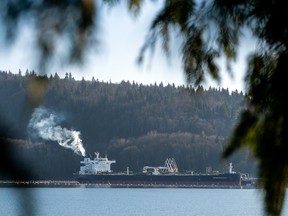
Chinese buyers are paying a premium for Canadian oil as the Iran War curtails supplies from their main sources in the Middle East.

THIS CONTENT IS RESERVED FOR SUBSCRIBERS ONLY
Subscribe now to read the latest news in your city and across Canada.
- Exclusive articles from Barbara Shecter, Joe O'Connor, Gabriel Friedman, and others.
- Daily content from Financial Times, the world's leading global business publication.
- Unlimited online access to read articles from Financial Post, National Post and 15 news sites across Canada with one account.
- National Post ePaper, an electronic replica of the print edition to view on any device, share and comment on.
- Daily puzzles, including the New York Times Crossword.
SUBSCRIBE TO UNLOCK MORE ARTICLES
Subscribe now to read the latest news in your city and across Canada.
- Exclusive articles from Barbara Shecter, Joe O'Connor, Gabriel Friedman and others.
- Daily content from Financial Times, the world's leading global business publication.
- Unlimited online access to read articles from Financial Post, National Post and 15 news sites across Canada with one account.
- National Post ePaper, an electronic replica of the print edition to view on any device, share and comment on.
- Daily puzzles, including the New York Times Crossword.
REGISTER / SIGN IN TO UNLOCK MORE ARTICLES
Create an account or sign in to continue with your reading experience.
- Access articles from across Canada with one account.
- Share your thoughts and join the conversation in the comments.
- Enjoy additional articles per month.
- Get email updates from your favourite authors.
THIS ARTICLE IS FREE TO READ REGISTER TO UNLOCK.
Create an account or sign in to continue with your reading experience.
- Access articles from across Canada with one account
- Share your thoughts and join the conversation in the comments
- Enjoy additional articles per month
- Get email updates from your favourite authors
Sign In or Create an Account
or
Article content
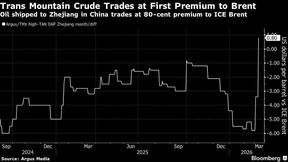
Canadian barrels now have a US$2 to US$3 advantage in Asia because of increased rates to charter a tanker and higher risk premiums for insurance in the Middle East, said Patrick O’Rourke, managing director of ATB Cormark Capital Markets. On Monday, heavy crude shipped off the Trans Mountain pipeline for China traded at an 80 cent premium to ICE Brent for the first time since Argus Media introduced the price September 2024.
Article content
Article content
Article content
Article content
In the past two weeks at least five ships were booked on a preliminary basis to deliver crude from Alberta’s oilsands to China, according to shipping reports compiled by Bloomberg. The vessels were chartered by companies including Chinese trader Unipec America Inc., Shell PLC and Exxon Mobil Corp.
Article content
Those bookings indicate shippers are willing to pay to transport oil on a pricier spot basis. Shipping costs have soared by more than 70 per cent since the start of the month, with the cost to transport Trans Mountain oil at about US$10 per barrel, compared with US$5.80 earlier, according to Bloomberg calculations.
Article content
The push for the safety of Canada is a boon for the country’s oil producers after nearly a decade when investors and international oil companies shifted their focus away from the oilsands to other markets, including the US shale patch.
Article content
“Where we see some opportunity for Canada is in a re-rating of the assets of the companies,” O’Rourke said in Calgary last week. “We’re seen as consistent safe haven, stable jurisdiction.”
Article content
The Iran War that started more than 10 days ago has wreaked havoc on the global oil market, bringing to a near halt tankers coming out of the Strait of Hormuz, a chokepoint where as much as 20 per cent of world crude supply flows.
Article content
Article content
On Monday, crude futures briefly surged above US$100 a barrel for the first time since June of 2022, before falling back down to below US$90. The world’s biggest oil exporter, Saudi Arabia, has started reducing oil production, along with the United Arab Emirates, Kuwait and Iraq.
Article content
Read More
Article content
The war is likely to shift perceptions of Middle Eastern countries as stable sources of oil. Asian buyers would “probably be trying to secure some supply already,” O’Rourke said. “There’s clearly demand coming from that region of the world for the barrels.”
Article content
Chinese refiners were already buying increasing volumes of high-sulfur, dense crude from Canada’s oilsands since the start of the Trans Mountain expansion pipeline in 2024, offsetting some volumes from the Middle East such as Iraqi Basrah Heavy. That is poised to continue if the war drags on, Susan Bell, senior vice president of downstream research at Rystad Energy in Calgary, said by phone.
Article content
“If it gets to the point where Asia truly is pinched on crude oil supply, then I would really expect to see Trans Mountain pipeline spot capacity fill up and that pull into the Asian market,” she said.
 English (US)