
.jpg) 1 hour ago
3
1 hour ago
3
Article content
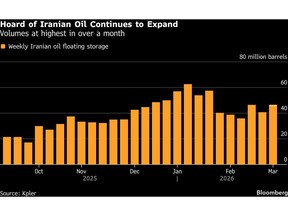
(Bloomberg) — A hoard of Iranian oil on tankers at sea and swelling onshore inventories in China will provide an initial cushion for the world’s biggest importer from the fallout of the conflict in the Middle East.

THIS CONTENT IS RESERVED FOR SUBSCRIBERS ONLY
Subscribe now to read the latest news in your city and across Canada.
- Exclusive articles from Barbara Shecter, Joe O'Connor, Gabriel Friedman, and others.
- Daily content from Financial Times, the world's leading global business publication.
- Unlimited online access to read articles from Financial Post, National Post and 15 news sites across Canada with one account.
- National Post ePaper, an electronic replica of the print edition to view on any device, share and comment on.
- Daily puzzles, including the New York Times Crossword.
SUBSCRIBE TO UNLOCK MORE ARTICLES
Subscribe now to read the latest news in your city and across Canada.
- Exclusive articles from Barbara Shecter, Joe O'Connor, Gabriel Friedman and others.
- Daily content from Financial Times, the world's leading global business publication.
- Unlimited online access to read articles from Financial Post, National Post and 15 news sites across Canada with one account.
- National Post ePaper, an electronic replica of the print edition to view on any device, share and comment on.
- Daily puzzles, including the New York Times Crossword.
REGISTER / SIGN IN TO UNLOCK MORE ARTICLES
Create an account or sign in to continue with your reading experience.
- Access articles from across Canada with one account.
- Share your thoughts and join the conversation in the comments.
- Enjoy additional articles per month.
- Get email updates from your favourite authors.
THIS ARTICLE IS FREE TO READ REGISTER TO UNLOCK.
Create an account or sign in to continue with your reading experience.
- Access articles from across Canada with one account
- Share your thoughts and join the conversation in the comments
- Enjoy additional articles per month
- Get email updates from your favourite authors
Sign In or Create an Account
or
Article content
Currently there are more than 46 million barrels of Iranian crude on vessels in Asia, with close to 80% of the ships anchored in the Singapore Strait and off the Chinese coast, according to data from Kpler Ltd. China also stockpiled crude at onshore sites over the past year at a rapid rate, including for strategic storage, which helped to buffer the broader global market from rising supply.
Article content
Article content
Article content
“China has been very wisely stockpiling a lot of crude last year so they have a buffer to overcome the current crisis,” Jorge León, head of geopolitical analysis at Rystad Energy, told Bloomberg Television on Monday.
Article content
By signing up you consent to receive the above newsletter from Postmedia Network Inc.
Article content
Oil surged on Monday following US and Israeli strikes on Iran over the weekend, with traders focusing on the effective closure of the Strait of Hormuz — a narrow waterway through which about a fifth of the world’s crude flows from the Persian Gulf to major markets such as India and China.
Article content
If shipping remains disrupted, state-owned refiners may be able to tap strategic oil reserves, said traders who are involved in the Middle East and Asian oil markets. Some refineries could be required schedule unplanned maintenance, the people added, asking to be identified as they’re not authorized to speak to the media.
Article content
China, however, is acutely aware of its energy vulnerability and has invested in diversifying its suppliers of oil and in alternatives to seaborne volumes.
Article content
“It vindicates China’s energy security strategy of supply diversification, stockpiling and demand substitution,” said Michal Meidan, head of China energy research at the Oxford Institute for Energy Studies. “Hormuz remains a key transit point, but the Chinese leadership has kept the share of Middle Eastern crude capped at around 50% of total imports.”
Article content
Article content
The situation would ultimately be more challenging for independent refiners, known as teapots, which operate on thin margins and have relied on cheaper oil from Iran, Russia, and Venezuela to keep their operations going. That pool of discounted crude has shrunk after US intervention in Venezuela earlier this year, and a prolonged conflict in the Middle East could crimp Iranian flows.
Article content
Even so, there is plentiful supply for now. Shandong — home to most of these processors — has the highest crude inventories across all of China’s provinces, according to Rystad Energy. Additional influx of Russian oil displaced from India in recent months have also helped to buoy supplies for these refiners.
Article content
—With assistance from Alan Wong.
Article content
(Updates with chart, detail from paragraph six.)
Article content
 English (US)