
.jpg) 1 hour ago
4
1 hour ago
4
Article content
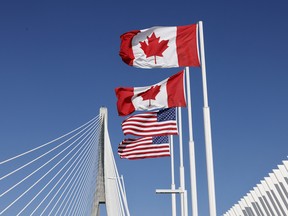
Canada can afford to stick out its escalating trade fight with the United States rather than accept a bad deal since time may ultimately favour the country despite the economic imbalance, says former Canadian ambassador to the United States Frank McKenna.

THIS CONTENT IS RESERVED FOR SUBSCRIBERS ONLY
Subscribe now to read the latest news in your city and across Canada.
- Exclusive articles from Barbara Shecter, Joe O'Connor, Gabriel Friedman, and others.
- Daily content from Financial Times, the world's leading global business publication.
- Unlimited online access to read articles from Financial Post, National Post and 15 news sites across Canada with one account.
- National Post ePaper, an electronic replica of the print edition to view on any device, share and comment on.
- Daily puzzles, including the New York Times Crossword.
SUBSCRIBE TO UNLOCK MORE ARTICLES
Subscribe now to read the latest news in your city and across Canada.
- Exclusive articles from Barbara Shecter, Joe O'Connor, Gabriel Friedman and others.
- Daily content from Financial Times, the world's leading global business publication.
- Unlimited online access to read articles from Financial Post, National Post and 15 news sites across Canada with one account.
- National Post ePaper, an electronic replica of the print edition to view on any device, share and comment on.
- Daily puzzles, including the New York Times Crossword.
REGISTER / SIGN IN TO UNLOCK MORE ARTICLES
Create an account or sign in to continue with your reading experience.
- Access articles from across Canada with one account.
- Share your thoughts and join the conversation in the comments.
- Enjoy additional articles per month.
- Get email updates from your favourite authors.
THIS ARTICLE IS FREE TO READ REGISTER TO UNLOCK.
Create an account or sign in to continue with your reading experience.
- Access articles from across Canada with one account
- Share your thoughts and join the conversation in the comments
- Enjoy additional articles per month
- Get email updates from your favourite authors
Sign In or Create an Account
or
Article content
“Time is on our side,” the former New Brunswick premier said. “It’s not good for investors. It’s not good for consumer confidence. But the wait is just as painful for the United States as it is for Canada. And Canadians have a high level of resolve.”
Article content
Article content
Article content
McKenna, deputy chair of TD Bank Financial Group, pointed to Canada’s fiscal position, higher revenues and continued investment as reasons the country has room to absorb more economic damage.
Article content
By signing up you consent to receive the above newsletter from Postmedia Network Inc.
Article content
The trade fight escalated again Tuesday when Canadian counter-tariffs took effect on $27.6-billion worth of U.S. goods, matching the 50 per cent the U.S. tariffs levied last month. U.S. President Donald Trump responded by outlining plans to ban imports of certain Canadian alcohol, dairy and other products starting Sept. 29.
Article content
He also expanded the range of Canadian goods subject to the U.S.’s 50 per cent tariffs and directed that $50-billion worth of Canadian products be stripped from major U.S. government procurement contracts.
Article content
Paul Beaudry, a professor at the University of British Columbia’s Vancouver School of Economics and former deputy governor of the Bank of Canada, also said Canada can withstand a prolonged dispute, but the costs will be greater for the country because it depends far more heavily on trade with the U.S.
Article content
“It’s not like the economy is collapsing through these tariffs,” he said. “It’s kind of like a hard adjustment.”
Article content
Article content
Despite that imbalance, Beaudry does not believe giving ground is the better option.
Article content
Article content
“Waiting it out is, at this point, the right approach,” he said. “If someone’s trying to push you around, sometimes you just have to stand up to it.”
Article content
Beaudry said the tariffs are hitting industries such as autos, steel and aluminum the hardest, but those industries represent a relatively small share of the overall economy. For example, motor vehicle and parts manufacturing and primary metal manufacturing together account for roughly 1.5 per cent of the country’s economy, according to Statistics Canada.
Article content
But the longer the uncertainty persists, the greater the potential consequences for investment, particularly in the auto sector, he said, with some automakers already reconsidering or postponing investment plans in Canada.
Article content
Despite that uncertainty, McKenna said the substantive differences separating the two countries are relatively narrow and most trade remains uncontentious, he said, with autos emerging as the biggest unresolved economic issue.
Article content
The divide centres on how much auto production remains in Canada as the Trump administration pushes to shift more manufacturing to the U.S., while Canada seeks to preserve its share of the integrated North American industry.
 English (US)