
.jpg) 2 hours ago
3
2 hours ago
3
Article content
(Bloomberg) — Andy Burnham, the prime ministerial-hopeful who markets worry may be too far to the Left, has at least one economic idea that should go down well across the political spectrum: reverse deindustrialization.

THIS CONTENT IS RESERVED FOR SUBSCRIBERS ONLY
Subscribe now to read the latest news in your city and across Canada.
- Exclusive articles from Barbara Shecter, Joe O'Connor, Gabriel Friedman, and others.
- Daily content from Financial Times, the world's leading global business publication.
- Unlimited online access to read articles from Financial Post, National Post and 15 news sites across Canada with one account.
- National Post ePaper, an electronic replica of the print edition to view on any device, share and comment on.
- Daily puzzles, including the New York Times Crossword.
SUBSCRIBE TO UNLOCK MORE ARTICLES
Subscribe now to read the latest news in your city and across Canada.
- Exclusive articles from Barbara Shecter, Joe O'Connor, Gabriel Friedman and others.
- Daily content from Financial Times, the world's leading global business publication.
- Unlimited online access to read articles from Financial Post, National Post and 15 news sites across Canada with one account.
- National Post ePaper, an electronic replica of the print edition to view on any device, share and comment on.
- Daily puzzles, including the New York Times Crossword.
REGISTER / SIGN IN TO UNLOCK MORE ARTICLES
Create an account or sign in to continue with your reading experience.
- Access articles from across Canada with one account.
- Share your thoughts and join the conversation in the comments.
- Enjoy additional articles per month.
- Get email updates from your favourite authors.
THIS ARTICLE IS FREE TO READ REGISTER TO UNLOCK.
Create an account or sign in to continue with your reading experience.
- Access articles from across Canada with one account
- Share your thoughts and join the conversation in the comments
- Enjoy additional articles per month
- Get email updates from your favourite authors
Sign In or Create an Account
or
Article content
Trouble is, it’s unlikely to create the jobs everyone wants — “pie in the sky,” says Jim Tomlinson, a professor at the University of Glasgow. “I would regard it as a kind of romanticization of what’s possible.”
Article content
Article content
Article content
In a globalized world, where supply chains can be severed overnight, reindustrialization has become the white whale of G-7 political leaders. But the problems are especially acute in Britain, which has the smallest industrial base and the highest energy costs of its wealthy-nation peers.
Article content
By signing up you consent to receive the above newsletter from Postmedia Network Inc.
Article content
Burnham, who is standing in a special election Thursday in the Makerfield seat in Wigan, one of northern England’s many post-industrial towns, sees an opportunity to tap nostalgia over lost factory work as he plots a path to 10 Downing Street. Like right-wing leader Nigel Farage, whose Reform party candidate is polling second in Makerfield, Burnham is tapping into memories of what voters believe were better times.
Article content
“Britain has been on the wrong path,” Burnham said in Leeds last month when he kicked off his campaign, lamenting the past 40 years of government policy. “The deindustrialization of the 1980s was devastating for places across Makerfield, the draining away of economic social and political power.”
Article content
The causes and culprits fill hundreds of miles of library shelves around the world, but UK manufacturing output has continued to grow since Thatcher left office in 1990 — up 83% gain in gross value added for the sector.
Article content
Article content
That’s small comfort to Andrew Wilby, managing director of Britain’s last bell foundry, John Taylor & Co. Squeezed between his penurious customers and surging energy costs, Wilby is fighting to avoid becoming a relic for tourists and historians – like the St Paul’s and York Minster cathedrals that ring the bells made by his Loughborough-based foundry.
Article content
“We’re still breathing,” says Wilby. “It’s not going to happen if we can help it, but you can get to the point where there’s not the money in it to sustain it.”
Article content
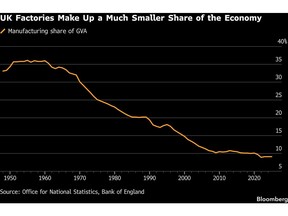
Deindustrialization has largely been a story of disappearing factory jobs and a dwindling share of the economy since the peaks of the 1950s and 1960s. In the late 1950s, it accounted for more than 8 million jobs, falling to below 5 million in 1990 and around 2.5 million by the end of last year — or 7% of the workforce.
Article content
When Thatcher left office in 1990, manufacturing was 19% of the economy – down from one third in the 1960s; in 2025, it made up just 9%, Office for National Statistics data shows.
Article content
With factories increasingly reliant on automation and sophisticated technology, any manufacturing revival is unlikely to provide a major source of new jobs, not least for unskilled workers.
 English (US)