
.jpg) 1 hour ago
3
1 hour ago
3
Article content
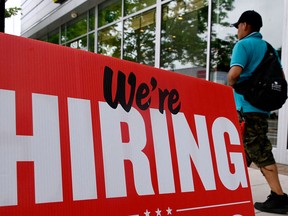
Canada’s unemployment rate fell to a two-year low of 6.4 per cent in July as the economy added 75,000 jobs across a wide range of industries, Statistics Canada said Friday.

THIS CONTENT IS RESERVED FOR SUBSCRIBERS ONLY
Subscribe now to read the latest news in your city and across Canada.
- Exclusive articles from Barbara Shecter, Joe O'Connor, Gabriel Friedman, and others.
- Daily content from Financial Times, the world's leading global business publication.
- Unlimited online access to read articles from Financial Post, National Post and 15 news sites across Canada with one account.
- National Post ePaper, an electronic replica of the print edition to view on any device, share and comment on.
- Daily puzzles, including the New York Times Crossword.
SUBSCRIBE TO UNLOCK MORE ARTICLES
Subscribe now to read the latest news in your city and across Canada.
- Exclusive articles from Barbara Shecter, Joe O'Connor, Gabriel Friedman and others.
- Daily content from Financial Times, the world's leading global business publication.
- Unlimited online access to read articles from Financial Post, National Post and 15 news sites across Canada with one account.
- National Post ePaper, an electronic replica of the print edition to view on any device, share and comment on.
- Daily puzzles, including the New York Times Crossword.
REGISTER / SIGN IN TO UNLOCK MORE ARTICLES
Create an account or sign in to continue with your reading experience.
- Access articles from across Canada with one account.
- Share your thoughts and join the conversation in the comments.
- Enjoy additional articles per month.
- Get email updates from your favourite authors.
THIS ARTICLE IS FREE TO READ REGISTER TO UNLOCK.
Create an account or sign in to continue with your reading experience.
- Access articles from across Canada with one account
- Share your thoughts and join the conversation in the comments
- Enjoy additional articles per month
- Get email updates from your favourite authors
Sign In or Create an Account
or
Article content
Here’s what economists had to say about the latest jobs numbers and what they could mean for the Bank of Canada’s future interest rate decisions.
Article content
Article content
‘Clear signs of recovery’: TD Economics
Article content
Beyond the job gains, July’s lower unemployment rate was “encouraging,” given that hiring outpaced the “sizeable” 61,000 gain in the labour force, said Andrew Hencic, director and senior economist at TD Economics.
Article content
Article content
“This shows the economy was able to absorb more labour market slack in July,” Hencic said in a note. “When coupled with the strong bounce-back in activity in the second quarter, some additional momentum on jobs in July is nice to see.”
Article content
By signing up you consent to receive the above newsletter from Postmedia Network Inc.
Article content
Hencic said the labour market is showing “clear signs of recovery,” but the country’s 6.4 per cent unemployment rate “continues to signal an economy operating with some slack.”
Article content
“Together with the prospect of new tariffs coming into effect on August 19th, the downside risks to the economy remain,” he said. “We continue to expect the unemployment rate to gradually decline in the coming months as the economy deals with the volatility in energy prices and potentially more trade headwinds.”
Article content
Against this backdrop, TD Economics expects the Bank of Canada to hold its benchmark interest rate at 2.25 per cent for the rest of the year.
Article content
Gains ‘much stronger’ than expected: Capital Economics
Article content
July’s job gains were “much stronger” than the 15,000 economists had expected, Capital Economics Ltd. senior North America economist Ariane Curtis said in a note.
Article content
Article content
“There was really nothing in the report to dislike, with the strength in employment reflecting a rise in both full-time and part-time employment and driven entirely by the private sector and to a lesser extent self-employment, while the number of public sector employees fell,” she said.
Article content
Article content
Average hourly wages were up 2.8 per cent year-over-year in July but down from 3.3 per cent in June, which Curtis said will provide some “comfort” to the Bank of Canada that the recent employment gains haven’t contributed to stronger wage pressures yet.
Article content
“While the Bank of Canada is likely to sound more hawkish following the fall in the unemployment rate, they are unlikely to rush into tightening policy given the ongoing softness of wage growth core inflation,” she said. “Indeed, for now we are sticking to our view that the Bank will remain on hold this year.”
Article content
‘Lots of sizzle and steak’: KPMG Canada
Article content
KPMG Canada chief economist Ali Jaffery said in a note that after holding back due to worries about trade, businesses are “getting on with it” and starting to hire again.
Article content
“These job gains are not being driven by new entrants, because population and labour force growth remain relatively soft,” he said. “Rather, they reflect unemployed workers finding jobs. The number of unemployed people has declined for three consecutive months, for a cumulative decrease of 112,000.”
 English (US)