
.jpg) 1 hour ago
3
1 hour ago
3
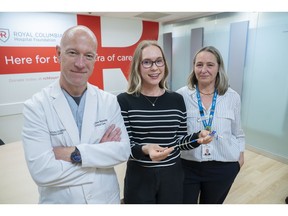
Article content
Royal Columbian Hospital and Simon Fraser University researchers report reduction in central-line complications in JAMA-published Canadian ICU study

THIS CONTENT IS RESERVED FOR SUBSCRIBERS ONLY
Subscribe now to read the latest news in your city and across Canada.
- Exclusive articles from Barbara Shecter, Joe O'Connor, Gabriel Friedman, and others.
- Daily content from Financial Times, the world's leading global business publication.
- Unlimited online access to read articles from Financial Post, National Post and 15 news sites across Canada with one account.
- National Post ePaper, an electronic replica of the print edition to view on any device, share and comment on.
- Daily puzzles, including the New York Times Crossword.
SUBSCRIBE TO UNLOCK MORE ARTICLES
Subscribe now to read the latest news in your city and across Canada.
- Exclusive articles from Barbara Shecter, Joe O'Connor, Gabriel Friedman and others.
- Daily content from Financial Times, the world's leading global business publication.
- Unlimited online access to read articles from Financial Post, National Post and 15 news sites across Canada with one account.
- National Post ePaper, an electronic replica of the print edition to view on any device, share and comment on.
- Daily puzzles, including the New York Times Crossword.
REGISTER / SIGN IN TO UNLOCK MORE ARTICLES
Create an account or sign in to continue with your reading experience.
- Access articles from across Canada with one account.
- Share your thoughts and join the conversation in the comments.
- Enjoy additional articles per month.
- Get email updates from your favourite authors.
THIS ARTICLE IS FREE TO READ REGISTER TO UNLOCK.
Create an account or sign in to continue with your reading experience.
- Access articles from across Canada with one account
- Share your thoughts and join the conversation in the comments
- Enjoy additional articles per month
- Get email updates from your favourite authors
Sign In or Create an Account
or
Article content
NEW WESTMINSTER, British Columbia, May 19, 2026 (GLOBE NEWSWIRE) — A BC-led clinical research team is behind a study that could help improve care for critically ill patients in intensive care units worldwide. Researchers from Royal Columbian Hospital and Simon Fraser University have published findings in the Journal of the American Medical Association (JAMA), one of the world’s most recognized peer-reviewed medical journals.
Article content
Article content
Article content
Article content

Article content
Article content
The study, known as the CLiCK trial, examined central venous access devices, often called central lines, in adult intensive care unit (ICU) patients and was presented by senior author Dr. Steven Reynolds at the American Thoracic Society International Conference on May 18th.
Article content
By signing up you consent to receive the above newsletter from Postmedia Network Inc.
Article content
At issue are the catheters used to deliver fluids, medications, antibiotics and nutrition to the majority of critical care patients in hospital ICUs. While central-line care is essential for many of these patients, their use may lead to risk for infection and functionality may be impeded by clotting in the catheter lumen. When one of the line channels is not being used, clinicians place a small amount of fluid (called a ‘catheter lock’) inside it to help keep the line open. A multi-centre clinical trial found that adding a 4% tetrasodium ethylenediaminetetraacetic acid (t-EDTA) locking solution was associated with a significant reduction in a composite measure of these complications.
Article content
The trial included 1,468 adult ICU patients at six Canadian hospitals: Royal Columbian Hospital, Surrey Memorial Hospital, Royal Jubilee Hospital, Nanaimo Regional General Hospital, St. Boniface Hospital and Burnaby Hospital. The trial was a triple-blind, multi-centre, cluster-randomized crossover trial designed to compare usual care with the study solution across busy ICU settings.
Article content
Article content
“This study tested a very practical question in ICU care: can we do more to keep central lines working safely for critically ill patients?” said Dr. Steven Reynolds, Critical Care Physician at Royal Columbian Hospital, Associate Professor in the Department of Biomedical Physiology and Kinesiology at Simon Fraser University, and Executive Lead of Royal Columbian Hospital Foundation’s Advancing Innovation in Medicine Institute (AIM). “Central lines are essential for many ICU patients, but complications can interrupt care and result in additional treatment. Because these lines are used in ICUs around the world, evidence on how to reduce complications can matter beyond one hospital or one health system. The trial found a significantly lower rate in a clinically relevant composite outcome, driven most clearly by fewer catheter occlusions requiring alteplase. It gives clinicians and health systems around the world evidence to consider, while also pointing to questions that need further study.”
Article content
The study’s first author is Marlena Ornowska, whose work on this study was part of her PhD thesis completed at Simon Fraser University’s Department of Biomedical Physiology and Kinesiology. She also holds a Research Associate position with AIM. Her doctoral work was central to the trial’s design, coordination and manuscript development.
 English (US)