
.jpg) 58 minutes ago
3
58 minutes ago
3
Article content
(Bloomberg) — South Korea’s central bank is widely expected to keep its policy rate unchanged this week, with investors watching for signs policymakers are formally shifting to a hawkish stance as inflation risks intensify and growth proves more resilient than expected.

THIS CONTENT IS RESERVED FOR SUBSCRIBERS ONLY
Subscribe now to read the latest news in your city and across Canada.
- Exclusive articles from Barbara Shecter, Joe O'Connor, Gabriel Friedman, and others.
- Daily content from Financial Times, the world's leading global business publication.
- Unlimited online access to read articles from Financial Post, National Post and 15 news sites across Canada with one account.
- National Post ePaper, an electronic replica of the print edition to view on any device, share and comment on.
- Daily puzzles, including the New York Times Crossword.
SUBSCRIBE TO UNLOCK MORE ARTICLES
Subscribe now to read the latest news in your city and across Canada.
- Exclusive articles from Barbara Shecter, Joe O'Connor, Gabriel Friedman and others.
- Daily content from Financial Times, the world's leading global business publication.
- Unlimited online access to read articles from Financial Post, National Post and 15 news sites across Canada with one account.
- National Post ePaper, an electronic replica of the print edition to view on any device, share and comment on.
- Daily puzzles, including the New York Times Crossword.
REGISTER / SIGN IN TO UNLOCK MORE ARTICLES
Create an account or sign in to continue with your reading experience.
- Access articles from across Canada with one account.
- Share your thoughts and join the conversation in the comments.
- Enjoy additional articles per month.
- Get email updates from your favourite authors.
THIS ARTICLE IS FREE TO READ REGISTER TO UNLOCK.
Create an account or sign in to continue with your reading experience.
- Access articles from across Canada with one account
- Share your thoughts and join the conversation in the comments
- Enjoy additional articles per month
- Get email updates from your favourite authors
Sign In or Create an Account
or
Article content
In a Bloomberg survey, 22 out of 23 economists forecast the Bank of Korea will hold the seven-day repurchase rate at 2.5% on Thursday in what will be Governor Shin Hyun Song’s first rate-setting meeting after he took office last month. The other respondent predicted a quarter-point hike. At its April meeting, policymakers voted unanimously to stand pat, warning that inflation may considerably outpace projections due to the Iran war.
Article content
Article content
Article content
The meeting will also usher in newly appointed board member Kim Jin Ill, whose arrival is seen as shifting the board in a more hawkish direction following the departure of dovish member Shin Sung Hwan. Policymakers will release the board’s second six-month dot plot along with forecasts for inflation and growth that are likely to be revised higher.
Article content
By signing up you consent to receive the above newsletter from Postmedia Network Inc.
Article content
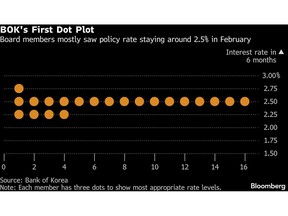
The first dot plot, introduced in February under former Governor Rhee Chang Yong to improve communications, reflected the board’s median expectation that rates would stay at 2.5% over the following six months, indicating a neutral stance. Investors will be watching to see if the median shifts higher under the new leadership and board composition, as well as whether Governor Shin makes any tweaks to Rhee’s communication framework.
Article content
Authorities will likely deliver an “evidently hawkish hold,” with one or two board members potentially dissenting in favor of a rate hike, according to Citigroup economist Jin-Wook Kim. Kim also expects the board’s median six-month policy-rate projection to rise to 3% from 2.5%.
Article content
Stronger-than-expected growth, fiscal stimulus and persistent inflation risks could ultimately lead the BOK into a full-fledged hiking cycle beginning later this year, Kim said.
Article content
Article content
Robust semiconductor exports have reinforced economists’ expectations that the central bank will raise its 2026 GDP growth projection to 2.8% from 2.2%. The pace of inflation is also expected to be revised higher, to 2.6% from 2.4%.
Article content
The BOK has already warned that inflation will likely accelerate well above the 2.2% forecast presented in February, while Governor Shin has cautioned that higher oil prices and currency weakness could both fuel inflation and weigh on growth.
Article content
Thursday’s decision comes at a pivotal moment for the central bank, which began an easing cycle in October 2024 that culminated with a reduction in borrowing costs to 2.75% in May 2025. Since then authorities have been on hold while gradually shedding language hinting at further easing as they weighed weak domestic demand against financial stability risks stemming from surging housing prices.
Article content
The war in Iran has driven oil prices higher, lifting import costs and fueling inflation fears in one of the world’s most energy-dependent economies. At the same time, growing demand for semiconductors tied to the global artificial-intelligence boom has strengthened exports, boosting growth beyond expectations.
 English (US)