
.jpg) 1 hour ago
3
1 hour ago
3
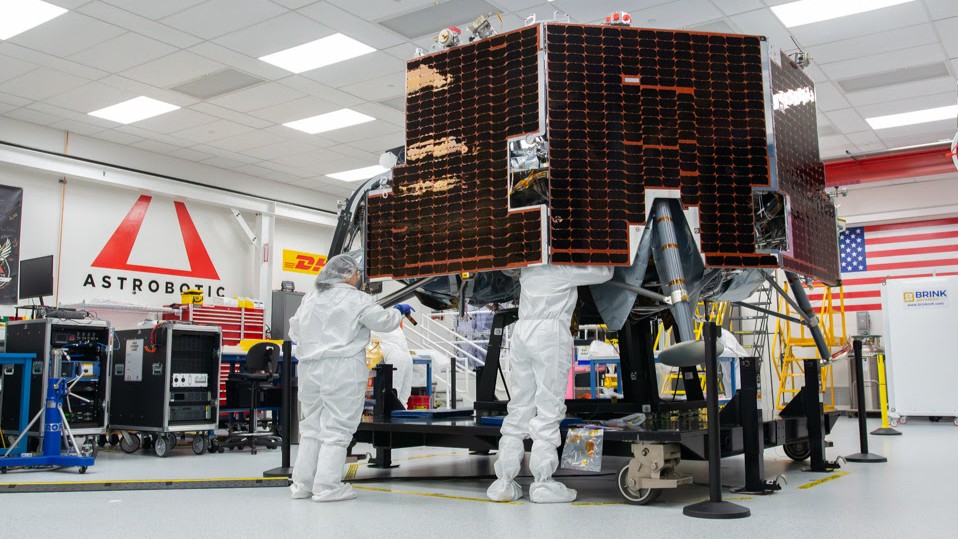
The next robotic lander to launch to the moon was revealed today (June 15) by Pittsburgh-based company Astrobotic.
NASA chose Astrobotic's Griffin vehicle to be the lander for its Moon Base II mission, part of the first phase of the agency's efforts to establish a permanent lunar outpost. Astrobotic is targeting late 2026 to launch Griffin Mission One (Griffin-1), which will lift off on a SpaceX Falcon Heavy rocket. The lander is contracted to deliver several research and technology demonstrations to the surface of the moon as part of NASA's Commercial Lunar Payload Services (CLPS) program, including the FLIP (Flex Lunar Innovation Platform) rover from California-based company Astrolab.
"This is the first infrastructure-class lander going to the surface of the moon," Astrobotic CEO John Thornton said during today's event. "This lander will be part of the cornerstone of building the moon base on the surface of the moon, so I'm just so excited for it to be here today, and to wish it good travels as it heads out to JPL [NASA's Jet Propulsion Laboratory] for environmental testing,"
Integration at the company's headquarters is expected to wrap up this week, with a number of payloads already incorporated onto the lander. Those payloads include Astrobotic's own BEACON CubeRover, in coordination with Mission Control Space Services, and the European Space Agency's LandCam-X, designed to help improve lunar landing precision and reliability on future missions.
Griffin-1 is scheduled for transportation to JPL in California next week for environmental testing, ahead of its delivery to Florida in the coming months, where the FLIP rover will be integrated into the lander prior to launch.
The mission will be the second from Astrobotic that shoots for the moon, after the debut of the company's smaller Peregrine lunar lander in January 2024. Peregrine experienced a propellant leak shortly after deploying into space, however, and never reached its destination.
In addition to being the company's first lander, Peregrine Mission One was the first-ever NASA CLPS flight. Through CLPS, NASA is partnering with commercial companies to provide lunar landers to deliver technology demonstrations and other payloads to the surface of the moon. The program aims to support NASA's Artemis program, through which the agency plans to establish a lunar base and eventual sustained human presence on the surface.
Griffin is considerably larger than Peregrine. Though both landers stand roughly 6 feet (2 meters) tall, Griffin is nearly twice as wide, measuring nearly 15 feet (4.5 meters) across. Astrobotic advertises the big lander's payload capacity to the lunar surface at 1,377 pounds (625 kilograms), with a cost of $544,000 per pound ($1.2 million per kilogram).
In total, Griffin-1 will carry 10 payloads from six separate nations, with four additional NASA payloads aboard FLIP. Some of the smaller payloads on the Griffin lander include a plaque from the Nippon Travel Agency, with messages collected from children in Japan to send to the moon; the Galactic Library to Preserve Humanity from Nanofiche that's carrying a super miniaturized repository of literature and art; and a MoonBox capsule that will deliver items from around the world submitted to the Tokyo-based company Astrobotic on micro SD cards.
"So, this is going to be chock full of interesting science and data that's going to be coming back from the moon, and some of the best imagery we have seen yet coming back from the surface," Thornton said.
 English (US)